Customer support is one of the first areas that can become difficult to manage as an ecommerce business grows. In the early stages, the founder can usually answer customer questions personally. When only a few orders arrive each day, responding to messages, checking order statuses, handling returns, and answering product questions may not require a dedicated support team.
But growth changes the situation.
As order volume increases, customer questions increase as well. What was once a manageable part of the founder’s daily routine can eventually consume several hours every day. At that point, the business owner faces an important question: When should customer support be handed over to someone else?
A Shopify Community discussion explores this question from several different perspectives. The main idea is that the decision should not be based only on store revenue, order volume, or business size. Instead, merchants should examine the type of support requests they receive, how frequently the same questions appear, how much time support requires, and how consistently the questions can be answered.
The discussion also suggests that hiring should not always be the first step. Businesses can often improve their support process by organizing information, improving product pages, creating better help content, and automating repetitive questions before adding employees.
Why Customer Support Becomes a Problem During Growth
In the beginning, customer support is often simple.
A founder may personally answer questions such as:
- Where is my order?
- When will my package arrive?
- Can I return this product?
- What size should I choose?
- Do you ship to my location?
- How does this product work?
- Can I change my shipping address?
Because the founder knows the products and business personally, answers can usually be provided quickly.
As the number of customers grows, however, the same questions begin appearing repeatedly.
A founder might spend an entire afternoon answering questions that have already been answered dozens of times.
This creates an operational problem.
The founder’s time could otherwise be spent on product development, marketing, supplier relationships, business strategy, or improving the store.
Therefore, scaling customer support is not simply about answering more messages. It is about building a process that allows customers to receive accurate answers without requiring the founder to personally handle every interaction.
Store Size Is Not the Only Factor
One of the strongest ideas in the discussion is that there is no universal store size at which customer support must be outsourced or handed to another person.
Two stores with similar sales can have completely different support workloads.
Consider two businesses.
Store A sells simple products with clear descriptions, predictable shipping, and very few returns.
Store B sells products that require sizing guidance, have many variations, and generate frequent questions about compatibility and returns.
Even if both stores have similar order volumes, Store B may require much more customer support.
This means the better question is not:
“How large is my store?”
It is:
“How much time and complexity is customer support creating for my business?”
That shift in perspective can help merchants make more practical staffing decisions.
Start by Reviewing Recent Support Tickets
Before hiring anyone, one of the suggested approaches is to review recent customer support tickets.
Looking at the last 100 tickets can provide a useful snapshot of what customers actually need.
Instead of guessing what the support team should handle, the merchant can categorize the conversations.
For example:
- Order status
- Shipping questions
- Returns
- Refunds
- Product information
- Product fit
- Payment questions
- Order changes
- Damaged products
- Frequently asked questions
After categorizing the tickets, patterns usually become easier to see.
Suppose 35 out of 100 tickets are about order tracking.
That suggests the business may have a communication problem rather than simply a staffing problem.
If customers are repeatedly asking where their orders are, improving shipping notifications or providing clearer tracking information may reduce the number of incoming tickets.
Similarly, if many customers ask the same product question, the answer may belong directly on the product page.
Customer Support Data Can Reveal Store Problems
Support tickets are more than requests that need responses.
They are also a source of information about weaknesses in the customer journey.
For example, repeated questions about:
“When will my order arrive?”
may indicate that delivery information is not visible enough.
Repeated questions about:
“How do I return this?”
may indicate that the return policy is difficult to find.
Repeated questions about:
“Which size should I choose?”
may indicate that the product page needs better sizing information.
Repeated questions about product features may indicate that product descriptions are incomplete.
This means customer support can act as a feedback system for the entire ecommerce business.
Before hiring more support staff, merchants should ask whether the underlying reasons for these questions can be fixed.
Improve Information Before Increasing Staff
If customers repeatedly ask questions that can be answered through the store itself, improving the available information may reduce support volume.
Useful areas to improve include:
Product Pages
Product pages should clearly explain important information such as:
- Product features
- Dimensions
- Materials
- Compatibility
- Sizes
- Usage instructions
- Shipping expectations
- Return conditions
The more useful information customers can find before purchasing, the fewer basic questions they may need to ask afterward.
Help Pages
A clear help section can answer common questions about:
- Orders
- Shipping
- Returns
- Refunds
- Payments
- Products
- Account information
Tracking Information
Customers frequently contact stores simply because they do not know where their package is.
Providing clear tracking information and shipping updates can reduce these requests.
Shipping Emails
Order confirmation and shipping messages should communicate important information clearly.
Customers should understand what has happened to their order and what they can expect next.
Automate Repetitive Questions
Not every support conversation requires a human response.
Many ecommerce questions are predictable.
For example:
“Where is my order?”
“What is your return policy?”
“How long does shipping take?”
“Do you ship internationally?”
If customers ask the same questions repeatedly, these interactions may be suitable for automated responses or self-service information.
The purpose is not to prevent customers from reaching a human.
Instead, automation should handle simple questions while allowing more complicated issues to reach a person.
This can reduce the workload on support staff and allow them to focus on situations that require judgment.
When a Virtual Assistant Can Help
If customer support still takes several hours per day after improving the store’s information and automating repetitive questions, the next step may be hiring a virtual assistant.
A virtual assistant can handle routine tasks such as:
- Answering common questions
- Checking order status
- Responding to shipping inquiries
- Explaining return procedures
- Categorizing support requests
- Escalating difficult cases
- Following standard response procedures
This can be a practical intermediate step between founder-managed support and a larger support department.
The business does not necessarily need multiple full-time employees immediately.
Instead, one person can take responsibility for routine support while the founder remains available for complex or sensitive situations.
When an Outsourced or Larger Team Makes Sense
A larger support team may become appropriate when support volume becomes consistently high.
Signs can include:
- Support requests arrive throughout the day.
- Customers expect extended coverage.
- One person cannot keep up with the volume.
- Response times are increasing.
- Multiple languages or regions need coverage.
- Different support specialties are required.
- Support volume is stable enough to justify several agents.
The key word is consistency.
A temporary sales spike may not justify building a large support department.
A consistently high support volume may.
Businesses should therefore examine support trends over time rather than making staffing decisions based on one unusually busy week.
Create Basic SOPs Before Hiring
One of the most practical recommendations in the discussion is to create simple procedures before bringing someone new into the support process.
These procedures are often called standard operating procedures.
They do not need to be complicated.
A basic procedure might say:
Order status question
- Check the order.
- Confirm the current status.
- Review the available tracking information.
- Provide the customer with the latest update.
- Escalate if the shipment is outside the expected timeframe.
Another procedure could cover returns:
- Confirm whether the order qualifies.
- Explain the return process.
- Provide the required instructions.
- Record the request.
- Escalate exceptions.
These instructions give new support staff a clear starting point.
Canned Responses Can Improve Consistency
Support employees should not have to write every basic response from scratch.
Reusable response templates can help maintain consistency.
For example, a store can prepare standard responses for:
- Shipping delays
- Order tracking
- Return requests
- Refund questions
- Product information
- Damaged products
- Order changes
However, templates should not make customer responses sound robotic.
Employees should still adapt the message to the customer’s specific situation.
The goal is to make accurate responses faster, not to remove the human element from customer support.
Build a Shared Knowledge Base
A shared knowledge base is another important part of scaling support.
It should contain information employees regularly need, such as:
- Product details
- Shipping policies
- Return rules
- Refund procedures
- Frequently asked questions
- Supplier information
- Escalation procedures
- Common customer problems
- Approved response templates
This reduces dependence on the founder.
Without a knowledge base, employees may repeatedly ask the founder for help.
That defeats part of the purpose of hiring support staff.
The goal should be to transfer knowledge from the founder’s head into a system that the support team can access.
Categorize Support Tickets
Ticket tagging or categorization can provide valuable information about support performance.
For example:
| Category | Number of Tickets |
| Shipping | 35 |
| Returns | 20 |
| Product Questions | 18 |
| Order Changes | 12 |
| Refunds | 10 |
| Other | 5 |
This type of breakdown can reveal where the support workload is concentrated.
If shipping represents a large percentage of tickets, the business may need to improve shipping communication.
If returns dominate, product descriptions or customer expectations may need attention.
If product questions are common, the product pages may need more detailed information.
Support data can therefore influence broader business decisions.
Quality Control Becomes More Important After Hiring
Handing customer support to another person does not mean the founder can completely stop monitoring it.
The business still needs to make sure customers are receiving accurate, professional responses.
One suggested approach is regularly reviewing a sample of support conversations.
For example, a manager might review several tickets each week and check:
- Was the response accurate?
- Was the customer answered clearly?
- Was the correct policy followed?
- Was the issue resolved?
- Was escalation necessary?
- Was the tone appropriate?
Regular review allows mistakes to be identified early.
It also helps improve training materials and response procedures.
AI-Assisted Support Can Be Part of the Process
The discussion also mentions using AI-assisted approaches before expanding the support team.
These systems can help with repetitive customer questions, draft responses, categorize tickets, or summarize conversations.
However, they should be used carefully.
Not every customer issue should be handled automatically.
Questions involving refunds, complaints, unusual orders, damaged products, or sensitive situations may require human review.
A useful support structure can therefore combine:
Self-service information → automated assistance → human support → specialist escalation
This creates different levels of support depending on the complexity of the customer’s problem.
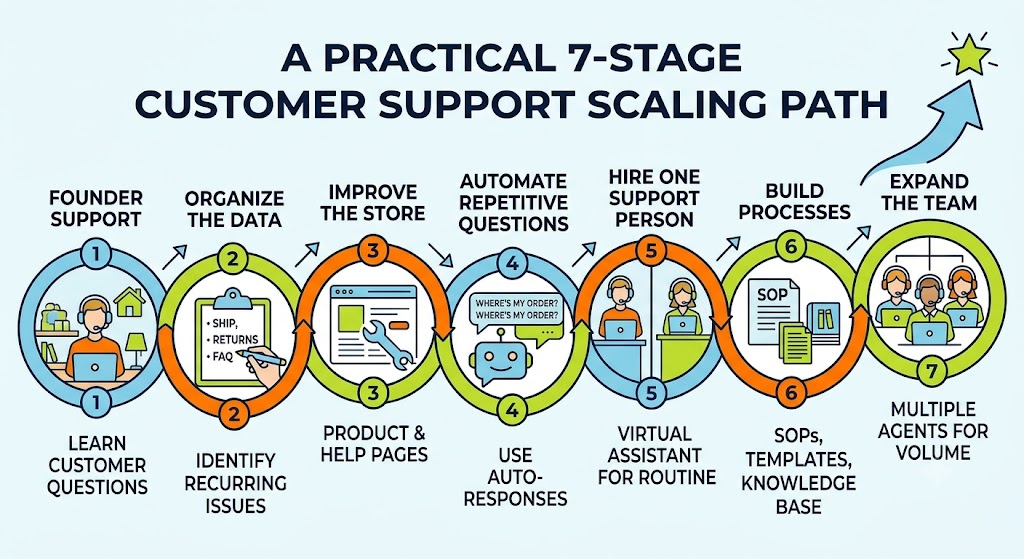
A Practical Scaling Path
For many ecommerce businesses, customer support can be scaled gradually.
Stage 1: Founder Support
The founder handles support personally.
At this stage, the priority should be learning what customers are asking.
Stage 2: Organize the Data
Review recent tickets and identify recurring questions.
Stage 3: Improve the Store
Add missing information to product pages, help pages, shipping communications, and return information.
Stage 4: Automate Repetitive Questions
Use self-service information and automated responses for simple requests.
Stage 5: Hire One Support Person
When support still consumes several hours per day, a virtual assistant or similar support role can take over routine tasks.
Stage 6: Build Processes
Create SOPs, response templates, escalation rules, and a shared knowledge base.
Stage 7: Expand the Team
Only when support volume becomes consistently high should the business consider multiple agents, broader coverage, or a dedicated support department.
This gradual approach helps businesses avoid hiring too early.
The Goal Is Not Just Faster Responses
A common mistake is measuring customer support only by response time.
Fast responses are useful, but they are not the only measure of good support.
A fast but incorrect answer can create more problems.
Useful customer support metrics can include:
- Response time
- Resolution time
- First-contact resolution
- Repeat contacts
- Customer satisfaction
- Refund-related tickets
- Escalation rate
- Ticket volume by category
These measurements provide a more complete picture of support quality.
Conclusion
Scaling customer support is not simply a question of when an ecommerce store becomes “big enough” to hire a support team.
The better approach is to examine the actual workload and complexity of customer conversations.
Start by reviewing recent tickets, especially a representative sample such as the last 100 conversations. Categorize them and identify repeated questions.
Then determine whether those questions can be reduced through better product information, clearer shipping updates, improved help content, self-service resources, and automation.
If support still consumes several hours every day, bringing in a virtual assistant can be a practical next step. As the business grows further and support volume becomes consistent, a larger outsourced or in-house team may become appropriate.
Before hiring, businesses should create basic SOPs, reusable response templates, escalation procedures, and a shared knowledge base. After hiring, regularly reviewing a sample of conversations helps maintain quality and reveals where training or process improvements are needed.
The broader lesson is that customer support should scale through process first, people second.
Hiring more people can increase capacity, but fixing repetitive problems and documenting the right processes can reduce the workload in the first place.
For a growing ecommerce business, the ideal support system is one where simple questions are answered quickly through self-service or automation, routine issues are handled efficiently by support staff, and complex problems receive personal attention when it is genuinely needed.
0 Comments