For many ecommerce businesses, the delivery method selected by a customer at checkout may seem like a small part of the order. In practice, it can affect fulfillment, customer notifications, payment calculations, reporting, accounting, and the entire workflow used to complete an order.
A growing request from merchants is the ability to change the delivery method of an existing, unfulfilled order. For example, a customer may originally choose shipping but later decide to collect the order from the store. Another customer may select pickup but later request local delivery. In these situations, merchants want to update the existing order rather than cancel it and create a completely new one.
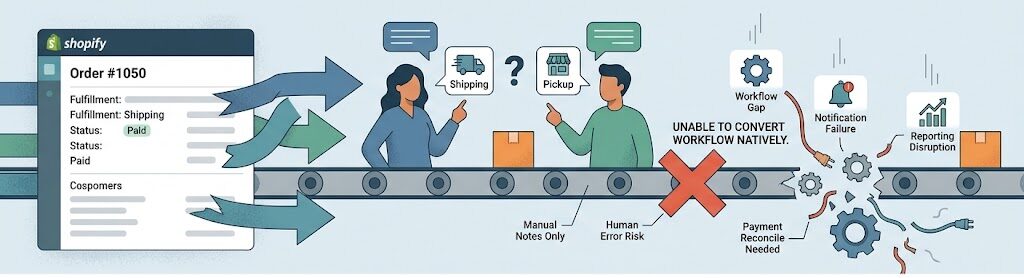
The challenge is that Shopify currently treats the delivery method selected during checkout as an important part of the order structure. Once the order has been created, merchants cannot simply convert it from shipping to pickup, pickup to local delivery, or local delivery to shipping through the standard administrative workflow.
This creates several practical problems for stores that regularly handle multiple fulfillment methods.
Why Customers Change Their Delivery Method
Customers do not always know exactly how they want to receive an order when they place it.
A customer might initially select shipping because they are unsure when they will be near the store. Later, they may realize that they can visit the store and want to collect the order themselves.
Another customer may choose pickup because they expect to visit the store, but circumstances can change. They might become unavailable, move to another location, or simply decide that delivery would be more convenient.
Local businesses can also have situations where staff members decide that an order is better handled through a different fulfillment method.
For example, imagine a customer places an order for shipping at 10 AM. At noon, they contact the store and say they are already nearby and would like to pick it up.
From a business perspective, the change is simple: the merchant does not need to ship the package.
However, from the ecommerce system’s perspective, the order was originally created as a shipping order. Changing how the customer receives it is therefore more complicated.
The Delivery Method Is Connected to the Checkout
The main reason this problem exists is that the delivery method is selected as part of the checkout process.
When the customer chooses shipping, the order is created with shipping-related information. When the customer chooses local delivery or pickup, the order is created according to that fulfillment workflow.
Once the order exists, changing some basic order information is possible, but changing the underlying delivery method is much more restricted.
This distinction is important.
A merchant may be able to manually add a note saying that the customer will pick up the order. They may also be able to add a tag indicating “Pickup.”
But adding a tag does not actually transform the order into a native pickup order.
The order still contains its original delivery structure.
That difference becomes especially important when the store relies on automated fulfillment and customer communication.
Why Manually Treating a Shipping Order as Pickup Is Not Enough
Suppose a customer originally selected shipping but later asks to collect the order.
The merchant could simply tell the warehouse or store employee not to ship the order. The employee could then keep it aside for the customer.
Operationally, this may work.
But the ecommerce system does not necessarily recognize the order as a genuine pickup order.
A native pickup workflow can include several stages.
The order may need to be prepared, marked as ready for pickup, and eventually marked as picked up. Customers may also receive notifications at different stages.
If a shipping order is simply tagged as “Pickup,” these native stages may not be triggered.
This creates a gap between what the business is actually doing and what the ecommerce system believes is happening.
The Missing “Prepare for Pickup” Workflow
One of the biggest concerns is the lack of the normal pickup workflow.
For a genuine pickup order, staff can follow a defined process.
First, the order is prepared.
Then the customer can be notified that the order is ready.
When the customer arrives, staff can mark the order as picked up.
This provides a clear record of what happened.
If an existing shipping order is manually converted into a pickup situation, those same steps may not be available in the expected way.
The merchant may have to manage the process manually using notes, tags, emails, or other internal procedures.
For small stores with a few orders, this might be manageable.
For stores processing hundreds or thousands of orders, it can become a significant operational burden.
Customer Notifications Can Also Be Affected
Customer communication is another important part of the problem.
Pickup customers generally need to know when their order is ready.
They may also need instructions about where to collect it, what information to provide, and when the store is open.
A standard pickup workflow can handle these communications more consistently.
If the merchant manually changes a shipping order into a pickup arrangement, they may need to send a custom message themselves.
This introduces another possibility for human error.
An employee might forget to notify the customer.
The customer might arrive before the order is ready.
The order could remain in an incorrect status.
Or multiple employees could communicate different information.
A simple change in delivery method can therefore create a chain of manual tasks.
Payment and Delivery Charges
Changing delivery methods can also create financial complications.
Consider a customer who originally paid a shipping charge but later switches to pickup.
The store may no longer need to pay the shipping cost, but the customer has already paid for shipping.
The merchant may therefore need to refund the delivery charge.
The opposite situation can also occur.
A customer originally chooses pickup but later requests local delivery. In that case, an additional delivery fee may be required.
If the existing order cannot properly change its delivery method, merchants may have to handle these financial adjustments separately.
This can complicate accounting and reconciliation.
The issue is not simply about changing a label on an order. The delivery method can affect what the customer paid and what the business owes to its fulfillment process.
Reporting and Accounting Problems
Accurate reporting depends on orders containing accurate information.
If a shipping order is actually collected from the store, reporting may still classify it according to the original delivery method.
This can make it harder for merchants to understand how customers are actually receiving their products.
For example, a business may want to know how many orders were shipped, how many were delivered locally, and how many were picked up.
If orders are manually handled outside the original workflow, the reporting data may not accurately represent the final fulfillment method.
Accounting can also become more complicated when shipping fees are refunded or additional delivery fees are collected manually.
Merchants may have to maintain additional records to explain why the original order information does not match the actual fulfillment process.
Order Numbers and Business Records
Another reason merchants prefer modifying the existing order is continuity.
Cancelling an existing order and creating a new one can create a new order number and a separate record.
That can be inconvenient for customers and staff.
It can also affect internal reporting, accounting records, customer service conversations, and other systems that refer to the original order.
For example, imagine a customer contacts support about order #1050.
If the merchant cancels it and creates a replacement order #1075, employees now need to understand the relationship between the two records.
The customer may also see multiple order records for what was actually one purchase.
Keeping the original order intact would provide a much cleaner experience.
Why Cancelling and Recreating the Order Is Not an Ideal Solution
Cancelling and recreating the order may appear to solve the delivery-method problem, but it introduces several disadvantages.
First, it creates unnecessary administrative work.
Second, payment records may need additional handling.
Third, inventory and fulfillment records can become more complicated.
Fourth, automated processes connected to the original order may behave differently.
Fifth, customers may become confused when they receive multiple order confirmations.
There can also be complications when an order has already been partially processed.
For these reasons, merchants are asking for a simpler solution: allow the delivery method of an existing unfulfilled order to be changed directly.
What Can Be Changed Today?
There are several things merchants can do to manage these situations, but they are generally workarounds rather than true delivery-method conversion.
One option is to add a tag such as “Pickup,” “Local Delivery,” or “Changed Delivery Method.”
Another option is to add an internal note explaining the customer’s request.
Merchants can also contact the customer directly with a custom confirmation message.
If a shipping charge needs to be returned, the merchant can process the appropriate refund manually.
If additional delivery charges are required, the merchant can collect the additional amount separately according to the store’s process.
The order can then be fulfilled manually based on the customer’s updated preference.
These approaches can work, especially for businesses with relatively low order volumes.
However, they require staff involvement.
Using Tags and Metafields for Internal Workflows
For businesses that need more automation, tags and structured custom fields can provide a useful workaround.
For example, when a customer asks to change an order from shipping to pickup, staff can mark the order accordingly.
An internal workflow can then use that information to notify the appropriate team.
A pickup-related tag could tell staff to keep the package at the store rather than sending it to a shipping carrier.
A local-delivery tag could trigger an internal delivery process.
This does not change the original delivery method at the system level, but it can create a controlled operational process around the existing order.
The important point is that businesses should clearly distinguish between the original delivery method and the merchant’s updated fulfillment instruction.
Custom Automation Can Reduce Manual Work
Businesses with more complex requirements can build custom workflows around these changes.
For example, a store could create a process where employees select the customer’s new delivery preference.
The system could then record the change, notify the fulfillment team, create the appropriate internal instructions, and send a customized customer message.
A pickup request could generate a checklist for store staff.
A local-delivery request could create a delivery task.
A shipping request could send the order back into the normal shipping workflow.
This approach does not create a native conversion of the original delivery method, but it can make the operational process much more reliable.
The Importance of a Clear Internal Process
Regardless of the technical solution, businesses should establish a clear process for delivery-method changes.
Staff should know who is authorized to change the method.
They should know how delivery charges are handled.
They should know how the new method is recorded.
They should know how the customer is notified.
They should also know how the fulfillment team receives the updated instruction.
Without a consistent process, employees may handle similar situations differently.
One employee may add a note.
Another may add a tag.
Another may cancel and recreate the order.
This makes reporting and customer service more difficult.
A standardized process helps reduce these inconsistencies.
What a Native Solution Could Look Like
A better long-term solution would allow merchants to edit the delivery method of an unfulfilled order directly from the administration area.
For example, a merchant could open an order and choose:
Shipping → Pickup
or
Pickup → Local Delivery
or
Local Delivery → Shipping
The system could then automatically update the relevant fulfillment workflow.
If an order changes to pickup, the pickup preparation and notification process could become available.
If an order changes to local delivery, the appropriate delivery information could be applied.
If the order changes back to shipping, the normal shipping workflow could resume.
The system could also calculate whether a refund or additional charge is required.
This would preserve the original order number while accurately reflecting the customer’s final delivery preference.
Why API Support Matters
This request is also important for businesses that depend on automation.
The current API capabilities can support certain order and fulfillment changes, but they do not provide a straightforward way to transform an existing order into a completely different delivery workflow.
For developers, this means that even a custom application cannot simply make an existing shipping order become a native pickup order through a single supported operation.
Some information can be modified, and fulfillment locations can be managed, but that is different from changing the underlying delivery method.
This limitation is especially significant for businesses with custom checkout processes, multiple locations, or sophisticated fulfillment operations.
A Practical Approach for Merchants Today
Until a native solution becomes available, merchants can use a layered process.
First, confirm the customer’s requested delivery method.
Second, check whether the order has already been fulfilled or partially processed.
Third, determine whether a delivery charge needs to be refunded or collected.
Fourth, record the new fulfillment instruction using a consistent internal method.
Fifth, notify the appropriate staff member.
Sixth, send the customer a confirmation.
Finally, complete the fulfillment manually according to the updated instruction.
For a small business, this may only take a few minutes per order.
For a larger business, documenting and automating these steps becomes much more important.
Why This Feature Would Benefit Growing Businesses
The ability to change delivery methods would be particularly valuable for businesses operating physical stores alongside online sales.
Retail stores, restaurants, bakeries, florists, gift businesses, grocery businesses, and other local merchants often have customers who move between delivery and pickup.
Customers’ plans can change after checkout.
Businesses should be able to accommodate those changes without creating duplicate orders or breaking fulfillment records.
A flexible delivery-method system would make the order lifecycle more closely match what actually happens in the real world.
Final Takeaway
The request to change an existing order between shipping, local delivery, and pickup is fundamentally about flexibility and operational accuracy.
Customers frequently change their preferences after placing an order. Merchants need a reliable way to accommodate those requests without cancelling the original order and creating another one.
At present, manually treating an order as pickup or delivery does not necessarily convert it into the corresponding native workflow. This can affect pickup notifications, fulfillment statuses, payment adjustments, reporting, accounting, order records, and automation.
Tags, notes, manual refunds, custom customer messages, and internal workflows can reduce the problem, while businesses with more advanced requirements can build customized processes around structured order information.
However, these are workarounds rather than a true solution.
The ideal functionality would allow an unfulfilled order’s delivery method to be changed directly while preserving the original order number, payment history, customer information, and fulfillment record.
Until that capability becomes available, merchants should use a consistent internal process for recording delivery changes and communicating them to customers and fulfillment teams.
For businesses that regularly support shipping, local delivery, and in-store pickup, this feature would remove unnecessary administrative work and make the entire order-management process more flexible, accurate, and customer-friendly.
0 Comments