Returns and refunds are a normal part of ecommerce, but they can become one of the biggest sources of financial loss for an online store. A customer returning a product does not simply mean that the original sale disappears. The business may also lose money through return shipping, payment processing, packaging, restocking, damaged products, discounts, and inventory that can no longer be sold at its original value.
For stores with products that customers frequently return, these costs can quickly become difficult to control.
A recent discussion among Shopify merchants focuses on this problem: how are store owners actually handling the financial impact of returns and refunds? More importantly, which costs hurt the most, and what kind of solution would be valuable enough for a merchant to pay for?
The discussion does not yet provide a specific solution or a clear consensus. Instead, it raises an important business question: How should ecommerce businesses measure, understand, and reduce the real cost of returns?
Why Returns Are More Expensive Than They Look
When a customer places an order, a merchant generally thinks about revenue, product cost, shipping, and marketing expenses.
When that customer requests a return, the economics change.
Suppose a customer buys a product for ₹2,000. The merchant may have paid ₹800 for the product and ₹150 for the original shipping. At first glance, there appears to be a reasonable margin.
But if the customer returns the product, the merchant may need to deal with additional expenses.
These could include:
- Return shipping
- Original shipping that cannot be recovered
- Refund processing
- Payment-related costs
- Packaging
- Inspection
- Restocking
- Warehouse handling
- Damaged inventory
- Discounting returned inventory
- Customer service time
If the product cannot be resold, the loss becomes even larger.
This is why looking only at the refunded amount can give merchants an incomplete picture of return costs.
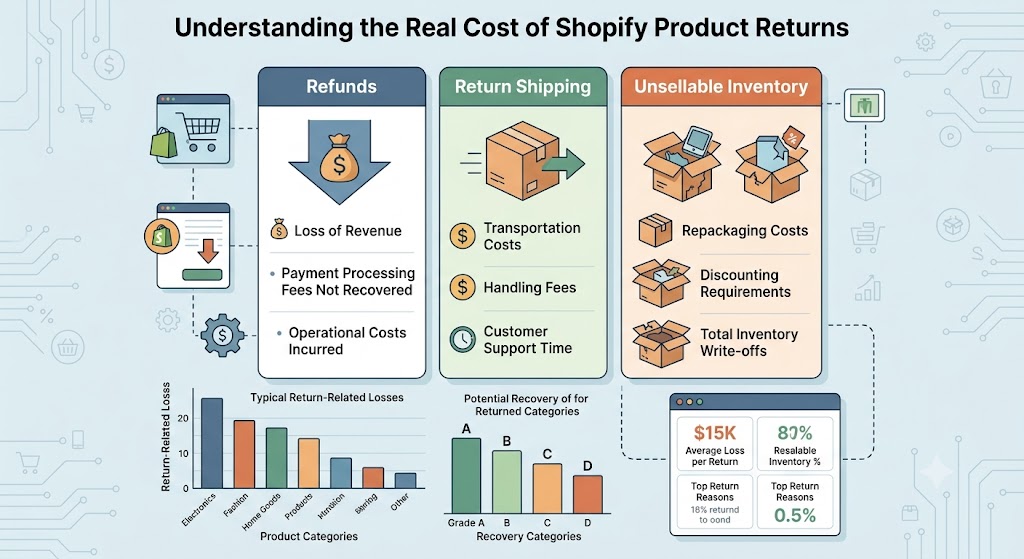
The Three Major Sources of Return Loss
The discussion highlights three particularly important areas:
- Refunds
- Return shipping
- Unsellable inventory
Each creates a different type of financial impact.
Refunds
The most obvious cost is the refund itself.
When a customer receives their money back, the original revenue disappears. However, the merchant may not recover every expense associated with the order.
Depending on the business model and return policy, the merchant may still have paid for product sourcing, original shipping, packaging, marketing, payment processing, and other operational costs.
This means that a returned order can turn what looked like a profitable transaction into a loss.
For businesses with high return rates, the effect becomes significant.
A merchant might have 100 orders and assume that 100 sales represent successful revenue. But if 20 or 30 of those orders are eventually refunded, the actual realized revenue is much lower.
This is why businesses should measure completed and retained sales rather than simply counting orders.
Return Shipping Can Become a Major Expense
Return shipping is another important cost.
When a customer sends a product back, someone has to pay for transportation.
Depending on the store’s policy, the merchant may pay the entire cost, the customer may pay it, or the cost may be shared.
The situation becomes more complicated with bulky products.
A small product may cost only a modest amount to return. A large or heavy product can cost substantially more.
International returns can be even more complicated because transportation, customs, duties, and handling may all be involved.
Therefore, merchants should calculate return shipping separately rather than combining it with general shipping expenses.
Knowing the average return shipping cost per returned order can help reveal which products are creating the greatest financial pressure.
Unsellable Inventory May Be the Biggest Hidden Loss
One of the most important points in return management is what happens to the product after it comes back.
A returned product is not automatically equivalent to new inventory.
Some products can be inspected, repackaged, and placed back into inventory.
Others may have:
- Visible signs of use
- Missing accessories
- Damaged packaging
- Scratches
- Broken components
- Hygiene concerns
- Missing labels
- Customer-specific customization
In these situations, the merchant may not be able to sell the item again at its original price.
The product may need to be discounted.
In some cases, it may have almost no resale value.
This creates an important distinction between returned inventory and recoverable inventory.
A business should not assume that every returned product represents recovered stock.
Why Product Category Matters
Return losses are not the same for every type of product.
For example, a low-cost product that can easily be inspected and resold may have relatively low return-related losses.
A fragile product may be returned damaged.
A fashion product may be returned after being tried on.
A customized product may have little or no resale value.
A bulky product may have expensive return transportation.
Therefore, merchants should analyze returns by product rather than only looking at the overall store return rate.
A store with a 10% return rate does not necessarily have a serious problem if most returned products can be resold easily.
Another store with a 5% return rate could have a much bigger financial problem if most returned products become unsellable.
Return Rate Alone Is Not Enough
Return rate is useful, but it is only one metric.
Merchants should also consider:
- Average refund amount
- Average return shipping cost
- Percentage of returned products that can be resold
- Average value recovered from returned inventory
- Average loss per returned order
- Product-specific return rates
- Reason for return
- Customer-paid versus merchant-paid return shipping
- Time required to process returns
These metrics provide a much clearer picture of the actual financial impact.
For example, imagine two products.
Product A has a 15% return rate but 90% of returned units can be resold.
Product B has a 7% return rate, but 80% of returned units are heavily discounted or discarded.
Product B may actually be more damaging to the business despite having a lower return rate.
Understanding Why Customers Return Products
Reducing return losses does not necessarily mean making returns difficult for customers.
Instead, merchants should understand why returns happen.
Common reasons may include:
- Product does not match expectations
- Incorrect size
- Product looks different from photographs
- Quality issues
- Damaged delivery
- Wrong product shipped
- Product description was unclear
- Customer ordered by mistake
- Product arrived too late
- Customer changed their mind
Some of these problems are controllable.
For example, if customers frequently return an item because its dimensions are unclear, better product information may reduce returns.
If customers return products because the actual color differs from the photographs, better product presentation may help.
If customers frequently receive damaged products, packaging and shipping processes may need improvement.
The objective should be to prevent avoidable returns while keeping the customer experience fair.
Return Reasons Can Become Valuable Business Data
Return information should not simply disappear after a refund is issued.
Every return provides information about the business.
Suppose a merchant notices that one particular product generates significantly more returns than other products.
The next question should be: why?
If most customers mention quality problems, the supplier may need to be reviewed.
If most mention sizing, the product information may need improvement.
If most mention damaged delivery, packaging may be the problem.
If most mention that the product does not match expectations, the product page may be creating unrealistic expectations.
This turns return management from a purely financial activity into a source of business intelligence.
The Importance of Recovering Value From Returns
Not every returned product needs to become a total loss.
Merchants can create different recovery categories.
For example:
Grade A: Product is unused and can return to normal inventory.
Grade B: Product is usable but packaging is damaged, so it can be sold at a discount.
Grade C: Product has minor damage and may be suitable for clearance.
Grade D: Product cannot reasonably be resold and must be written off or handled separately.
This type of classification helps merchants understand how much value is recovered from returned inventory.
It also makes return-related financial reporting more accurate.
Should Merchants Charge Customers for Returns?
This depends heavily on the business model.
Free returns can make customers more comfortable purchasing online. However, they also shift more of the financial burden to the merchant.
Charging customers for return shipping may reduce unnecessary returns, but it can also create friction during the buying process.
The right approach depends on factors such as:
- Product category
- Customer expectations
- Competition
- Average order value
- Return frequency
- Shipping costs
- Profit margin
For some products, free returns may be an important conversion and trust feature.
For others, charging a reasonable return fee may be more financially sustainable.
The important thing is to understand the economics before choosing a policy.
What Would a Useful Return-Management Solution Need?
The original discussion asks an important question about what features would justify paying for a solution.
A valuable solution should not simply record that a return happened.
It should help merchants understand the financial consequences.
Useful capabilities could include:
Return Cost Tracking
The system should calculate the total cost associated with each returned order.
Product-Level Analysis
Merchants should be able to identify products generating the highest return losses.
Return Reason Analysis
Businesses should see why customers are returning products.
Inventory Recovery Tracking
Returned products should be categorized according to whether they can be resold at full price, discounted, or not sold again.
Loss Calculation
The merchant should be able to see the actual financial loss associated with returns.
Supplier Analysis
If product quality is causing returns, merchants should be able to identify the supplier or source associated with those problems.
Customer Behavior Analysis
Businesses may also benefit from understanding whether certain return patterns are concentrated among particular customer segments or order types.
The goal should be to turn scattered return information into actionable business information.
The Business Case for Paying for Return Management
A merchant is more likely to pay for a solution when the solution can clearly save or recover more money than it costs.
For example, suppose a store loses ₹50,000 per month from returns.
If better return analysis helps reduce unnecessary losses by ₹15,000 per month, paying for a system that enables those improvements may make financial sense.
But if the solution simply creates another dashboard without helping the merchant reduce costs, its value becomes harder to justify.
This is why return-management solutions need to focus on measurable outcomes.
The key question is not:
“How many returns did I receive?”
It is:
“How much money did those returns actually cost me, and what can I do about it?”
Build a Return Loss Dashboard
A simple return dashboard could provide merchants with a monthly overview containing:
- Total orders
- Total returns
- Return percentage
- Total refunded amount
- Return shipping cost
- Resalable inventory value
- Discounted inventory value
- Unsellable inventory value
- Average loss per return
- Top products by return loss
- Top return reasons
This would give business owners a much more realistic picture of return performance.
Preventing Returns Is Better Than Managing Them
Return management should not only happen after a customer requests a refund.
The best return strategy begins before the purchase.
Merchants can reduce avoidable returns by improving:
- Product descriptions
- Product images
- Size information
- Product specifications
- Shipping expectations
- Packaging
- Quality control
- Customer communication
The clearer the customer’s expectations are before purchase, the less likely they are to feel that the product is unsuitable after delivery.
However, not every return can or should be eliminated.
Customers sometimes genuinely need to return products, and a reasonable return process is part of good ecommerce service.
The goal is therefore not to eliminate returns completely. The goal is to reduce avoidable and unnecessarily expensive returns.
Conclusion
Returns and refunds are more complicated than simply giving a customer their money back.
A returned order can create several layers of financial impact, including refunds, return shipping, handling costs, damaged inventory, discounts, and products that can no longer be sold.
For this reason, merchants should look beyond their overall return rate.
They should understand which products are being returned, why customers are returning them, how much transportation costs, how much inventory value is recovered, and how much money is ultimately lost.
The most valuable return-management approach is one that connects these different pieces.
When merchants know exactly where return losses are coming from, they can make better decisions about product selection, suppliers, packaging, customer communication, return policies, and inventory management.
The discussion around Shopify returns remains open because every business has a different cost structure. A fashion store, a furniture business, an electronics seller, and a dropshipping operation may experience completely different return economics.
That is why the first step is not necessarily finding a universal solution.
It is understanding the numbers.
Once a merchant knows whether the biggest problem is refunds, return shipping, damaged inventory, unsellable products, or repeated product-specific returns, it becomes much easier to decide what needs to change.
Ultimately, effective return management is about protecting both customer trust and business profitability. A good return experience should make customers feel confident buying from the store, while a good internal process should prevent every return from becoming an unnecessary financial loss.


0 Comments