For many Shopify retailers, growth does not always have to come from advertising, search traffic, or adding more products to their own store. Another powerful growth opportunity is collaboration with other retailers that sell complementary products.
This is especially useful for businesses serving specific customer groups. A maternity and baby products retailer, for example, may have a highly relevant audience but may not sell every product that a new parent needs. Another retailer may sell baby clothing, nursery products, toys, feeding accessories, or gifts. Instead of competing for the same customer, both businesses can work together and introduce customers to products they may already be looking for.
This is the basic idea behind retailer partnerships and cross-selling.
However, finding the right businesses to partner with is not always easy. A retailer may know exactly what type of partner they want but have no simple directory showing all other merchants in the same category. Privacy restrictions also mean that businesses cannot simply browse a complete list of other independent retailers and contact them.
A recent Shopify Community discussion highlights this challenge. A retailer selling maternity and baby products wanted to find other merchants who might be interested in using a shared product-selling network for cross-selling and promotional partnerships. The discussion also produced several practical ideas for finding suitable businesses.
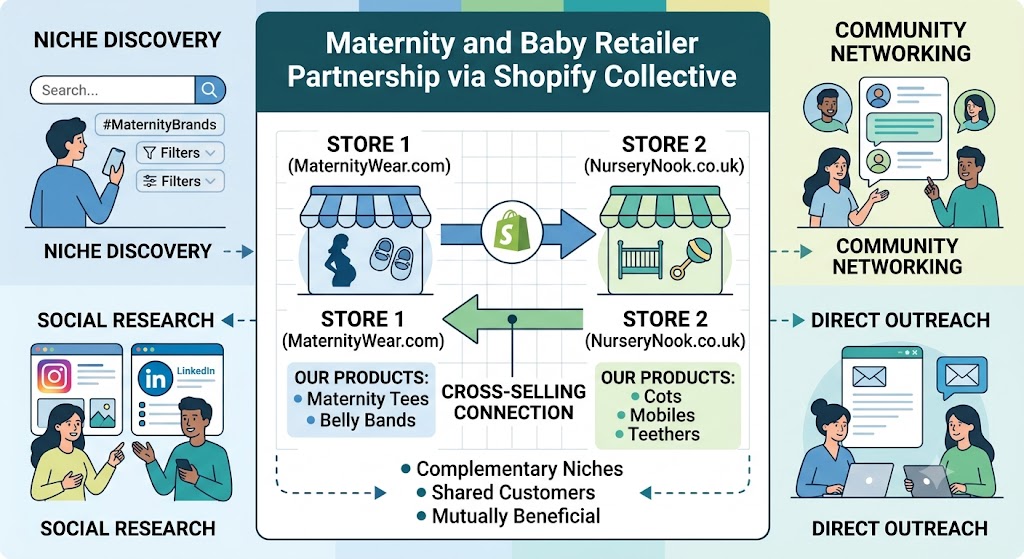
The larger lesson is important: finding partnership opportunities requires a combination of platform discovery, community networking, social research, and direct outreach.
Why Retailer Partnerships Matter
Retailers often think about competitors when they look for businesses in their industry. But not every business selling to the same customer is a direct competitor.
For example, a maternity retailer could sell pregnancy clothing while another company sells maternity accessories. A baby clothing store could complement a nursery furniture business. A children’s gift store could work with a baby skincare brand.
These businesses may serve the same customer without selling exactly the same products.
That creates an opportunity for collaboration.
A partnership can help businesses:
- Introduce products to new customers
- Increase average order value
- Expand product selection
- Generate referrals
- Promote complementary products
- Build relationships with other business owners
- Create joint promotions
- Reach a more relevant audience
- Reduce dependence on paid advertising
For smaller ecommerce businesses, these benefits can be particularly valuable because acquiring completely new customers can be expensive.
Instead of asking, “How can I get more visitors?”, merchants can also ask, “Who already has the customers I want, and how can we help each other?”
The Challenge of Finding Similar Retailers
The biggest challenge is discovery.
A retailer may want to connect with other maternity and baby brands, but there is not necessarily a public directory containing every relevant Shopify merchant.
This is understandable because merchants’ business information and platform relationships may be private.
As a result, retailers need to find potential partners through other channels.
The process becomes less about finding a single database and more about identifying businesses through communities, product discovery, social media, search, and personal networking.
This requires a little more effort, but it can actually produce better partnerships because the merchant can evaluate each potential partner individually.
Start With Your Customer Instead of Your Product
One of the best ways to identify potential partners is to think about the customer journey.
Consider everything your customer might need before, during, and after purchasing your product.
For a maternity and baby business, the customer journey might include:
- Pregnancy clothing
- Hospital bags
- Baby clothing
- Feeding products
- Nursery items
- Baby gifts
- Toys
- Personal care products
- Postpartum products
- Accessories
- Educational products
The goal is not to find another business selling exactly the same thing.
Instead, look for businesses serving the same customer with complementary products.
This makes the partnership more valuable because customers can discover products that naturally fit their needs.
Use Online Communities for Networking
Online business communities can be a strong source of partnership opportunities.
Shopify-focused communities, ecommerce groups, Facebook groups, LinkedIn communities, and niche-specific business groups can help merchants connect with other store owners.
The key is to participate rather than simply advertise.
A post saying, “Buy from my store” is unlikely to generate meaningful partnerships.
A better approach is to explain what type of business you operate and what kind of partnership you are looking for.
For example, a maternity retailer could explain that it is looking for other baby and parenting brands interested in cross-selling complementary products.
This gives other merchants a clear reason to respond.
Community participation also helps build trust. Store owners are more likely to collaborate with someone they have seen contributing useful information than with a completely unknown account sending a generic promotional message.
Search for Niche-Specific Communities
Broad ecommerce groups can be useful, but niche communities may be even more valuable.
A maternity and baby retailer could look for communities focused on:
- Baby brands
- Parenting businesses
- Maternity businesses
- Mom-owned businesses
- Children’s products
- Nursery businesses
- Handmade baby products
- Family-focused ecommerce
The more closely the community matches the retailer’s target customer, the more likely it is that members will be relevant partnership candidates.
The same principle works in other industries.
A pet retailer could search for pet brands and animal-focused businesses. A fitness store could connect with wellness, nutrition, sportswear, and training businesses.
The partnership strategy should always begin with the customer category.
Use Product Discovery Features
Another useful approach is to explore product discovery features available within the merchant’s ecommerce environment.
When a platform recommends products or businesses based on categories and customer interests, those recommendations can become a starting point for partnership research.
Instead of looking for a complete list of every retailer, merchants can evaluate businesses one at a time.
Look at:
- What products they sell
- Who their customers appear to be
- Whether their products complement yours
- Whether their brand quality matches yours
- Whether their pricing is compatible
- Whether their customer base appears relevant
- Whether their business seems active
This creates a more targeted partnership list.
The important point is that recommendations should be treated as leads, not automatic partnership matches.
A suggested business may appear relevant but still be unsuitable after closer research.
Search Social Media Strategically
Social media can also help discover potential retail partners.
Instead of searching only for individual brand names, merchants can search for industry-specific phrases and hashtags.
For a maternity and baby retailer, searches might focus on terms related to:
- Baby brands
- Maternity businesses
- Parenting products
- Baby clothing
- Nursery products
- Mom-owned businesses
- Children’s ecommerce
Platforms such as Instagram and LinkedIn can reveal businesses that are actively building their brands and may be open to collaboration.
Social media is particularly useful because it gives merchants more information than a simple company name.
You can often see:
- Product categories
- Brand positioning
- Audience engagement
- Promotional style
- New product launches
- Customer comments
- Business activity
This makes it easier to determine whether a potential partner is worth contacting.
Build a Partnership Shortlist
Finding dozens of businesses is not enough.
The next step should be creating a shortlist.
A simple spreadsheet can include:
| Information | What to Record |
| Brand name | Business name |
| Website | Store website |
| Product category | Main products |
| Target customer | Primary audience |
| Complementary products | Why the partnership makes sense |
| Contact method | Email or social account |
| Social activity | Active or inactive |
| Partnership idea | Possible collaboration |
| Contacted | Yes or No |
| Response | Interested, declined, pending |
This turns random research into a repeatable process.
A retailer might initially identify 30 businesses but discover that only 10 are genuinely relevant. Those 10 should receive personalized outreach rather than sending the same message to all 30.
Look for Complementary Products
Product compatibility is one of the most important factors.
Suppose one retailer sells baby clothing and another sells nursery decorations.
Their customers may overlap significantly, but their products do not directly compete.
This can create opportunities such as:
- Product recommendations
- Bundle promotions
- Referral partnerships
- Joint social campaigns
- Gift guides
- Seasonal promotions
- Cross-store product discovery
The strongest partnerships usually have a clear reason for both businesses to participate.
If only one company benefits, the partnership is unlikely to last.
Direct Outreach Can Work
Once suitable businesses have been identified, direct outreach becomes the next step.
The message should be short, personalized, and focused on mutual benefit.
Instead of sending a generic sales pitch, mention why the business was selected.
For example, a retailer could explain that both businesses serve parents and that their products appear complementary.
The message can then introduce the partnership idea and ask whether the other retailer would be interested in discussing it.
The objective of the first message should not be to explain every detail.
It should simply start a conversation.
Personalization Matters
Generic outreach is easy to ignore.
If a retailer receives a message that clearly appears to have been sent to hundreds of businesses, there is little reason to respond.
A personalized message demonstrates that the sender has actually researched the business.
Mention something specific such as:
- A product category
- A customer segment
- A recent collection
- A complementary product
- A shared audience
This makes the conversation more relevant.
For example, a baby clothing retailer could contact a nursery brand because both serve new parents, rather than simply saying, “We would like to collaborate.”
The first approach gives the recipient a reason to consider the proposal.
Not Every Response Will Be Relevant
The original discussion also demonstrates an important reality: when merchants post publicly looking for business partners, unrelated companies may respond.
A business might advertise an unrelated service even though the original request is specifically for maternity or baby retailers.
This means merchants must qualify responses carefully.
A response should be evaluated based on:
- Industry relevance
- Customer overlap
- Product compatibility
- Business reputation
- Partnership value
- Geographic considerations
- Operational compatibility
The goal is not to collect the largest number of contacts.
The goal is to find the right contacts.
Consider Geographic Compatibility
Location can also matter.
Two businesses may have excellent product compatibility but operate in completely different markets.
For some partnerships, geography does not matter because both businesses sell internationally.
For others, shipping costs, taxes, delivery expectations, and local regulations can make international collaboration more complicated.
Therefore, retailers should determine whether they want:
- Local partners
- National partners
- International partners
- Businesses targeting the same market
- Businesses serving similar customer demographics
This should be decided before large-scale outreach begins.
Start With a Small Partnership Test
Even when a retailer finds a promising partner, it is better to start small.
A partnership should be treated as an experiment.
For example, two businesses might initially test:
- A small product collection
- A limited-time promotion
- A referral campaign
- A joint social media post
- A small cross-selling campaign
Then they can measure the results.
Important metrics can include:
- Clicks
- Referrals
- Orders
- Conversion rate
- Average order value
- New customers
- Repeat purchases
- Revenue generated
If the test produces positive results, the partnership can be expanded.
Measure the Quality of the Partnership
A successful partnership is not simply one that produces clicks.
The most important question is whether the partnership produces valuable customers.
A retailer should evaluate whether referred customers:
- Purchase products
- Have reasonable acquisition costs
- Return for future purchases
- Purchase complementary products
- Generate profitable orders
This helps distinguish real business value from superficial engagement.
A partnership generating thousands of views but no sales may not be useful.
A smaller partnership generating highly relevant customers could be much more valuable.
Protect Your Brand
Retailers should also be selective about whom they partner with.
A partnership effectively connects two brands in the customer’s mind.
If one business has poor customer service, low-quality products, misleading descriptions, or unreliable shipping, that association could affect the other retailer’s reputation.
Before partnering, review the potential partner’s:
- Website
- Product quality
- Customer reviews
- Shipping information
- Return policies
- Social media activity
- Customer experience
A strong audience match is not enough if the business itself is unreliable.
Make Partnership Expectations Clear
Before launching a partnership, both sides should understand how the arrangement works.
Questions should include:
- Which products will be promoted?
- Who handles customer support?
- How are orders processed?
- Who handles returns?
- How are referrals tracked?
- How is revenue shared?
- How long will the promotion run?
- What happens if a product becomes unavailable?
- How will either party end the partnership?
Written expectations reduce misunderstandings.
This is particularly important when multiple businesses are involved in selling, fulfillment, customer service, or promotions.
Build Partnerships Around Customer Value
The strongest partnerships are not built simply because two companies want more sales.
They work because customers receive something useful.
For example, a new parent may appreciate discovering several complementary products from trusted businesses instead of searching for each product separately.
That creates a better customer experience.
Retailers should therefore ask:
“How does this partnership make shopping easier or more valuable for our customers?”
If there is a clear answer, the partnership has a stronger foundation.
A Practical Process for Finding Retail Partners
A repeatable process can make partnership discovery much easier.
Step 1: Define Your Ideal Partner
Decide what type of retailer you want to work with.
Step 2: Define the Shared Customer
Identify the customer both businesses are trying to reach.
Step 3: Identify Complementary Products
Find products that naturally fit together without creating direct competition.
Step 4: Search Relevant Communities
Participate in ecommerce, industry, and niche-specific communities.
Step 5: Explore Product Discovery
Review relevant product and retailer recommendations available through your ecommerce environment.
Step 6: Research Social Media
Find active brands using industry-specific searches and hashtags.
Step 7: Create a Shortlist
Record the most relevant potential partners and why they are suitable.
Step 8: Contact Them Personally
Send a short message explaining the mutual opportunity.
Step 9: Run a Small Test
Start with a limited campaign or product collaboration.
Step 10: Measure Results
Track sales, referrals, customer quality, and profitability.
Step 11: Expand Successful Partnerships
Invest more time in partnerships that demonstrate real results.
Conclusion
Finding other retailers for cross-selling and promotional partnerships can be difficult when there is no public directory of businesses that match a specific niche.
However, that does not mean merchants have to work alone.
Online communities, product discovery features, social media research, industry networking, and direct outreach can all help retailers identify potential partners.
For a maternity and baby retailer, the best opportunities may come from businesses serving the same parents but selling complementary products. The same strategy can be applied to almost any ecommerce niche.
The most important lesson is to focus on relevance rather than volume.
A list of hundreds of random businesses is less valuable than a shortlist of carefully selected retailers with a shared audience, complementary products, reliable operations, and a genuine reason to collaborate.
Retail partnerships should also begin with small experiments. Test the relationship, measure customer response, understand the operational requirements, and expand only when the results demonstrate real value.
Ultimately, successful cross-selling partnerships are not just about helping retailers sell more products. They are about creating a stronger ecosystem where businesses introduce customers to useful products while benefiting from each other’s audiences.
For Shopify merchants looking for sustainable growth, learning how to identify, approach, and evaluate complementary retailers can become an important part of the overall ecommerce strategy.

0 Comments