Building an application for an ecommerce platform can be an exciting opportunity, especially when the application solves a problem that merchants regularly encounter. However, having a technically possible idea is not the same as having a product that merchants actually need.
A developer may have a concept for an application that allows store owners to improve their product pages without editing theme code or writing Liquid. The application could allow merchants to add comparison tables, trust icons, product statistics, feature highlights, and other conversion-focused elements while automatically adapting them to the store’s existing design.
At first glance, this sounds straightforward. Merchants want better product pages, and many store owners do not have the technical knowledge required to modify their themes safely. An application that simplifies this process could therefore provide real value.
But there is an important question that should be answered before significant time and money are invested:
Is this idea different enough from existing solutions, and does it solve a problem merchants are willing to pay for?
That question is at the heart of the discussion surrounding the proposed application.
The Problem With Editing Product Pages Manually
Product pages are one of the most important parts of an ecommerce store.
Customers visit product pages to understand what a product does, evaluate its quality, compare alternatives, and decide whether they should purchase it.
A basic product page may contain only:
- Product images
- Product title
- Price
- Description
- Variant options
- Add-to-cart button
- Basic product information
However, merchants often want to add more information to make the page more persuasive.
They may want to include:
- Comparison tables
- Trust badges
- Product specifications
- Key statistics
- Feature lists
- Shipping information
- Warranty information
- Customer benefits
- Frequently asked questions
- Social proof
- Product highlights
The challenge is that adding these elements manually may require technical knowledge.
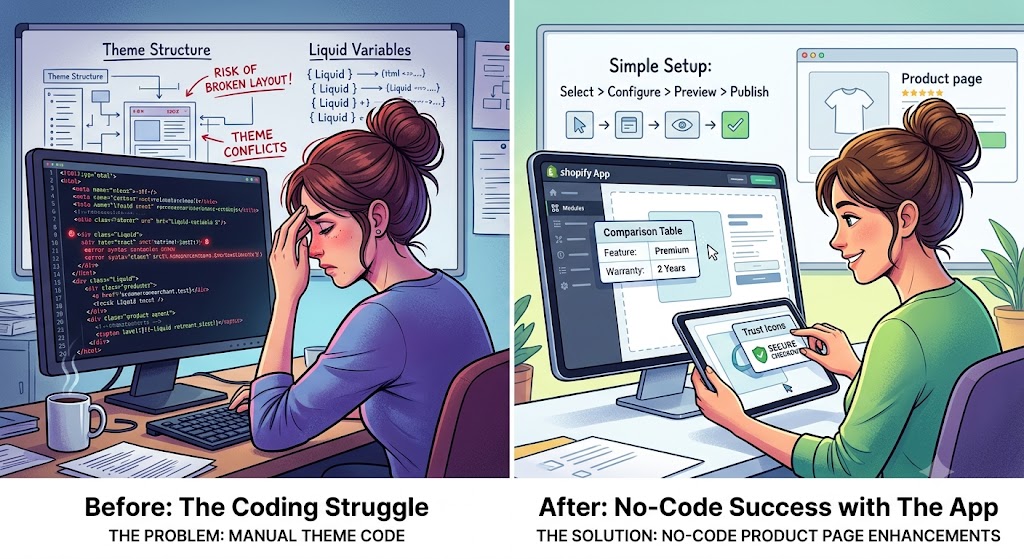
A merchant may need to understand the store’s theme structure, identify the correct template, edit theme files, insert code, and make sure the new element does not interfere with the existing layout.
For a technical developer, this may be relatively easy.
For a small business owner, it can be intimidating.
The Risk of Theme Editing
One of the strongest arguments for this type of application is reducing the risks associated with manual theme modifications.
A merchant who edits theme code incorrectly can potentially create:
- Broken layouts
- Mobile responsiveness problems
- JavaScript conflicts
- Styling inconsistencies
- Slow page performance
- Unexpected changes to other pages
- Difficult-to-reverse modifications
Even when the changes are relatively simple, merchants may not know which part of the theme should be modified.
This creates an opportunity for a solution that allows merchants to customize product pages through a visual or simplified interface rather than directly editing code.
The Proposed Solution
The proposed application would essentially act as a product-page enhancement layer.
Instead of asking merchants to edit theme code, it could allow them to select an enhancement and configure it through a user-friendly interface.
For example, a merchant could select a comparison table and enter:
| Feature | Product A | Product B |
|---|---|---|
| Material | Premium | Standard |
| Warranty | 2 Years | 1 Year |
| Shipping | Free | Paid |
The application could then display the table directly on the product page.
Similarly, a merchant could add trust icons representing:
- Secure checkout
- Fast shipping
- Money-back guarantee
- Quality guarantee
- Customer support
The merchant would not need to manually write code for each element.
This is the fundamental value proposition:
Make advanced product-page customization accessible to non-technical merchants.
Matching the Store’s Existing Theme
One of the most important aspects of the idea is visual consistency.
A product-page element should not look like it was copied from a completely different website.
For example, imagine a minimalist ecommerce store using a simple black-and-white design. If a newly added comparison table suddenly appears with bright colors, oversized borders, and unrelated typography, the result could look unprofessional.
The application therefore needs to work with the store’s existing design.
Ideally, new elements should automatically inherit or adapt to characteristics such as:
- Typography
- Font sizes
- Colors
- Button styles
- Spacing
- Border radius
- Background colors
- Alignment
- Mobile layouts
This would make the enhancement feel like part of the original storefront rather than an external component.
Why Theme Compatibility Is Technically Important
Theme compatibility is more difficult than simply inserting HTML into a product page.
Modern ecommerce themes can have significantly different structures.
One theme might use a traditional product template, while another might organize its product page into modular sections.
There can also be differences in:
- CSS conventions
- JavaScript behavior
- Product page structure
- Mobile breakpoints
- Section placement
- Cart functionality
- Dynamic content
An application that works perfectly with one theme may behave differently with another.
Therefore, theme compatibility should be treated as a major product requirement rather than a minor feature.
The application needs a reliable method of placing its components without disrupting the existing storefront.
The Importance of No-Code Customization
The proposed concept becomes more valuable when it focuses specifically on merchants who do not want to deal with code.
A merchant should ideally be able to:
- Install the application.
- Select a product.
- Choose an enhancement.
- Configure the content.
- Preview the result.
- Publish it.
This is much easier than finding a developer every time the merchant wants to add a small piece of information.
For example, a merchant might decide that a product needs a comparison table before launching a new advertising campaign.
Instead of contacting a developer, waiting for availability, discussing the requirements, and paying for a small coding change, the merchant could make the change independently.
That convenience can become a significant selling point.
The Real Challenge: Existing Competition
The developer’s concern about competition is completely reasonable.
If similar applications already exist, simply creating another application with the same features may not be enough.
The ecommerce ecosystem already contains many solutions for product-page customization.
That does not automatically mean the new idea is bad.
Competition can actually demonstrate that merchants are willing to pay for a particular problem to be solved.
The real question is:
What will make this application meaningfully better or different?
A new product needs a clear reason for merchants to choose it over existing alternatives.
Possible Ways to Differentiate
The application could potentially differentiate itself in several ways.
1. Better Design Matching
Instead of providing generic components, the application could focus heavily on automatically matching the merchant’s existing theme.
This could become a central selling point.
Rather than:
“Add comparison tables to your product page.”
The proposition could become:
“Add conversion-focused product sections that automatically match your store’s design.”
That is more specific and potentially more compelling.
2. Simpler User Experience
Many applications offer numerous configuration options.
While flexibility can be useful, too many settings can overwhelm non-technical merchants.
A simpler interface could be a competitive advantage.
For example:
Choose component → Add content → Preview → Publish
This approach minimizes the learning curve.
3. Mobile-First Design
A product-page component should work well on smartphones.
Comparison tables are a good example.
A large desktop table can become difficult to read on a small screen.
The application could automatically transform the table into a mobile-friendly format rather than simply shrinking the desktop version.
4. Performance
Performance can also become a differentiator.
If an application loads large scripts, images, and unnecessary assets, it can negatively affect the storefront experience.
A lightweight implementation could therefore provide value to merchants who care about page speed.
5. Conversion-Focused Components
Instead of building a generic page builder, the application could focus specifically on product-page conversion.
Its components might include:
- Product comparison
- Benefit highlights
- Trust indicators
- Specification tables
- Guarantee sections
- Shipping information
- Feature comparisons
- Product statistics
This narrower focus can make the application easier to understand and market.
Validation Should Come Before Heavy Investment
Perhaps the most important lesson from the discussion is the importance of validating the idea before spending significant money on development and ongoing costs.
Developers sometimes make the mistake of building the entire product first and looking for customers afterward.
That can be expensive.
A better approach is to validate the problem first.
The developer should try to determine:
- Who has this problem?
- How frequently does it occur?
- How are merchants solving it today?
- What do existing solutions do well?
- What do merchants dislike about them?
- Would merchants pay for a better solution?
- Which feature is most valuable?
- What price would be acceptable?
These questions can provide more useful information than simply asking whether people “like” the idea.
Talking to Real Merchants
Direct conversations with merchants can be particularly valuable.
Instead of asking:
“Would you use an application like this?”
A better question might be:
“How do you currently add comparison tables or trust sections to your product pages?”
Then ask:
“What is frustrating about your current process?”
This can reveal whether merchants are:
- Editing code themselves
- Hiring developers
- Using existing applications
- Avoiding customization altogether
- Using page-building tools
- Adding custom sections through their theme
If merchants already have a solution but consistently complain about its complexity, pricing, design limitations, or performance, that is a strong signal.
Building a Minimum Viable Product
The developer does not necessarily need to build every possible component immediately.
A small first version could focus on three or four high-value features.
For example:
Comparison Table
Allow merchants to create product comparisons without code.
Trust Icons
Allow merchants to add trust indicators with customizable labels and icons.
Product Statistics
Allow merchants to display important product numbers in a visually appealing format.
Feature Highlights
Allow merchants to create structured product benefits.
These features would be enough to test the core concept.
If merchants respond positively, additional functionality can be developed later.
Measuring Real Validation
Successful validation should involve more than compliments.
Positive comments such as “This looks useful” are encouraging but do not necessarily indicate commercial demand.
Stronger validation signals include:
- Merchants requesting access
- Merchants installing the application
- Merchants actively using the features
- Merchants asking for additional functionality
- Merchants agreeing to pay
- Merchants continuing to use the application over time
Ultimately, actual usage and willingness to pay provide much stronger evidence than opinions alone.
Pricing and Ongoing Costs
The developer also expressed concern about continuing subscription or maintenance costs.
This is an important business consideration.
An application may have ongoing expenses related to:
- Hosting
- Infrastructure
- Development
- Customer support
- Security
- Maintenance
- Platform requirements
- Updates
- Monitoring
If the application does not generate enough revenue, these costs can become difficult to justify.
This is another reason to validate demand early.
A developer should know approximately how many paying merchants would be required to cover ongoing expenses.
For example, if the monthly operating cost is $500 and the application charges $10 per month, at least 50 paying customers would be needed just to cover that basic cost before accounting for other expenses.
The exact pricing strategy depends on the product and market, but the underlying principle is simple:
The business model needs to work before the application becomes expensive to maintain.
How the Idea Could Be Presented More Clearly
One practical criticism from the discussion was that the idea should be explained more clearly.
This is important because a technical description may focus too much on what the developer is building instead of why merchants should care.
A clearer presentation could be structured around:
The Problem
Many merchants want to enhance their product pages but do not want to edit theme code or hire a developer.
The Solution
A simple application that lets merchants add professionally designed product-page sections without coding.
Key Features
- Comparison tables
- Trust icons
- Product statistics
- Feature highlights
- Theme-matching design
- Mobile-friendly layouts
Main Benefit
Merchants can improve product pages quickly without risking theme-code problems.
This makes the concept easier for potential users to understand.
Final Takeaway
The proposed application addresses a genuine ecommerce problem: merchants often want to improve their product pages but may not have the technical skills or confidence to modify theme code.
A solution that provides no-code product-page enhancements could therefore be useful.
However, the existence of similar applications means that the developer should not assume that the basic idea alone is enough to create a successful product.
The strongest opportunity may lie in differentiation.
A particularly promising direction is to focus on simple, conversion-oriented product-page components that automatically adapt to the merchant’s existing design.
Theme compatibility, mobile responsiveness, performance, ease of use, and a simple setup process could become important advantages.
Most importantly, development should be guided by validation.
Before committing significant money to subscriptions, infrastructure, maintenance, and a large feature set, the developer should speak with real merchants and understand how they currently solve the problem.
The goal should be to identify an underserved need rather than simply reproduce features that already exist.
A small minimum viable product can then be used to test the concept. If merchants install it, use it, request additional features, and are willing to pay for it, the developer has meaningful evidence that the product has potential.
In the end, the success of the application will not depend solely on whether it can technically add comparison tables, trust icons, or statistics to a product page.
It will depend on whether it can make those improvements easier, safer, better-looking, and more valuable for merchants than the alternatives they already have.
That distinction—between building a technically functional application and building a product merchants genuinely want—is what should guide the next stage of development.