Launching a new product is one of the most exciting and stressful decisions in business.
No matter the industry—physical goods, eCommerce, manufacturing, consumer products, or creator merchandise—every product launch creates the same fundamental question:
Should you start with a small test order to validate demand, or commit to larger production immediately?
This decision affects nearly every part of a business:
- cash flow
- inventory management
- marketing strategy
- operational planning
- profitability
- customer experience
- long-term growth
The discussion above highlights this exact dilemma.
One side argues that businesses should launch carefully with small production runs to reduce inventory risk.
The other side believes businesses should only launch after extensive research and preparation, making larger initial production safer and more efficient.
Neither approach is universally correct.
The best strategy depends on factors such as:
- product complexity
- production lead times
- available capital
- customer demand certainty
- advertising budget
- operational capabilities
The conversation becomes even more interesting because it raises another common startup challenge:
How do you test demand if you have limited marketing budget and inventory does not exist yet?
Let’s explore how businesses think about product launch decisions, why both approaches exist, and how companies reduce uncertainty before scaling production.
Why Product Launch Decisions Are So Difficult
Every product launch involves uncertainty.
Businesses rarely know with complete confidence:
- Will customers buy?
- Will pricing work?
- Will production scale?
- Will competitors react?
- Will advertising convert?
This uncertainty creates tension between two competing fears:
Fear #1:
Producing too much.
Fear #2:
Producing too little.
Both outcomes carry costs.
The Risk of Ordering Too Much Inventory
Many businesses worry about overproduction.
This happens when inventory exceeds actual demand.
The consequences can include:
- tied-up capital
- warehouse costs
- discounting pressure
- slower cash flow
- inventory write-offs
For new businesses, excess inventory can become extremely difficult to recover from.
Unsold products represent locked business resources.
Why Inventory Risk Feels Bigger for New Businesses
Established businesses usually have:
- historical demand data
- repeat customers
- predictable forecasting
New launches do not.
Every decision becomes an assumption.
Businesses must estimate:
- market interest
- purchase behavior
- conversion rates
- reorder timing
Small testing often feels safer because uncertainty remains high.
Why Businesses Still Choose Large Initial Production
If small testing reduces risk, why do businesses ever launch big?
Because underproduction creates its own problems.
Running out of stock can cause:
- lost revenue
- disappointed customers
- delayed fulfillment
- reduced momentum
- weaker advertising efficiency
For products with long production cycles, inventory shortages become especially painful.
The Cost of Going Out of Stock
Stockouts are often more expensive than businesses expect.
When customers cannot buy:
- conversion opportunities disappear
- acquisition costs increase
- trust may decline
Customers do not always return later.
A competitor may capture demand instead.
This is why some businesses intentionally launch larger.
The Case for Starting Small
One perspective in the discussion favored small initial orders.
This approach treats product launches as experiments.
The objective becomes:
learn first,
scale later.
Businesses launch limited inventory and observe:
- customer behavior
- pricing response
- feedback
- conversion performance
This reduces exposure.
Why Small Testing Supports Product-Market Fit
Product-market fit refers to finding evidence that customers genuinely want what is being sold.
Small launches help businesses answer:
- Are customers buying?
- Are they returning?
- Are margins healthy?
- Is messaging effective?
Small tests reduce the cost of learning.
Why Customer Feedback Matters Early
Customers often reveal issues businesses never predicted.
Examples include:
- packaging concerns
- unexpected usage behavior
- pricing objections
- quality expectations
- missing features
Small launches allow adjustments before scaling.
The Case for Going Big
Another viewpoint in the discussion supported larger launches after extensive preparation.
This strategy assumes:
research reduces uncertainty.
Instead of testing demand publicly, businesses invest heavily in preparation beforehand.
Why Research and Prototyping Matter
Product confidence increases when businesses conduct extensive development.
This may include:
- market analysis
- customer interviews
- repeated design iterations
- stress testing
- operational simulations
The goal becomes reducing surprises.
Why Prototype Cycles Build Confidence
Prototyping helps businesses identify:
- manufacturing flaws
- design issues
- usability concerns
- production inefficiencies
Products improve before customers ever see them.
Large launches become less risky.
Why Confidence Changes Inventory Decisions
Inventory decisions become easier when businesses have:
- stronger customer validation
- production certainty
- repeatable operations
Confidence reduces perceived risk.
But confidence never removes uncertainty completely.
Why Demand Testing Is Becoming More Important
Modern businesses increasingly prioritize testing demand before scaling.
Customer behavior changes quickly.
Trends move faster.
Competition increases.
Testing reduces wasted production.
The Challenge of Testing Demand With Low Budget
The discussion eventually raised a practical problem:
What if advertising budget is limited?
Many businesses face this exact situation.
Testing demand becomes harder when:
- products are still being designed
- inventory does not exist
- marketing resources are limited
This is where creativity becomes important.
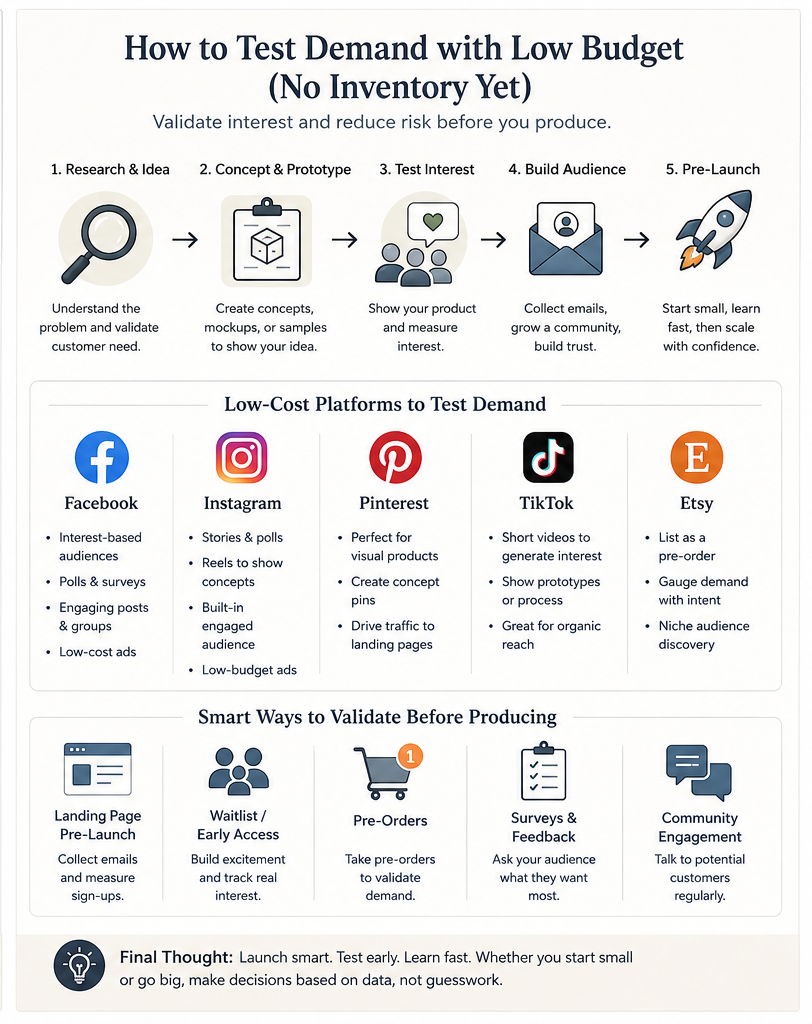
Why Demand Can Be Validated Before Production
Demand testing does not always require finished inventory.
Businesses often validate interest through:
- audience building
- waitlists
- previews
- community engagement
- early access campaigns
The goal becomes measuring interest before investing heavily.
Why Audience Building Matters
Successful launches often begin long before products exist.
Businesses increasingly build:
- email audiences
- social communities
- interest groups
- early-access lists
Audience demand reduces launch uncertainty.
Why Pre-Launch Feedback Is Valuable
Customer conversations often reveal:
- desired features
- preferred pricing
- purchase intent
- concerns
Pre-launch engagement improves decision quality.
Why Marketing Efficiency Affects Launch Strategy
Advertising budget influences production decisions heavily.
High-budget businesses may absorb failed launches.
Smaller businesses usually cannot.
Limited budgets often push businesses toward:
- smaller launches
- faster iteration
- lower inventory exposure
Why Lean Product Launches Became Popular
Modern businesses increasingly adopt lean launch models.
The philosophy is simple:
Build less.
Learn faster.
This reduces:
- inventory waste
- development cost
- operational risk
Scaling occurs after validation.
Why Some Products Require Bigger Launches
Not all products support small testing.
Large initial production may make sense for:
- expensive manufacturing setups
- seasonal launches
- long production timelines
- high minimum production requirements
Context matters.
Why Margins Influence Inventory Decisions
Profit margins dramatically affect launch risk.
Higher margins allow:
- more experimentation
- smaller production runs
Lower margins often push businesses toward larger production efficiency.
Why Customer Expectations Matter
Customer experience influences launch planning.
If customers expect:
- immediate shipping
- fast delivery
- product availability
small inventory may create problems.
Businesses must align inventory strategy with customer expectations.
Why Data Improves Future Decisions
Every launch generates valuable information.
Businesses learn:
- customer behavior
- pricing sensitivity
- acquisition cost
- reorder timing
Testing improves future launches.
Why Product Strategy Evolves Over Time
Most businesses do not permanently choose one approach.
Many follow stages:
Stage 1:
Small testing.
Stage 2:
Validation.
Stage 3:
Controlled scaling.
Stage 4:
Larger production.
Strategy evolves with confidence.
Why There Is No Universal Formula
The discussion remained unresolved because no single answer fits every business.
Different companies optimize for different priorities.
Some value:
- growth speed
Others prioritize:
- risk reduction
Others focus on:
- operational certainty
The right answer depends on business goals.
The Bigger Lesson About Product Launches
The real objective is not choosing small or big.
The objective is reducing uncertainty intelligently.
Successful businesses rarely gamble blindly.
They combine:
- customer understanding
- operational planning
- feedback loops
- measured scaling
Growth becomes more sustainable.
Final Thought
The debate between testing small and launching big reflects one of the most important decisions in product strategy.
Small launches reduce financial exposure and help validate real demand.
Larger launches maximize momentum and reduce stockout risk when confidence is high.
Neither strategy guarantees success.
The strongest product launches usually balance:
- preparation
- customer validation
- operational readiness
- measured scaling
Because launching a product is not simply about producing inventory.
It is about learning how much confidence the business truly has in customer demand.
Conclusion
The discussion around small test orders versus large initial production highlights a fundamental challenge in modern business growth.
Small launches offer:
- lower risk
- faster learning
- greater flexibility
Large launches offer:
- stronger momentum
- inventory availability
- operational efficiency
Businesses increasingly succeed not by choosing extremes, but by building systems that allow them to learn quickly and scale responsibly.
In modern commerce, the most valuable asset is often not inventory itself—
it is the ability to make smarter decisions before committing to larger growth.