Restaurants often build strong relationships with their customers through food, atmosphere, service, and local identity. Many customers do not only visit a restaurant because of the menu. They also connect with its personality, story, design style, neighborhood presence, and community culture. This is why restaurant merchandise can become an effective way to extend a brand beyond the dining experience.
T-shirts, hats, hoodies, tote bags, mugs, and other branded items can help customers show support for a restaurant they enjoy. Merchandise can also create an additional source of revenue, promote the restaurant outside its physical location, and strengthen customer loyalty.
The discussion focuses on a restaurant owner who wants to set up an online merchandise store for shirts, hats, hoodies, and similar items. The owner is exploring a setup that allows products to be sold online without needing to purchase large amounts of inventory in advance. This approach is commonly known as print-on-demand or dropshipping.
The main points in the discussion explain that Shopify acts as the storefront and checkout system, while the printing and shipping process is handled by a separate supplier. The choice of shirt brands, hoodie styles, hat types, printing methods, and product costs depends on the supplier selected. The discussion also explains the difference between screen printing and digital printing, as well as how restaurant pickup can work alongside home delivery.
This article explains how restaurant owners can approach online merchandise, choose products, understand printing methods, calculate costs, and launch a store with less inventory risk.
Why Restaurant Merchandise Can Be Valuable
Restaurant merchandise can turn loyal customers into brand supporters.
When someone wears a restaurant hoodie or cap, they are sharing the brand with other people. This creates visibility outside the restaurant itself.
Merchandise can also help restaurants build a stronger identity.
For example, a restaurant may have:
- A recognizable logo
- A memorable slogan
- A popular menu item
- A local neighborhood connection
- A unique mascot
- A strong visual style
- A loyal customer community
These elements can be turned into products that customers want to wear or use.
A restaurant merchandise store can offer several benefits:
- Additional revenue
- Increased brand awareness
- Customer loyalty
- Local community engagement
- Seasonal promotional opportunities
- Gift options for customers
- Limited-edition product launches
For restaurants with a strong following, merchandise can become more than a side project. It can become part of the brand experience.
Understanding the Role of the Online Store
The online store acts as the place where customers browse products, select sizes, pay for orders, and choose delivery or pickup options.
However, the online store does not usually produce the clothing itself.
The printing and shipping process is handled by a separate supplier.
This is an important clarification because many new business owners assume that Shopify provides the shirts, hats, hoodies, or printing services directly. In reality, the store platform helps manage the customer-facing side of the business, while a supplier handles product production and fulfillment.
The supplier may provide:
- Blank shirts
- Hoodies
- Hats
- Tote bags
- Printed designs
- Packaging
- Shipping
- Tracking information
The restaurant owner chooses the products, uploads designs, sets prices, and promotes the store.
Choosing Apparel Products
Before launching a merchandise store, restaurant owners should decide which products make sense for their audience.
Common merchandise items include:
- T-shirts
- Hoodies
- Sweatshirts
- Hats
- Tote bags
- Aprons
- Mugs
- Stickers
- Water bottles
- Posters
The best products depend on the restaurant’s brand and customers.
A casual café may sell tote bags, mugs, and simple shirts. A sports bar may sell caps, jerseys, and hoodies. A popular local restaurant may create limited-edition shirts connected to a signature dish or neighborhood event.
It is usually better to start with a small number of products instead of launching a very large catalog.
For example, a restaurant may begin with:
- One classic T-shirt
- One hoodie
- One hat
- One tote bag
This makes it easier to test customer interest.
Understanding Apparel Blank Brands
The quality and style of merchandise depend heavily on the blank apparel products used.
A blank is the unprinted shirt, hoodie, or hat that receives the restaurant’s design.
Different suppliers offer different apparel brands and styles.
Some blanks may be lightweight and affordable. Others may be thicker, softer, more durable, or more premium.
Restaurant owners should consider:
- Fabric weight
- Fit
- Material quality
- Color options
- Size range
- Durability
- Print quality
- Customer comfort
A low-cost shirt may seem attractive because it improves profit margins, but customers may be disappointed if it shrinks, feels rough, or loses shape quickly.
For restaurant merchandise, quality matters because the product represents the brand.
Why Samples Are Important
Before launching merchandise, restaurant owners should order samples.
A sample allows the owner to check:
- Print quality
- Shirt material
- Sizing
- Color accuracy
- Packaging
- Delivery speed
- Overall customer experience
A design may look perfect on a screen but appear different when printed on fabric.
Colors may look darker, lighter, or less vibrant. Small text may be difficult to read. A logo may be placed too high or too low.
Samples help identify these issues before customers begin ordering.
Design Costs and Artwork
The discussion explains that design costs depend on whether the restaurant already has artwork.
If the restaurant already has a logo, slogan, illustration, or graphic design, it may be able to use that artwork without additional design costs.
However, some designs may need adjustment before printing.
For example, a logo created for menus or signs may need to be resized, simplified, or converted into a print-ready format.
If a restaurant does not have suitable artwork, it may need to hire a designer.
Design costs are usually a one-time expense.
A designer may create:
- T-shirt graphics
- Hoodie designs
- Hat logos
- Restaurant slogans
- Mascot illustrations
- Limited-edition artwork
- Seasonal designs
Good merchandise design should be simple, recognizable, and wearable.
Customers may like the restaurant, but they may not want to wear a shirt that looks like an advertisement. The best designs often feel stylish even to people who do not know the restaurant.
Understanding Product Costs
The cost of each merchandise item usually includes:
- Blank product cost
- Printing cost
- Shipping cost
- Packaging cost
- Platform fees
- Payment processing fees
The supplier’s price is often the printed product cost plus shipping.
Restaurant owners should calculate the full cost before setting retail prices.
For example, a hoodie may cost more to produce and ship than a T-shirt because it is heavier and requires more material.
The retail price should cover all costs while leaving enough profit margin.
However, pricing should also match customer expectations.
A restaurant with a premium brand may be able to sell higher-priced merchandise. A casual neighborhood restaurant may need more affordable options.
Setting Retail Prices
Pricing should balance profitability and customer value.
Restaurant owners should consider:
- Product quality
- Brand positioning
- Competitor pricing
- Customer spending habits
- Shipping costs
- Profit goals
A common mistake is setting prices too low.
Low prices may attract customers, but they can leave little profit after production, shipping, fees, and refunds.
Another mistake is setting prices too high without offering premium quality or unique design.
The best approach is to review product costs carefully and choose prices that feel fair for both the business and the customer.
Screen Printing for Larger Orders
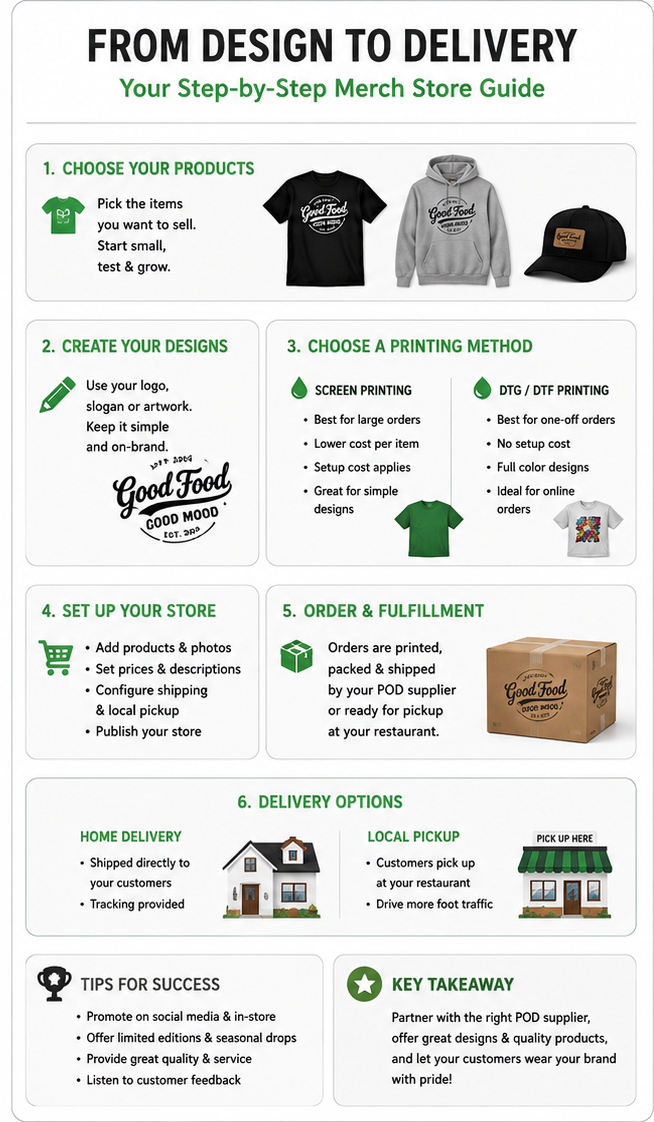
Screen printing is a traditional printing method often used for larger production runs.
It works well for simple designs with limited colors.
The process involves preparing screens for each color in the design. Because of this setup process, screen printing can become expensive for small orders.
However, when printing a large number of the same design, the cost per item can become lower.
Screen printing may be a good option when a restaurant wants to order a large batch of merchandise for:
- Events
- Staff uniforms
- Festivals
- Promotions
- Anniversary celebrations
- Local markets
- In-store sales
For high-volume orders, screen printing can provide strong color quality and durability.
Digital Printing for Small Orders
Digital printing is often better for online merchandise stores that produce items one at a time.
This method does not usually require the same setup process as screen printing.
It can be useful for:
- One-off orders
- Small product launches
- Multiple design variations
- Full-color artwork
- Limited-edition merchandise
- Online-only stores
Digital printing allows restaurants to sell products without buying large amounts of inventory in advance.
This reduces financial risk.
Instead of ordering 100 hoodies and hoping they sell, the restaurant can produce each hoodie only after a customer places an order.
Print-on-Demand and Inventory Risk
Print-on-demand is attractive because it reduces inventory risk.
Traditional merchandise requires businesses to purchase stock before knowing whether customers will buy it.
This can create problems such as:
- Unsold inventory
- Storage needs
- Upfront costs
- Limited cash flow
- Seasonal leftovers
With print-on-demand, products are produced after the order is placed.
This means the restaurant does not need to keep shirts, hats, or hoodies in storage.
However, the product cost per item may be higher than ordering in bulk.
The restaurant must decide whether lower risk is more important than lower production cost.
For many restaurants starting their first merchandise store, print-on-demand is a practical way to test demand.
Offering Home Delivery
Home delivery allows customers to order merchandise from anywhere.
This can be useful for customers who live outside the local area or want to send gifts.
The supplier usually handles printing, packaging, and shipping directly to the customer.
This reduces work for the restaurant.
However, restaurant owners should clearly communicate delivery timelines.
Customers may expect fast shipping, especially if they are used to quick food delivery. Merchandise production and shipping may take longer.
Clear delivery information helps avoid complaints.
Offering Restaurant Pickup
Restaurant pickup can be a useful option for local customers.
Some customers may prefer to collect their merchandise while visiting the restaurant.
Pickup can offer several benefits:
- Lower shipping costs
- More restaurant visits
- Stronger local connection
- Easier gift purchases
- Opportunities for additional food sales
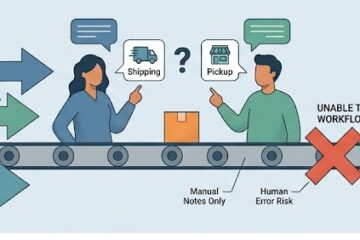
The online store can allow customers to choose between home delivery and local pickup.
The restaurant should decide how pickup orders will be handled.
For example, the supplier may ship bulk merchandise to the restaurant, or the restaurant may keep a small amount of popular items in stock for pickup.
Managing Customer Expectations
Customers should understand how merchandise orders work.
The store should clearly explain:
- Production time
- Shipping time
- Pickup instructions
- Size guides
- Return policies
- Exchange policies
- Care instructions
Clear information reduces customer confusion.
For clothing, size guides are especially important. Customers may return products if the fit is different from what they expected.
Creating Limited-Edition Merchandise
Limited-edition merchandise can create excitement.
Restaurants can release special designs for:
- Anniversaries
- Holidays
- Local events
- New menu launches
- Sports seasons
- Community fundraisers
- Restaurant milestones
Limited products can encourage customers to purchase sooner.
However, the restaurant should avoid creating too many designs at once.
A small number of strong designs is usually more effective than a large number of average designs.
Promoting the Merchandise Store
A merchandise store needs promotion.
Restaurants can promote products through:
- Social media
- Email newsletters
- Table cards
- Menu inserts
- Staff uniforms
- In-store displays
- Event promotions
- Loyalty programs
Staff can also help promote merchandise by wearing it.
When customers see a stylish hoodie or hat on a staff member, they may ask where they can buy it.
Measuring What Works
Restaurant owners should track which products sell best.
Useful information includes:
- Most popular sizes
- Best-selling colors
- Highest-selling product types
- Repeat customers
- Seasonal demand
- Customer feedback
This helps the restaurant improve future merchandise launches.
For example, if hats sell better than hoodies, the restaurant may focus more on hats. If customers frequently ask for children’s sizes, the restaurant may add family merchandise.
Conclusion
Launching an online merchandise store can help restaurants build stronger customer relationships, create new revenue opportunities, and expand their brand beyond food and dining. Shirts, hats, hoodies, tote bags, and other products can become meaningful items for loyal customers who want to support the restaurant.
The online store handles product browsing, payments, delivery choices, and pickup options, while a separate supplier manages printing and shipping. The choice of apparel quality, product styles, printing method, and pricing depends on the supplier and the restaurant’s business goals.
For small online launches, digital printing and print-on-demand can reduce inventory risk. For larger events or high-volume orders, screen printing may provide lower costs per item.
The best way to begin is with a small product range, strong designs, carefully tested samples, clear pricing, and simple delivery options. By starting small and learning what customers want, a restaurant can create a merchandise store that supports both its brand and its business growth.