A Practical Guide to Communities, Suppliers, and Smarter Research
Sourcing furniture online can be one of the most challenging parts of starting or growing an ecommerce business. Furniture is a broad category that includes home décor, office furniture, outdoor items, storage products, bedroom furniture, dining furniture, lighting, and many other product types. Unlike small accessories or lightweight products, furniture often involves larger order values, more complicated shipping, higher return costs, and greater customer expectations around quality.
The discussion focuses on a user looking for forums, chat groups, or platforms where they can learn more about sourcing furniture online. The user is not necessarily asking for one direct supplier. Instead, they want to understand where experienced sellers, suppliers, and ecommerce businesses discuss furniture sourcing. They are looking for practical communities and resources that can help them discover suppliers, compare options, and avoid common mistakes.
The main response explains that there may not be one large, active community dedicated only to furniture dropshipping. Instead, useful advice is often spread across broader ecommerce groups, product sourcing discussions, supplier communities, and online business forums. The response also mentions a furniture sourcing platform connected to a large home and living supplier, which may provide access to a broad catalog and easier store integration.
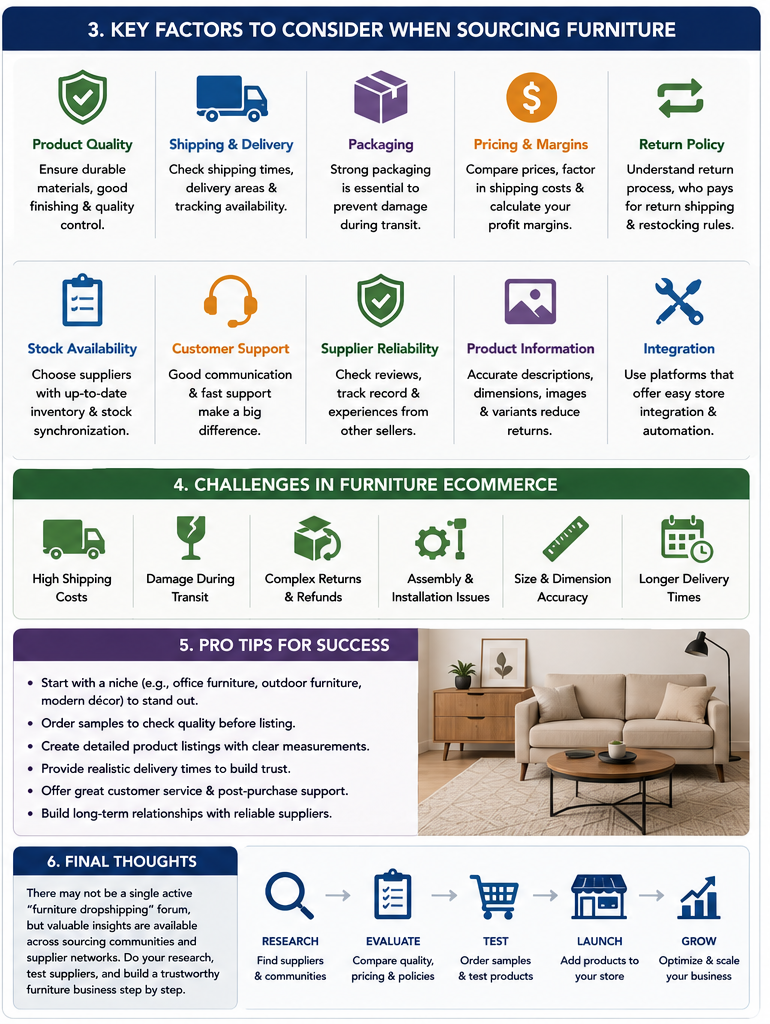
Although the discussion does not reach a final answer, it highlights several important lessons. Furniture sourcing requires more research than many other product categories. Sellers need to think about supplier reliability, product quality, shipping speed, packaging, return policies, stock availability, and customer support. Finding the right community or supplier can make a major difference in whether a furniture business grows successfully.
Why Furniture Sourcing Is Different
Furniture is not like selling small fashion accessories, phone cases, or lightweight beauty products. Furniture is usually larger, heavier, more expensive, and more difficult to ship.
This creates several challenges for online sellers.
Furniture customers often expect:
- High-quality materials
- Accurate dimensions
- Clear product images
- Reliable delivery
- Safe packaging
- Easy returns
- Helpful customer service
A customer buying a small item may accept minor imperfections. A customer buying a sofa, dining table, wardrobe, office chair, or bed frame usually has much higher expectations.
Because furniture orders often have higher prices, customers may also take longer to decide before purchasing. They may compare several stores, read reviews, ask questions, and carefully check product details.
For this reason, furniture sellers need reliable suppliers and accurate product information.
Why Online Communities Are Useful
Online communities can help new furniture sellers learn from other people’s experiences.
Instead of making every mistake alone, business owners can ask questions about suppliers, shipping, returns, product quality, marketing, and customer service.
Useful discussions may include topics such as:
- Which suppliers offer reliable furniture products
- How to handle damaged deliveries
- Which furniture categories sell well
- How to manage large-item shipping
- How to create accurate product descriptions
- How to reduce return rates
- How to price furniture profitably
- How to manage supplier stock updates
Communities can also help sellers discover suppliers they may not find through normal search results.
However, it is important to remember that advice from online groups should be researched carefully. Not every recommendation will be suitable for every business.
Why There May Not Be a Dedicated Furniture Dropshipping Forum
The discussion suggests that there may not be a large, active forum focused only on furniture dropshipping.
This is understandable because furniture sourcing is spread across many different business models.
Some sellers use dropshipping. Others buy wholesale inventory. Some work directly with manufacturers. Others use warehouses or fulfillment partners.
Because of this, furniture sourcing discussions often appear in broader communities related to:
- Ecommerce
- Product sourcing
- Home and living products
- Wholesale business
- Importing and exporting
- Retail operations
- Online marketplaces
- Small business ownership
Rather than searching only for furniture-specific groups, sellers may find better information by joining general sourcing and ecommerce communities.
Exploring Product Sourcing Discussions
Product sourcing discussions can be useful because many of the challenges are similar across industries.
For example, sellers in different categories may all need help with:
- Finding reliable suppliers
- Checking product quality
- Negotiating prices
- Managing shipping delays
- Understanding minimum order quantities
- Handling damaged goods
- Creating private-label products
Even if a community is not focused only on furniture, the advice may still be valuable.
A seller can ask specific questions such as:
- How do you check furniture supplier quality before ordering?
- Which suppliers offer reliable delivery for bulky products?
- How do you manage returns for large furniture items?
- What furniture categories are easiest to sell online?
- How do you handle stock updates from suppliers?
Specific questions usually lead to better responses.
Supplier-Specific Communities
Supplier-specific communities can also be useful.
Some suppliers have customer groups, support channels, knowledge bases, or merchant communities where sellers can ask questions and share experiences.
These communities may provide information about:
- Product availability
- Shipping locations
- Delivery times
- Product feed updates
- Return processes
- Store setup
- Customer support
Supplier communities can be helpful because members may already be using the same catalog or service.
However, sellers should still compare information with independent sources. A supplier community may naturally focus on positive experiences and may not always discuss problems openly.
Furniture Sourcing Platforms
The discussion mentions a furniture sourcing platform that provides access to a large catalog of home and living products.
Platforms like this can be attractive because they may offer:
- Large furniture catalogs
- Product images
- Product descriptions
- Stock availability
- Order fulfillment support
- Store integration
- Automated product updates
For new sellers, this can reduce the amount of manual work required to upload products and manage inventory.
Instead of creating product listings one by one, sellers may be able to import products directly into their store.
This can save time, especially when managing hundreds of furniture products.
Why Large Catalogs Can Be Helpful
A large catalog gives sellers more options.
Furniture stores often need variety because customers have different tastes, budgets, and home styles.
A broad catalog may include:
- Sofas
- Chairs
- Tables
- Storage units
- Beds
- Outdoor furniture
- Office furniture
- Lighting
- Home décor
- Garden products
However, having too many products can also create problems.
A new store does not need thousands of random items. It is usually better to start with a focused category.
For example, a seller may focus on:
- Small-space furniture
- Modern office furniture
- Outdoor garden furniture
- Scandinavian-style home décor
- Nursery furniture
- Storage and organization products
A focused store often feels more professional and easier for customers to understand.
The Importance of Product Quality
Furniture quality is one of the most important factors when choosing a supplier.
Customers expect furniture to be durable, stable, safe, and accurately described.
Before working with a supplier, sellers should ask questions about:
- Materials used
- Weight capacity
- Assembly requirements
- Product dimensions
- Packaging quality
- Warranty options
- Quality control processes
If possible, sellers should order samples or test products before listing them.
A product may look attractive in supplier photos but feel cheap or unstable in real life.
Testing helps sellers avoid customer complaints later.
Shipping Challenges for Furniture
Furniture shipping is more complicated than shipping small products.
Large items may require special handling, oversized packaging, freight services, or appointment-based delivery.
Common shipping problems include:
- Damage during transport
- Delayed delivery
- High shipping costs
- Lost packages
- Customer refusal
- Delivery to incorrect addresses
Before choosing a supplier, sellers should ask:
- Which countries do you ship to?
- What are the delivery times?
- Are tracking details provided?
- How are large items packaged?
- Who is responsible for damaged goods?
- Are returns accepted?
- Are shipping costs included in the product price?
Clear answers help sellers avoid unexpected expenses.
Managing Returns for Furniture
Furniture returns can be expensive.
A customer may return an item because of:
- Damage
- Incorrect size
- Wrong color
- Difficult assembly
- Poor quality
- Delivery delays
Unlike small products, furniture returns may require expensive shipping or collection services.
Sellers should understand the supplier’s return policy before listing products.
Important questions include:
- Who pays return shipping?
- How long do customers have to request a return?
- Does the supplier replace damaged items?
- Is photo evidence required?
- Are refunds available?
- Can customers return assembled furniture?
A clear return policy helps protect both the seller and the customer.
Choosing the Right Furniture Niche
Furniture is a very large market.
New sellers may struggle if they try to sell every type of furniture at once.
A focused niche can make marketing easier.
Possible furniture niches include:
- Compact furniture for apartments
- Home office furniture
- Outdoor garden furniture
- Nursery furniture
- Luxury home décor
- Budget storage solutions
- Eco-friendly furniture
- Modern minimalist furniture
- Pet-friendly furniture
A niche helps a store build a clear identity.
For example, a store focused on small-space furniture can create content about apartment living, storage ideas, and compact home design.
This attracts customers with specific needs.
Comparing Suppliers Before Choosing One
Sellers should avoid choosing the first supplier they find.
It is better to compare several options.
Important comparison factors include:
- Product quality
- Product range
- Shipping speed
- Pricing
- Return policy
- Customer support
- Stock availability
- Store integration
- Supplier reputation
A supplier with slightly higher prices may still be better if they offer faster shipping, better packaging, and stronger customer support.
Why Product Information Matters
Furniture customers need detailed information before buying.
Product listings should include:
- Accurate dimensions
- Materials
- Weight
- Assembly instructions
- Color options
- Care instructions
- Delivery details
- Return policy
If supplier information is incomplete, sellers may need to create their own descriptions or request more details.
Accurate product information reduces customer confusion and return requests.
Building Trust With Furniture Customers
Furniture customers often spend more money than customers buying small products.
This means trust is essential.
A furniture store should provide:
- Clear product images
- Detailed descriptions
- Customer reviews
- Shipping information
- Return policies
- Contact details
- Frequently asked questions
The more confident customers feel, the more likely they are to purchase.
Learning From Other Sellers
One of the best ways to improve furniture sourcing is to learn from other sellers.
Experienced merchants may share useful advice about:
- Reliable suppliers
- Shipping methods
- Pricing strategies
- Product categories
- Customer service
- Marketing ideas
However, sellers should always test information themselves.
A supplier that works well for one business may not work well for another.
Different businesses may serve different countries, price ranges, or customer types.
Starting With a Small Product Range
New furniture sellers should avoid launching with too many products.
A smaller catalog is easier to manage.
It allows sellers to focus on:
- Product quality
- Listing quality
- Customer service
- Marketing
- Supplier communication
Once the business understands which products perform well, it can expand gradually.
Conclusion
The discussion highlights a common challenge for new ecommerce sellers: finding reliable furniture sourcing information and communities. While there may not be one dedicated furniture dropshipping forum, useful advice can be found across broader ecommerce groups, sourcing communities, supplier networks, and online business discussions.
Furniture sourcing requires careful planning because products are often bulky, expensive, and difficult to return. Sellers need to evaluate suppliers based on product quality, shipping reliability, return policies, stock availability, and customer support.
Platforms that offer large furniture catalogs and easier store integration can help reduce manual work, but sellers should still research suppliers carefully and test products whenever possible.
The best approach is to start with a focused furniture niche, compare multiple suppliers, join relevant ecommerce communities, and build knowledge gradually. By taking time to research products, shipping processes, and supplier policies, sellers can create a more reliable furniture business and provide a better experience for customers.