Introduction
Running a dropshipping business can be convenient because sellers do not need to store large quantities of products or manage their own warehouses. When a customer places an order, the supplier usually handles product packaging and shipping directly to the customer. This makes it easier to start an online business with lower initial investment and fewer storage responsibilities.
However, one important challenge that dropshipping sellers often face is managing customer returns. What happens when a customer receives a damaged product, orders the wrong size, changes their mind, or simply wants a refund? Where should the customer send the returned item?
For sellers who operate their businesses from home, sharing a personal residential address with customers may not be comfortable or practical. They may not have enough space to receive returned packages, inspect products, or store items that need to be sent back to suppliers.
Fortunately, dropshipping sellers do not necessarily need to use their home address for returns. There are other ways to manage the process professionally, including supplier-managed returns and third-party fulfillment centers.
This article explains how dropshipping businesses can handle customer returns without receiving packages at home, what options are available, and what sellers should consider before choosing a return solution.
Why Customer Returns Are a Challenge in Dropshipping
In a traditional retail business, sellers generally keep products in their own stores or warehouses. When a customer wants to return an item, the seller can provide a return address and inspect the product after receiving it.
Dropshipping works differently. The seller may never physically handle the product. Instead, the supplier stores the inventory and ships orders directly to customers.
This creates a few additional challenges when a return is requested.
- No physical storage location
Many dropshipping businesses operate without a warehouse. If a customer sends a product back, the seller may have nowhere suitable to receive or store it.
- Supplier and seller responsibilities are different
The supplier may handle shipping but might not automatically accept customer returns. Some suppliers only accept returns when products are defective, while others have specific return conditions.
- Personal privacy concerns
Home-based sellers may not want to share their residential address on return instructions. Using a professional business address can help maintain privacy and create a more professional customer experience.
- Returned products need inspection
A returned product may be unused, damaged, incomplete, or unsuitable for resale. Someone needs to inspect it and decide what should happen next.
- Return shipping can become expensive
Depending on the product, supplier location, and customer’s location, return shipping costs can reduce the profit from an order. International returns can be especially expensive.
For these reasons, sellers should create a return management process before accepting orders rather than waiting until the first customer requests a return.
Option 1: Use a Supplier or Dropshipping Partner That Handles Returns
One of the simplest solutions is to work with a supplier or dropshipping partner that offers return management services.
Some suppliers allow customers to return products directly to their designated return address. The supplier receives the package, checks the product, and follows the agreed return procedure.
For example, imagine an online store selling home decoration products. A customer purchases a decorative lamp but receives a damaged item. Instead of asking the customer to send it to the seller’s home, the seller can provide the supplier’s approved return address.
The supplier receives the returned lamp and checks its condition. Depending on the agreement, the supplier may provide a replacement, issue a credit, or arrange another solution.
Benefits of supplier-managed returns
- Convenience: Sellers do not need to receive returned packages personally.
- Less storage responsibility: Products remain within the supplier’s operational network.
- Simpler communication: The supplier may already understand the product and its condition.
- Better coordination: Returns and replacements can be handled through an established supplier relationship.
What should sellers confirm?
Not every supplier provides the same return services. Before choosing this option, sellers should ask:
- Do you accept returns directly from customers?
- What is the approved return address?
- Which products are eligible for returns?
- How many days does a customer have to request a return?
- Who pays for return shipping?
- What happens if the product is damaged or used?
- Will you provide a replacement, refund, or store credit?
- How long does the inspection and return process take?
It is important to get these conditions in writing. A supplier may agree to accept returns but charge additional handling fees or refuse certain categories of returned products.
A seller should also check whether the supplier’s return policy matches the policy displayed in the online store. If the customer is promised a 30-day return period but the supplier only accepts returns within seven days, the seller may face unnecessary disputes.
Option 2: Use a Third-Party Logistics Fulfillment Center
Another practical solution is to use a third-party logistics provider, commonly known as a fulfillment center.
A fulfillment center is a separate business that manages storage, receiving, packing, shipping, and sometimes returns for other businesses. Instead of sending returned products to a home address, sellers can direct customers to an approved fulfillment center.
This option is particularly useful for sellers who work with multiple suppliers or sell products that require physical inspection before being resold.
How does a fulfillment center manage returns?
The process generally works in the following way:
Step 1: Customer requests a return
A customer contacts the online store and explains why they want to return a product. The seller reviews the request according to the store’s return policy.
Step 2: Seller provides a return address
If the return is approved, the seller provides the fulfillment center’s designated return address and any required return instructions.
Step 3: Fulfillment center receives the package
The returned product arrives at the center instead of the seller’s home. Staff record the package and identify the order using the return information.
Step 4: Product inspection
The fulfillment center checks whether the item is unused, damaged, incomplete, or suitable for resale. The seller may define the inspection requirements in advance.
Step 5: Decide what happens next
Based on the product’s condition and the seller’s instructions, the fulfillment center can:
- Restock the product if it is in sellable condition.
- Store it until another order is received.
- Send it back to the original supplier.
- Arrange refurbishment if the service is available.
- Dispose of the product if it cannot be sold again.
Step 6: Seller completes the return
After receiving the inspection report, the seller can process the appropriate refund, replacement, or other resolution.
Benefits of using a fulfillment center
Professional return handling: Customers receive a dedicated business return address rather than the seller’s residential address.
Product inspection: Returned items can be checked before deciding whether they can be sold again.
Inventory recovery: Products in good condition may be returned to available inventory instead of becoming a complete loss.
Business flexibility: Sellers can focus on customer service, marketing, and sales while the fulfillment center manages physical returns.
Room for growth: A fulfillment arrangement can support higher order volumes without requiring the seller to rent and operate a personal warehouse.
Possible disadvantages
Fulfillment centers are not free. Sellers may need to pay receiving fees, inspection charges, storage costs, return processing fees, and shipping expenses.
Some providers may also have minimum monthly requirements or restrictions on the products they accept.
Therefore, sellers should compare the total cost of using a fulfillment center with the expected number of returns and the value of the products being sold.
Supplier Returns vs. Third-Party Fulfillment Centers
Both options can help dropshipping sellers avoid receiving returned packages at home, but they serve slightly different purposes.
| Factor | Supplier-Managed Returns | Third-Party Fulfillment Center |
| Return destination | Supplier’s approved address | Fulfillment center address |
| Product inspection | Depends on supplier | May be available as a paid service |
| Inventory storage | Usually with supplier | Can be stored separately |
| Restocking | Depends on agreement | Possible if included in the service |
| Additional charges | May include supplier fees | Receiving, inspection, storage, and handling fees |
| Best suited for | Sellers with reliable suppliers | Sellers needing independent return handling |
There is no single solution that works for every dropshipping business. The right choice depends on the product category, supplier location, order volume, return frequency, and available budget.
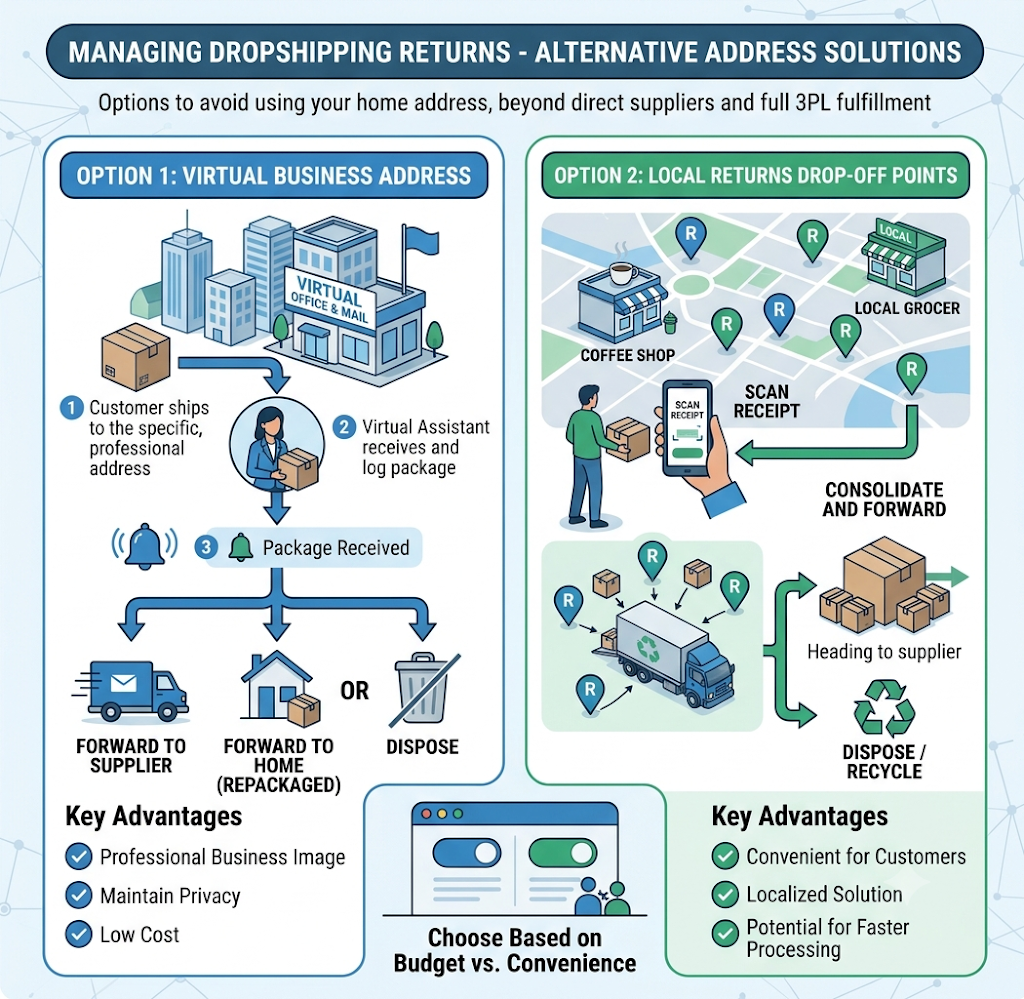
What Happens to Returned Products?
Receiving a returned package is only one part of the process. Sellers also need a clear plan for the product after it reaches the return location.
There are several possible outcomes.
1. Restocking
If the product is unopened, undamaged, and suitable for resale, it may be added back to available inventory.
For example, a customer returns an unused kitchen accessory because they ordered the wrong size. After inspection, the fulfillment center confirms that the packaging is intact. The seller can then make the product available for another order.
2. Refurbishment
Some products can be repaired, cleaned, repackaged, or restored before being sold again. This may be useful for electronics, furniture, and certain household products.
However, refurbishment should only be offered when the fulfillment provider has the appropriate facilities and expertise.
3. Return to Supplier
In some situations, the returned product needs to go back to the original supplier. This may happen when the item is defective or when the supplier has agreed to accept customer returns.
Before selecting this option, sellers should check the additional shipping costs and whether the supplier will provide a refund or replacement.
4. Disposal
Some returned products cannot be resold because they are damaged, incomplete, unsafe, or unsuitable for reuse. In such cases, disposal may be the most practical option.
The seller should understand any disposal charges and confirm that the provider follows appropriate handling procedures.
Who Should Pay for Return Shipping?
Return shipping costs should be discussed before choosing a supplier or fulfillment center.
There is no universal rule that the seller, customer, or supplier must always pay. Responsibility depends on the store’s return policy, the reason for the return, applicable consumer protection requirements, and the supplier agreement.
For example:
- Defective or damaged product: The seller may need to cover return shipping or arrange another suitable resolution.
- Incorrect product delivered: The seller should coordinate with the supplier to resolve the issue and determine who bears the cost.
- Customer changes their mind: The store’s disclosed return policy may explain whether the customer pays return shipping.
- Wrong size or personal preference: Responsibility should be clearly stated in the store’s policy, subject to applicable law.
Sellers should avoid making assumptions about who will pay. A return that appears profitable at first can become expensive after adding shipping, inspection, and handling charges.
A written agreement with the supplier or fulfillment center can help prevent disagreements later.
How to Choose the Right Return Address
Before selecting a return location, sellers should consider several important factors.
Location: Choose a return address that is reasonably convenient for the customers being served. If most customers are in one country, a return location in that country may reduce shipping costs and delivery time.
Cost: Ask for a complete list of charges, including package receiving, inspection, storage, repacking, and disposal.
Product handling: Confirm that the provider can safely handle the type of products being sold. Fragile, electronic, oversized, or temperature-sensitive items may require special arrangements.
Communication: The provider should be able to notify the seller when a return arrives and share its inspection results.
Processing time: Ask how quickly returned packages are recorded, inspected, and made ready for the next step.
Business reliability: Check the provider’s experience, customer feedback, service terms, and ability to handle the expected return volume.
A cheap service is not always the best option. A reliable return process can protect customer trust and prevent unnecessary losses.
Common Mistakes Dropshipping Sellers Should Avoid
Many sellers focus heavily on finding products and generating sales but overlook the return process. This can create problems once orders start arriving.
Here are some common mistakes to avoid:
- Choosing a return address without permission
Never send customers to a supplier or fulfillment center without confirming that it accepts customer returns. A package may be rejected or lost if the address is not approved for that purpose.
- Not checking supplier return conditions
Some suppliers only accept defective products, while others have strict packaging and time requirements. Sellers should understand these rules before advertising a return policy.
- Ignoring additional fees
Return shipping is not the only expense. Inspection, storage, handling, repackaging, and disposal can all increase the total cost.
- Providing unclear return instructions
Customers should know where to send products, how to request authorization, what condition products must be in, and how long the process may take.
- Promising refunds before understanding the process
A seller should not promise an immediate refund if the product needs to be received and inspected first, unless the store’s policy or applicable law requires a different approach.
- Failing to track returned products
Every return should be connected to its original order. This makes it easier to monitor the product’s location, inspection result, refund status, and final outcome.
Best Practices for Building a Smooth Return Process
A well-planned return system can make a dropshipping business more reliable and easier to manage.
Consider following these practices:
- Create a clear return policy: Explain eligible products, return periods, conditions, shipping responsibilities, and refund timelines.
- Confirm the return address: Use only an address that has been approved by the supplier or fulfillment provider.
- Keep written agreements: Document who receives, inspects, stores, and processes returned products.
- Track every return: Maintain records of the order number, customer request, shipping details, product condition, and refund decision.
- Calculate return costs: Include shipping and handling expenses when calculating product profitability.
- Communicate with customers: Send clear instructions and updates when a return is approved and received.
- Review return patterns: If many customers return the same product, investigate product quality, descriptions, sizing information, and supplier reliability.
These practices help sellers manage returns more consistently while reducing confusion between customers, suppliers, and fulfillment providers.
Conclusion
Managing customer returns is an important part of running a successful dropshipping business. Even though sellers may not physically handle products during normal order fulfillment, they remain responsible for providing a clear and reliable customer experience.
Using a home address is not the only option. Sellers can work with suppliers that offer return handling or choose a third-party fulfillment center that receives, inspects, stores, and processes returned products.
Supplier-managed returns may be more convenient for businesses working with a single reliable supplier. A fulfillment center may be more suitable for sellers who need independent inspection, storage, or product recovery services.
However, choosing a return destination is only the beginning. Sellers must also understand shipping responsibilities, inspection charges, refund conditions, supplier agreements, and what happens to returned products.
The most important step is to establish the complete return process before customers start requesting returns. A clear agreement, reliable return address, proper tracking, and transparent communication can protect the seller’s privacy, reduce unnecessary costs, and improve customer confidence.
A dropshipping business does not need to own a warehouse to manage returns professionally. With the right return arrangement, sellers can operate from almost anywhere while maintaining a structured and dependable customer service process.
0 Comments