Introduction
The fragrance industry offers an interesting opportunity for entrepreneurs who want to build their own product brand without manufacturing perfumes themselves. One business model that attracts many new sellers is private-label perfume dropshipping.
Private-label perfumes are fragrances manufactured by another company but sold under the seller’s own brand name. This allows entrepreneurs to create a unique identity, choose packaging, develop a product range, and build customer loyalty without owning a perfume manufacturing facility.
Dropshipping can make this business model even more attractive. Instead of purchasing and storing large quantities of products, sellers work with suppliers who manufacture or hold the inventory and ship orders directly to customers.
However, finding a supplier who supports both private labeling and dropshipping can be challenging. Not every perfume manufacturer offers direct-to-customer shipping, and not every dropshipping supplier allows sellers to use their own branding.
A discussion among ecommerce sellers highlights this challenge. One participant mentioned connections with European perfume manufacturers and the possibility of helping interested sellers or offering distribution opportunities. Another suggested testing demand through small, unbranded 10 ml perfume bottles, with an estimated wholesale price of $1–2 per bottle and a minimum order of 30 units.
Although these suggestions provide possible starting points, they do not confirm that either supplier offers a complete private-label dropshipping service.
This article explains how private-label perfume dropshipping works, how to find suitable suppliers, what to ask before making an agreement, and how to build a fragrance business with a manageable investment.
What Is Private-Label Perfume Dropshipping?
Private-label perfume dropshipping combines two business models: private labeling and dropshipping.
Private labeling means selling a product manufactured by another company under your own brand. The manufacturer handles production, while you focus on branding, marketing, sales, and customer relationships.
Dropshipping means selling products without keeping them in your own inventory. When a customer places an order, the supplier prepares and ships the product directly to the customer.
When these models are combined, the supplier manufactures or supplies a fragrance with your branding and fulfills customer orders on your behalf.
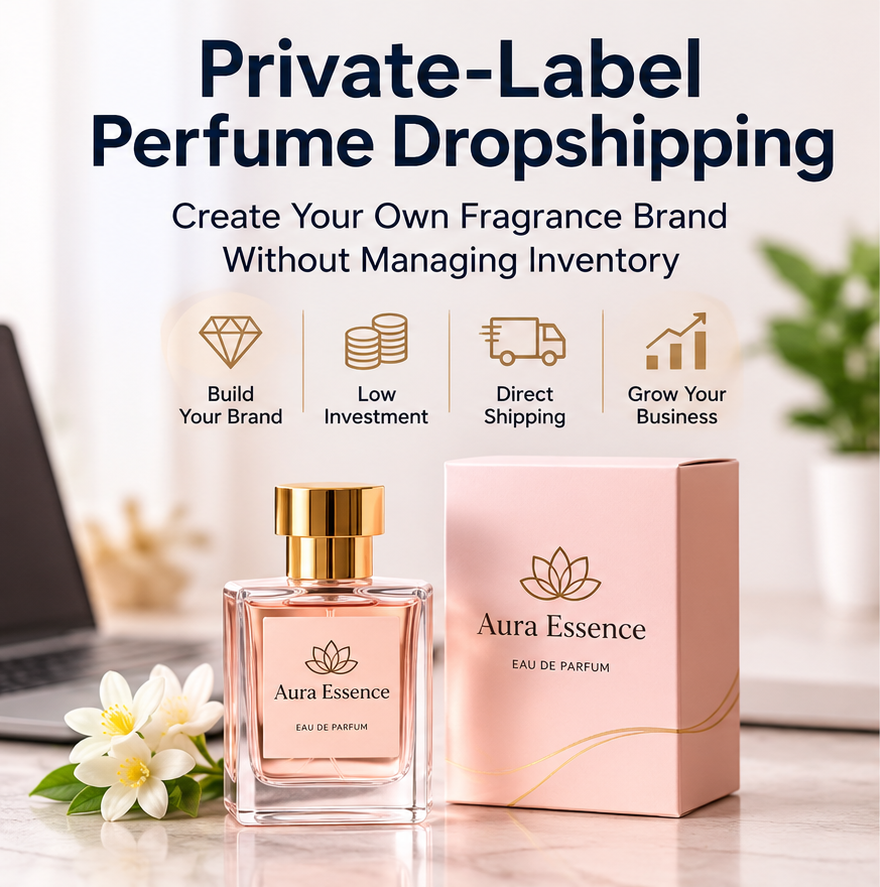
For example, imagine an entrepreneur wants to launch a perfume brand called “Aura Essence.” Instead of creating a perfume factory, the entrepreneur partners with a fragrance manufacturer.
The manufacturer produces a fragrance, fills the bottles, applies the agreed branding, and prepares the packaging. When a customer purchases a perfume through the online store, the manufacturer or fulfillment partner ships it directly to the customer.
The seller earns money from the difference between the selling price and the total product and fulfillment costs.
This model allows entrepreneurs to build a recognizable fragrance brand without managing every part of manufacturing and shipping.
Why Are Entrepreneurs Interested in Private-Label Perfumes?
Perfumes are attractive products for ecommerce because they are connected to personal style, lifestyle, gifting, and self-expression. Customers often look for fragrances that match their preferences or create a particular impression.
Private labeling also gives sellers more control over how they present their products.
1. Building Your Own Brand
Selling established perfume brands means competing with businesses offering the same products. Private labeling allows sellers to create their own brand identity.
They can choose:
- Brand name and logo.
- Bottle design and appearance.
- Packaging style.
- Fragrance names.
- Product descriptions.
- Brand messaging and positioning.
A consistent identity can help customers recognize the business and remember its products.
2. Lower Initial Investment
Traditional perfume manufacturing may require investment in production facilities, equipment, ingredients, packaging, and inventory.
With a private-label supplier, sellers can avoid owning manufacturing infrastructure.
Dropshipping may reduce the need to purchase large quantities of inventory in advance. However, sellers should understand that private-label production may still involve minimum order quantities, setup charges, or branding costs.
3. Product Differentiation
A business can create a collection around a particular customer group or fragrance preference.
For example, a brand might focus on:
- Everyday fragrances.
- Premium-inspired scents.
- Floral fragrances.
- Fresh and citrus fragrances.
- Gift collections.
- Travel-size perfumes.
The objective is to offer a clear identity rather than selling random products without a consistent theme.
4. Easier Business Expansion
Once a seller establishes a relationship with a reliable manufacturer, additional fragrances and product variations may be introduced.
The business can gradually expand its collection based on customer feedback and sales performance instead of launching a large product range immediately.
How to Find Private-Label Perfume Suppliers
Finding the right supplier is one of the most important steps in this business.
A supplier should not only manufacture good-quality fragrances but also support the business model the seller wants to use.
Some manufacturers specialize in bulk production, while others provide private-label packaging or direct shipping. These services are different and should not be treated as interchangeable.
1. Contact Perfume Manufacturers Directly
Perfume manufacturers can be a good starting point because they understand fragrance production, ingredients, packaging, and quality control.
Some manufacturers may offer private-label services, allowing businesses to select existing fragrance formulas and customize the packaging.
When contacting manufacturers, explain that you want to launch your own perfume brand and ask whether they support small businesses.
Important questions include:
- Do you manufacture private-label perfumes?
- Can products carry my brand name and logo?
- Can I choose from existing fragrance formulas?
- Do you offer custom fragrance development?
- What is the minimum order quantity?
- Can you provide product samples?
- Do you offer individual order fulfillment?
- Can you ship directly to customers?
- Do you support international shipping?
A manufacturer may be willing to produce private-label perfumes but may not support dropshipping. In that case, another fulfillment arrangement may be necessary.
2. Explore European Manufacturers
The discussion mentioned a participant with connections to European perfume manufacturers.
Europe has an established fragrance industry, and some manufacturers provide services to businesses interested in developing their own perfume collections.
However, working with a European supplier does not automatically guarantee that the business will receive private-label dropshipping services.
Sellers should confirm the manufacturer’s location, production capabilities, branding options, shipping arrangements, and applicable regulatory requirements.
They should also request samples and documentation before placing a large order.
3. Consider Smaller Wholesale Suppliers for Testing
Another suggestion in the discussion was to start with unbranded 10 ml perfume bottles.
The supplier mentioned an estimated wholesale price of $1–2 per bottle and a minimum order quantity of 30 units.
This type of arrangement may help a beginner understand customer demand without committing to a large inventory purchase.
For example, a seller could purchase a small batch of different fragrances, collect customer feedback, and identify which scents receive the most interest.
However, this is not the same as private-label dropshipping. If the bottles are unbranded and shipped in bulk to the seller, the business still needs to arrange branding, storage, packaging, and individual order fulfillment.
The seller should confirm whether the supplier can add custom labels and ship individual orders before assuming that a complete dropshipping arrangement is available.
Private Label vs. Unbranded Wholesale Perfumes
These two options can help sellers enter the fragrance market, but they serve different purposes.
| Factor | Private-Label Perfumes | Unbranded Wholesale Perfumes |
| Branding | Sold under your own brand | Usually sold without your brand |
| Packaging | Can be customized | Usually standard packaging |
| Brand identity | Stronger opportunity to build recognition | Limited differentiation |
| Initial requirements | May involve branding and production costs | May be simpler to purchase |
| Inventory | Depends on supplier arrangement | Often requires purchasing stock |
| Dropshipping | Must be confirmed separately | Must be confirmed separately |
| Best suited for | Building a long-term product brand | Testing demand or reselling products |
A seller who wants to build a recognizable fragrance business should eventually consider private labeling. However, starting with a small wholesale batch can be a useful way to learn about customer preferences and product demand.
Can Private-Label Perfumes Be Dropshipped Directly?
This is the main question that sellers need to resolve before selecting a supplier.
A supplier may offer private-label manufacturing without offering dropshipping. Another may provide dropshipping but only for products that already exist under the supplier’s own branding.
To support private-label dropshipping, the supplier should be able to manage several activities:
Product branding: The perfume bottle and packaging must carry the seller’s approved branding.
Order processing: The supplier should receive or access new customer orders and prepare the correct products.
Individual packaging: Each order should be packed appropriately, preferably without unnecessary supplier branding if the seller wants a consistent brand experience.
Direct shipping: Products should be shipped to individual customers rather than delivered in bulk to the seller.
Tracking information: The supplier should provide shipment details so the seller can update customers.
Return and replacement handling: The agreement should explain how damaged, defective, or incorrect products are handled.
If the supplier cannot perform all these activities, the seller may need to combine private-label manufacturing with a separate fulfillment service.
For example, the manufacturer can produce and brand a batch of perfumes, while a fulfillment provider stores the products and ships each order when it arrives.
This arrangement requires more coordination but can provide greater control over the customer experience.
Why Testing Small Quantities Is Important
Launching a new perfume brand without testing demand can create unnecessary financial risk.
Fragrance preferences are highly personal. A scent that one customer loves may not appeal to another. Sellers should therefore avoid investing heavily in a large collection before understanding their target audience.
Starting with a small quantity can help answer important questions:
- Which fragrance categories attract the most interest?
- What bottle size do customers prefer?
- Are customers comfortable with the proposed selling price?
- Does the packaging look professional?
- Are customers satisfied with the fragrance quality?
- Are customers willing to purchase again?
The suggested 30-unit minimum order can be viewed as a possible small-batch testing opportunity, depending on the supplier’s actual terms.
Before ordering, sellers should request samples and confirm whether the products can legally be resold in their intended market.
They should also check whether the supplier permits the use of the product under a different brand name.
Important Things to Check Before Choosing a Supplier
A low wholesale price should not be the only reason to select a perfume supplier. Product quality, reliability, documentation, and shipping arrangements are equally important.
1. Fragrance Quality
Always request samples before making a bulk purchase.
Evaluate the fragrance, packaging, bottle quality, spray mechanism, and overall presentation. Check whether the scent remains consistent between samples and later production batches.
2. Branding and Packaging
Ask whether the supplier can provide custom labels, bottles, boxes, and other packaging elements.
Confirm who owns the artwork and whether there are additional charges for printing, design, or packaging setup.
3. Minimum Order Quantity
Some manufacturers may require a minimum number of bottles for each fragrance or branding design.
Ask whether the minimum applies to the entire order or separately to each fragrance.
4. Shipping and Delivery
Perfumes often contain alcohol and may be subject to special shipping restrictions.
Before choosing a supplier, confirm that the supplier and shipping carrier can legally transport the products to the intended customer destinations.
Ask about delivery timelines, tracking, shipping charges, and international shipping limitations.
5. Product Safety and Legal Requirements
Perfumes are cosmetic products and may be subject to specific safety, labeling, ingredient, and documentation requirements depending on the country where they are manufactured and sold.
For example, sellers targeting European customers should check the applicable EU cosmetic requirements. Businesses selling in India should review the relevant Indian cosmetics and import regulations.
Ask suppliers for appropriate ingredient information, safety documentation, batch details, and other required product records.
Never assume that a product is compliant simply because a manufacturer offers it for sale.
6. Returns and Damaged Products
Perfume bottles can break or leak during shipping. The supplier agreement should explain who is responsible when a customer receives a damaged product.
Confirm whether replacements, refunds, or return shipments are supported and who pays the associated costs.
How to Build a Private-Label Perfume Business Step by Step
A structured approach can make the process easier for beginners.
Step 1: Select your target market
Decide whether the brand will focus on affordable everyday perfumes, premium fragrances, gift products, or travel-size collections.
Step 2: Research customer preferences
Study competing brands, popular fragrance categories, customer reviews, and expected price ranges.
Step 3: Shortlist suppliers
Contact several manufacturers and compare their private-label services, minimum order quantities, sample costs, and fulfillment options.
Step 4: Request product samples
Test the fragrance quality, packaging, and overall product experience before committing to production.
Step 5: Confirm the business arrangement
Decide whether the supplier will dropship individual orders or whether you will need to use a separate fulfillment provider.
Step 6: Develop your brand identity
Create a brand name, logo, packaging design, product descriptions, and consistent visual style.
Step 7: Calculate the complete cost
Include product costs, branding, packaging, shipping, payment fees, taxes, returns, and marketing expenses.
Step 8: Launch with a small collection
Start with a limited number of fragrances and collect customer feedback before expanding.
Step 9: Monitor customer satisfaction
Track product reviews, repeat purchases, delivery performance, and complaints to understand what needs improvement.
Conclusion
Private-label perfume dropshipping can be an attractive business opportunity for entrepreneurs who want to create their own fragrance brand without managing manufacturing themselves.
However, finding a supplier who offers both private labeling and direct-to-customer fulfillment requires careful research. A manufacturer may provide custom branding but require bulk orders, while a dropshipping supplier may offer individual shipping without allowing custom labels or packaging.
The suggestions in the original discussion, including contacting European manufacturers and testing small 10 ml perfume bottles, provide possible starting points. However, neither suggestion confirms a complete private-label dropshipping arrangement.
The best approach is to clarify business requirements before selecting a supplier. Sellers should ask about branding, minimum order quantities, product samples, individual shipping, packaging, returns, and regulatory documentation.
Starting with a small product range can help reduce risk and reveal which fragrances customers actually want. Once demand is established, sellers can invest in better packaging, additional fragrance options, and a more structured fulfillment arrangement.
Ultimately, success in private-label perfume dropshipping depends on more than finding inexpensive products. It requires reliable manufacturing, consistent quality, professional branding, suitable shipping arrangements, and a customer experience that encourages people to purchase again.
0 Comments