Introduction
Dropshipping is a popular e-commerce business model that allows entrepreneurs to sell products online without maintaining their own inventory. Instead of purchasing and storing products in advance, store owners work with suppliers who handle product storage, packaging, and shipping directly to customers. This approach reduces the initial investment required to start an online business and makes it easier to test different products and markets.
However, as a dropshipping business grows and begins selling internationally, shipping becomes an important factor in customer satisfaction. Customers in different countries may expect different delivery times, shipping costs, and fulfillment experiences. A store owner selling products to customers in the United States, the Middle East, Europe, or other regions may need to consider how to deliver products as efficiently as possible.
One dropshipping store owner raised a question about managing orders through different suppliers based on the buyer’s location. The idea was to use one supplier for customers in the United States and another supplier for customers in the Middle East, with the goal of reducing shipping times and improving the overall customer experience.
The discussion highlighted some practical challenges associated with this strategy, including warehouse availability, supplier limitations, shipping timelines, and the complexity of managing multiple fulfillment sources. It also introduced the idea of using a centralized dropshipping management platform to simplify supplier selection and order fulfillment.
Understanding these challenges is important for anyone planning to operate an international dropshipping business.
Understanding the Idea of Location-Based Dropshipping
Location-based dropshipping is a fulfillment strategy in which a store owner selects suppliers or warehouses according to the customer’s shipping destination.
For example, an online store may receive orders from customers in several different countries. Instead of sending every order through the same supplier, the store owner may want to route orders to suppliers that are closer to the buyers.
The purpose of this approach is to reduce transportation distances, improve delivery speed, and potentially lower shipping costs.
Imagine an online store selling accessories, home products, or lifestyle items to customers in the United States and the Middle East.
The store owner might consider the following arrangement:
- Orders from the United States would be fulfilled by a supplier with inventory located in the United States.
- Orders from the Middle East would be fulfilled by a supplier with inventory located closer to the buyer’s country or region.
- Customers would receive products through shipping routes that are potentially more efficient for their destinations.
This approach appears attractive because international shipping can sometimes take longer than domestic shipping. By selecting a supplier based on customer location, the store owner hopes to create a better delivery experience.
However, the strategy is not as straightforward as simply connecting two suppliers to a store and assigning each one to a different geographical region.
The availability of inventory, supplier locations, product compatibility, order processing systems, and shipping arrangements all need to be considered.
Why Using Different Suppliers for Different Countries Can Be Difficult
Although location-based supplier selection sounds practical, managing multiple suppliers according to customer location can introduce several complications.
1. Suppliers May Not Have Inventory in Every Region
One of the biggest challenges in international dropshipping is warehouse availability.
A supplier may advertise products that can be shipped internationally, but this does not necessarily mean that the products are physically stored in warehouses in every destination country.
Some suppliers operate warehouses in the United States, Europe, or China, while others may have limited regional storage facilities. Warehouse availability may also vary depending on the product.
For example, a supplier may have a particular product available in a United States warehouse but not in a warehouse serving Middle Eastern countries.
In such a situation, the store owner cannot automatically assume that every order from the Middle East will be fulfilled locally or through a nearby warehouse.
The supplier may instead ship the product from a distant warehouse, resulting in delivery times similar to those offered by other suppliers.
This limitation makes it important to verify the actual warehouse location for each product rather than relying only on the supplier’s general shipping capabilities.
2. Maintaining Inventory in Multiple Warehouses Can Be Expensive
Large e-commerce businesses often maintain inventory in different regions to reduce delivery times. However, this approach requires significant investment and operational planning.
Businesses that maintain regional inventory may need to pay for:
- Warehousing and storage.
- Inventory purchases.
- Stock management.
- Packaging and fulfillment.
- Regional logistics.
- Inventory transfers between locations.
For a beginner dropshipping business, maintaining inventory across multiple regions may not be financially practical.
Dropshipping is generally attractive because it allows businesses to avoid purchasing large quantities of products before receiving orders. However, maintaining inventory in multiple locations can introduce some of the same financial and operational responsibilities associated with traditional retail.
Even when a supplier provides regional warehouses, the store owner may need to deal with product availability, warehouse-specific pricing, stock shortages, and fulfillment restrictions.
Therefore, location-based fulfillment should not be considered a guaranteed way to achieve faster shipping without additional complexity.
Understanding Shipping Times for Different Regions
Shipping times vary depending on the supplier, warehouse location, shipping method, customs procedures, destination country, and local delivery services.
In the discussion, one participant mentioned estimated shipping times of approximately 7–12 days for customers in the United States and 8–15 days for customers in the Middle East.
These timelines were presented as examples within the discussion rather than universal shipping estimates.
The difference between the two ranges may not be significant enough to justify creating a complicated fulfillment system for every region.
For example, if one supplier can deliver a product to the United States in approximately one week and another supplier can deliver the same product to the Middle East in a slightly longer period, the store owner may decide that managing both suppliers is unnecessary.
However, shipping times can vary considerably between individual products and destinations.
Some orders may arrive faster because they are shipped from regional warehouses, while other orders may experience delays due to customs processing, local delivery conditions, or stock availability.
Store owners should compare actual shipping estimates for their specific products and target countries before deciding whether a multi-supplier arrangement is worthwhile.
Why Shipping Speed Alone May Not Justify Multiple Suppliers
Shipping speed is an important factor in e-commerce, but it is not the only factor affecting the success of a dropshipping business.
Using multiple suppliers may improve delivery times in certain situations, but it can also increase the amount of work required to manage the store.
Supplier Coordination
Each supplier may have different order processing procedures, product availability, shipping policies, and customer support arrangements.
Managing several suppliers means the store owner must monitor multiple systems and ensure that orders are being fulfilled correctly.
If an order is delayed, the store owner may need to contact the supplier responsible for that particular shipment.
Inventory Synchronization
Inventory availability can change frequently.
If a store sells products from several suppliers, it must ensure that the product listings reflect current stock availability. Otherwise, customers may purchase items that are unavailable.
Inventory synchronization becomes particularly important when the same product is available through multiple suppliers or warehouses.
Pricing Differences
Different suppliers may charge different prices for the same product.
These differences may include product costs, shipping charges, packaging fees, or regional fulfillment costs.
If the store owner selects suppliers based on customer location, pricing may also need to be adjusted to ensure that the business remains profitable.
Order Fulfillment Complexity
Orders may need to be routed according to destination, supplier availability, warehouse location, or product variation.
Without a reliable fulfillment process, the store owner may have to manually select suppliers for individual orders.
This can become time-consuming as order volume increases.
Customer Support
Customers may ask questions about delivery times, tracking information, delayed shipments, or missing packages.
When multiple suppliers are involved, managing these questions may become more complicated because each supplier may have different shipping arrangements and tracking procedures.
For a new dropshipping business, these operational challenges may outweigh the benefits of slightly faster shipping.
The Role of a Unified Dropshipping Management Platform
Another participant in the discussion suggested using a unified dropshipping management platform that provides access to multiple suppliers and centralizes important fulfillment activities.
The purpose of such a platform is to reduce the need for store owners to manage every supplier independently.
Instead of manually coordinating orders, inventory, and product information across several suppliers, store owners may be able to manage these activities from a single interface.
Depending on the platform and the supplier integrations available, such systems may offer several useful capabilities.
Access to Multiple Suppliers
A unified platform may provide access to a large supplier network, allowing store owners to compare products and fulfillment options.
This can be useful when the same product is available from different suppliers or when the store owner wants to explore alternatives.
The availability of multiple suppliers can also help businesses avoid relying entirely on one source for every product.
Automated Order Fulfillment
Automated fulfillment can reduce the amount of manual work involved in processing customer orders.
When an order is received, the system may help transmit order details to the selected supplier, allowing the fulfillment process to begin more efficiently.
Automation can be especially useful for businesses receiving several orders per day.
However, automation depends on the available integrations, supplier compatibility, product configuration, and the store owner’s fulfillment settings.
Inventory Synchronization
Inventory synchronization can help keep product availability updated between the supplier and the online store.
If a supplier runs out of stock, the system may update the store’s product availability to help prevent customers from purchasing unavailable products.
Inventory synchronization can reduce manual work, although store owners should still monitor inventory information and verify that updates are working correctly.
Regional Supplier Filtering
Some supplier management platforms offer ways to search or filter suppliers according to warehouse location, shipping destination, or other fulfillment characteristics.
This can help store owners identify products that may be shipped from locations closer to their customers.
For example, a store owner targeting the United States may prioritize products available from United States warehouses, while a store targeting other countries may explore alternative warehouse locations.
The availability of regional filtering does not guarantee that every product can be shipped from a nearby warehouse. The actual product, warehouse stock, and shipping destination should always be verified.
Product Research and Optimization
Some centralized platforms also offer product discovery and research features.
These capabilities may help store owners identify products, compare suppliers, review product costs, and evaluate different fulfillment options.
Such features can make it easier to build a product catalog and explore new opportunities without manually searching through numerous supplier websites.
However, product research tools should be used alongside independent evaluation of product quality, shipping reliability, pricing, and customer demand.
How to Choose the Right Fulfillment Strategy
A dropshipping business should choose its fulfillment strategy according to its target market, product selection, order volume, budget, and operational capacity.
There is no single approach that works for every store.
Option 1: Use One Supplier for Multiple Regions
For a new store, using one reliable supplier may be the simplest approach.
This can reduce operational complexity and make it easier to manage product listings, order fulfillment, tracking information, and customer support.
If shipping times are acceptable across the target regions, maintaining a single supplier may be more practical than creating a complicated fulfillment arrangement.
Option 2: Use Multiple Suppliers Based on Product Availability
Store owners may choose different suppliers for different products rather than assigning suppliers exclusively by geographical region.
For example, one supplier may offer better prices or product quality for accessories, while another may provide more reliable fulfillment for home products.
This strategy focuses on product-specific advantages rather than geographical rules alone.
Option 3: Use Regional Warehouses When Available
If a supplier offers the same product from different warehouses, selecting the warehouse that serves the customer’s destination may help reduce shipping times.
Store owners should verify warehouse availability, shipping costs, delivery estimates, and stock levels before using this strategy.
Regional fulfillment can be particularly useful when the business has a consistent customer base in specific countries.
Option 4: Use a Centralized Fulfillment Management System
A centralized system may help manage multiple suppliers, synchronize inventory, and automate order processing.
This approach can be useful for stores that are growing and need to manage a larger product catalog or more frequent orders.
However, store owners should evaluate the platform’s supplier network, automation capabilities, pricing, and compatibility with their existing store before relying on it.
Best Practices for International Dropshipping
Before implementing a location-based fulfillment strategy, store owners should consider several important practices.
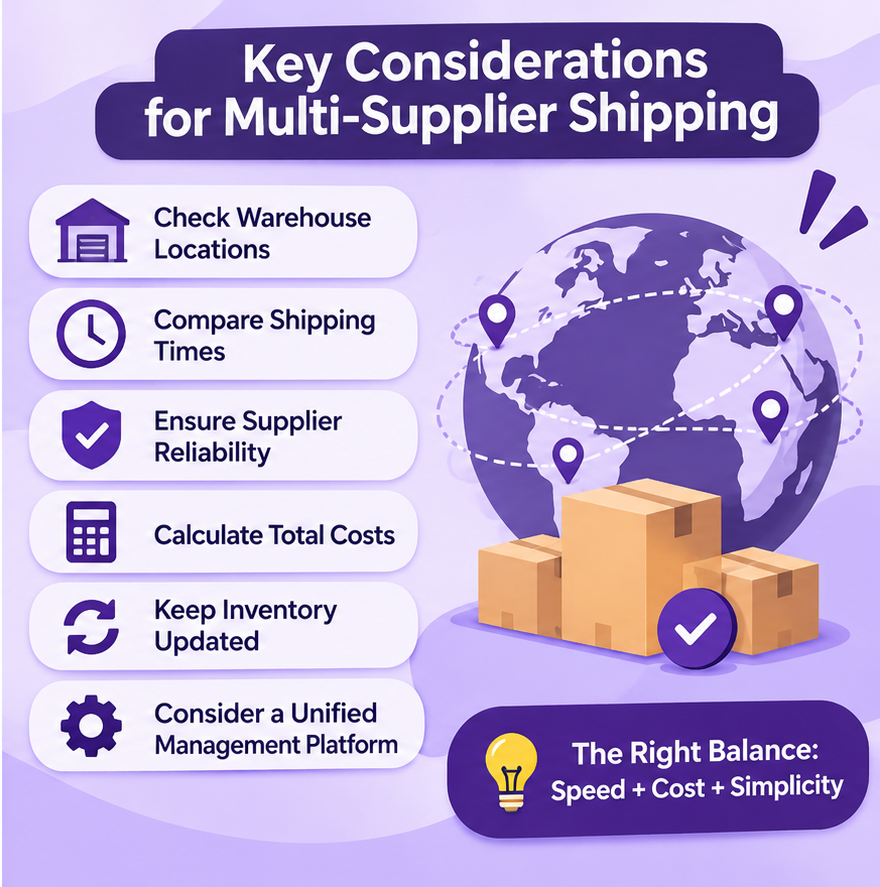
- Verify warehouse locations: Confirm where the product is physically stored before listing shipping estimates.
- Compare actual delivery times: Evaluate shipping estimates for specific products and destination countries.
- Check supplier reliability: Consider product quality, fulfillment consistency, customer support, and stock availability.
- Calculate total costs: Include product prices, shipping charges, payment fees, and other applicable expenses.
- Monitor inventory: Ensure that product availability is updated regularly.
- Test the fulfillment process: Place test orders where practical to understand the actual shipping experience.
- Communicate clearly with customers: Provide realistic delivery estimates and tracking information.
- Avoid unnecessary complexity: Choose a fulfillment system that matches the business’s current size and order volume.
These practices can help store owners make better decisions and create a more reliable shopping experience for customers across different countries.
Conclusion
The discussion about using different dropshipping suppliers for customers in the United States and the Middle East highlights an important challenge in international e-commerce: faster shipping is desirable, but achieving it through multiple suppliers can introduce operational complexity.
Although location-based supplier selection may help improve delivery times when regional inventory is available, suppliers do not necessarily maintain products in every region. Shipping times may also vary depending on product availability, warehouse location, customs procedures, and transportation arrangements.
For beginners, using a single reliable supplier may be the simplest approach when delivery times are reasonable. As the business grows, store owners can explore regional warehouses, alternative suppliers, and centralized fulfillment systems to improve efficiency.
The best dropshipping strategy is not necessarily the one with the most suppliers, but the one that balances delivery speed, cost, reliability, inventory management, and simplicity.

0 Comments