Building Structured Product Data for Global Inventory
The growth of ecommerce has made it easier than ever for businesses to sell products online. However, selling everyday consumer products is very different from selling industrial, commercial, and technical equipment.
A customer shopping for a shirt may only need to know its size, color, and material. A business purchasing an electrical transformer, switchgear, safety equipment, machinery, or construction component may need to know dozens of technical specifications before making a purchasing decision.
This difference creates an important challenge for ecommerce platforms that want to support B2B industrial and commercial marketplaces.
The discussion behind this proposal focuses on how Shopify could become more useful for this type of marketplace by introducing category-based structured product attributes. The idea is to make technical product information consistent, searchable, comparable, and easier for buyers and sellers to manage.
The proposal becomes particularly important when multiple suppliers are selling similar products through the same marketplace. If every supplier describes products differently, buyers may struggle to find the exact equipment they need.
Why Industrial Ecommerce Is Different
Industrial ecommerce operates differently from traditional online retail.
When purchasing consumer products, shoppers often make decisions based on appearance, price, reviews, brand, and basic specifications.
Industrial buyers usually have much more specific requirements.
For example, someone purchasing a transformer may need to know:
- Voltage
- KVA rating
- Phase
- Frequency
- Installation type
- Enclosure rating
- Physical dimensions
- Material
- Condition
- Manufacturing year
- Location
- Availability
Similarly, a buyer looking for safety equipment may need information about material, protection rating, size, application, certification, and intended environment.
If this information is stored only in free-form descriptions, finding products becomes difficult.
Two suppliers might sell nearly identical products but describe the specifications differently.
One supplier might write “100 KVA,” another might write “100kVA,” while another might include the information only inside a long product description.
To a human reader, these may appear equivalent.
To an automated search or filtering system, however, inconsistent information can make the products much harder to discover and compare.
This is where structured attributes become important.
What Are Category-Based Structured Attributes?
The basic proposal is that product categories should determine which technical fields are available to merchants.
Instead of giving every product the same generic collection of fields, the platform could provide attributes appropriate to the selected category.
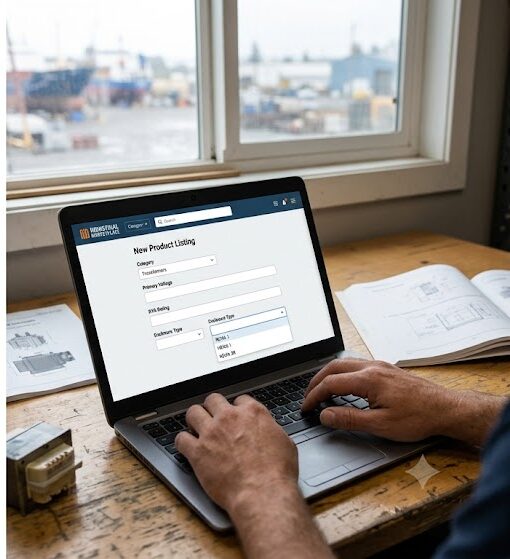
For example, a transformer category might contain fields such as:
- Power rating
- Primary voltage
- Secondary voltage
- Phase
- Frequency
- Cooling type
- Enclosure information
- Dimensions
- Weight
A switchgear category could have different attributes:
- Voltage rating
- Current rating
- Number of poles
- Protection rating
- Mounting type
- Enclosure type
Office equipment would require an entirely different set of fields.
This category-specific approach would make product information more organized and useful.
Instead of asking sellers to invent their own terminology, the marketplace could provide a consistent structure.
Why Standardization Matters in a Multi-Supplier Marketplace
Standardization becomes especially important when several suppliers sell products within the same marketplace.
Imagine that ten suppliers sell electrical equipment.
Supplier A describes a product using one terminology. Supplier B uses another. Supplier C leaves some specifications inside the description. Supplier D uses abbreviations that are familiar to industry professionals but different from those used by other suppliers.
A buyer searching for a particular technical specification may not discover every relevant product.
A standardized structure could solve much of this problem.
If every seller provides the same core attributes for a category, buyers can search and filter products according to those fields.
This could create a marketplace where products from different suppliers are easier to compare.
The benefit is not limited to buyers.
Suppliers would also have clearer guidelines for creating listings, reducing inconsistent product information.
Improving Search and Product Discovery
Search is one of the most important components of any marketplace.
A marketplace containing thousands or millions of industrial products cannot depend entirely on customers reading product descriptions one by one.
Buyers need to narrow the catalog based on technical requirements.
For example, a buyer might want:
Transformer → 500 KVA → Three-phase → Specific voltage range
Instead of searching through hundreds of listings manually, the marketplace could allow buyers to select these requirements using structured filters.
The same principle could work across different industries.
A construction buyer could filter equipment by dimensions, capacity, material, or condition.
A manufacturing company could search machinery according to production capacity, power requirements, dimensions, or year.
A commercial buyer could filter office equipment based on size, function, capacity, or configuration.
The more consistent the underlying product data is, the more useful these filters become.
Product Comparison Becomes Easier
Structured attributes can also improve product comparison.
Suppose a buyer finds five industrial machines from different suppliers.
If each listing uses a different format, the buyer may have to open every product page and manually compare specifications.
With standardized attributes, the marketplace could present comparable information in a consistent format.
For example:
| SpecificationProduct AProduct BProduct C | |||
| Capacity | 500 units/hour | 600 units/hour | 450 units/hour |
| Power | 20 kW | 25 kW | 18 kW |
| Material | Steel | Steel | Aluminum |
| Condition | New | Refurbished | New |
The buyer can understand the differences much more quickly.
This is particularly valuable in B2B purchasing because product decisions often depend on technical compatibility rather than appearance.
The Importance of This Model for Global Inventory
The proposal also highlights a major opportunity involving surplus industrial inventory.
Industrial equipment can be expensive and may have long manufacturing lead times.
A company may need a particular component immediately but discover that the manufacturer requires several weeks or months to produce it.
At the same time, another company somewhere else in the world may already have the same equipment sitting unused in a warehouse.
This creates an opportunity for a global marketplace for surplus inventory.
Instead of manufacturing a new item, buyers could potentially locate an existing item that is already available.
However, this model requires highly detailed inventory information.
A buyer needs to know not just what the product is, but exactly what specifications it has, where it is located, what condition it is in, and whether it meets the required technical standards.
Structured product information could make this type of global inventory discovery significantly easier.
Making Supplier Onboarding More Consistent
A large marketplace also needs a reliable supplier onboarding process.
If suppliers can freely enter information in any format they want, product data can quickly become inconsistent.
A category-based structure could provide suppliers with predefined requirements.
For example, when a supplier selects an industrial equipment category, the marketplace could ask for the important specifications associated with that category.
Required fields could ensure that critical information is not missing.
Optional fields could allow suppliers to provide additional technical details.
This would make supplier listings more consistent from the beginning.
It could also reduce the amount of manual work required to clean and standardize product information later.
Marketplace Governance
A B2B industrial marketplace also needs governance.
Technical products can involve safety, compatibility, regulatory, and financial considerations.
Therefore, a marketplace needs mechanisms for maintaining listing quality.
Governance could involve:
- Required technical information
- Supplier verification
- Product data validation
- Category-specific listing rules
- Condition declarations
- Location information
- Inventory status
- Documentation requirements
- Rules for updating outdated listings
The objective would be to create a marketplace where buyers can understand exactly what they are purchasing.
Structured information provides the foundation for these governance processes.
Inventory Synchronization
Another important requirement is inventory synchronization.
Industrial suppliers may have inventory stored in warehouses across different locations.
Some products may also be listed in multiple sales channels.
If inventory information is not updated properly, a product could remain available online even after it has been sold elsewhere.
This can create serious problems in B2B transactions.
A marketplace designed for global industrial inventory would therefore need reliable inventory updates.
Product availability could include information such as:
- Quantity available
- Warehouse location
- Reserved quantity
- Available-to-sell quantity
- Expected replenishment
- Last inventory update
- Product condition
Keeping this information accurate becomes increasingly important as the marketplace grows.
Automated Commissions and Payouts
A multi-supplier marketplace also needs a way to handle money between buyers, suppliers, and the marketplace operator.
If a marketplace takes a commission from each transaction, the system needs to calculate the appropriate amount and distribute the remaining funds to the supplier.
For example, if an industrial product sells for $20,000 and the marketplace commission is a predetermined percentage, the system would need to calculate the marketplace’s share and the supplier’s payout.
For high-value industrial transactions, transparent financial processes are particularly important.
Suppliers need to understand when they will be paid and how commissions are calculated.
Buyers need confidence that transactions are processed correctly.
The Role of Existing Product Customization
The discussion acknowledges that some existing product customization capabilities can serve as a temporary solution.
Merchants can currently create additional product information fields and organize product data according to their requirements.
This can help businesses create category-specific information.
For a small catalog, manually maintaining these fields may be manageable.
However, as a marketplace grows, maintaining hundreds or thousands of product attributes manually can become increasingly difficult.
A built-in category-specific structure could make the process more scalable.
The distinction is important:
A workaround can help a business operate today, while native marketplace infrastructure could make the model easier to operate at scale.
The Challenge of High-Value Industrial Products
One of the more recent concerns mentioned in the discussion relates to advertising expensive industrial and construction surplus equipment.
Industrial marketplaces can contain products worth tens of thousands of dollars or significantly more.
A product advertising limit can therefore become a practical obstacle if the platform’s commerce or promotional infrastructure is designed primarily around lower-priced consumer products.
For example, a construction company may need a large piece of equipment worth far more than the typical consumer purchase.
If the platform places a $50,000 USD price limit on products promoted through its shopping environment, sellers of equipment above that threshold may face restrictions in promoting those products through that channel.
This does not necessarily prevent the products from being sold through other methods, but it can limit how effectively they can be promoted within the ecosystem.
For a global industrial marketplace, pricing infrastructure needs to account for the fact that B2B products can have extremely high transaction values.
Why Structured Data Is the Foundation
At first glance, category-based attributes may seem like a small product feature.
In reality, they can become the foundation of a much larger marketplace system.
Structured product information can support:
Search — Buyers can locate products based on technical requirements.
Filtering — Buyers can narrow thousands of products using category-specific specifications.
Comparison — Similar products can be evaluated using the same fields.
Supplier onboarding — Sellers know what information they need to provide.
Inventory management — Product availability can be associated with structured records.
Marketplace governance — Required information can improve listing quality.
Global discovery — Buyers can find surplus inventory based on technical specifications rather than inconsistent descriptions.
Without consistent product data, each of these functions becomes more difficult.
A Possible Future Marketplace Model
The broader proposal can be imagined as a complete B2B marketplace structure.
A supplier could register and select the relevant product category.
The marketplace would then provide category-specific fields.
The supplier enters the technical specifications, price, condition, location, and available quantity.
The product becomes searchable within a shared catalog.
Buyers can filter products according to technical requirements and compare listings from different suppliers.
When a purchase occurs, inventory is updated and the marketplace calculates the relevant financial distribution.
This model could support industries ranging from electrical equipment and construction materials to manufacturing machinery, safety supplies, office equipment, and commercial infrastructure.
Conclusion
The proposal for a stronger B2B industrial and commercial marketplace is ultimately about making complex products easier to discover and understand online.
Industrial buyers do not simply search for products by name. They often search according to highly specific technical requirements.
That means a marketplace needs more than product titles and descriptions.
It needs structured information.
Category-based attributes could provide a consistent foundation for technical specifications, helping suppliers create better listings and allowing buyers to search, filter, and compare products more efficiently.
This becomes even more important when multiple suppliers are involved. A shared marketplace catalog can only provide effective discovery if products from different sellers use comparable information.
The opportunity is particularly significant for surplus industrial inventory. Expensive equipment with long manufacturing lead times may already exist somewhere in the world, but buyers need a reliable way to discover it and determine whether it meets their requirements.
Existing product customization features can provide a temporary workaround, but a larger marketplace model would benefit from deeper native support for category-specific attributes, supplier governance, inventory synchronization, buyer filtering, and marketplace financial processes.
The discussion therefore represents more than a request for additional product fields. It describes a broader vision for how ecommerce infrastructure could support global B2B commerce involving complex, technical, and high-value products.
For such a marketplace, structured product data is not merely an administrative convenience. It is the foundation that connects suppliers, inventory, search, buyers, and transactions into a more organized commercial ecosystem.


0 Comments