What you’re experiencing is a very common but critical turning point in an eCommerce or product-based business. Starting with a single supplier is often the smartest and simplest decision in the early stages. It allows you to focus on building your product, validating demand, and managing operations without unnecessary complexity.
However, as your business grows, the same simplicity that once helped you becomes a potential risk. The recent disruptions caused by tariffs and supply chain instability have made this issue even more visible. Many businesses that relied on a single supplier suddenly found themselves unable to fulfill orders, leading to stockouts, lost revenue, and damaged customer trust.
This situation raises an important strategic question: When does supplier diversification become essential, and how can it be implemented without creating operational chaos?
📦 The Early Advantage of a Single Supplier
Starting with one supplier is not a mistake—it is actually a smart and efficient approach in the beginning.
Why it works well initially:
- You manage only one relationship
- Communication is clear and consistent
- Quality standards are easier to maintain
- Lead times are predictable
- Operations remain simple and manageable
For a new business, reducing complexity is crucial. A single supplier allows you to focus on marketing, sales, and customer experience instead of dealing with multiple moving parts.
⚠️ The Hidden Risk of Supplier Dependency
As your business grows, the risks of relying on a single supplier become more significant.
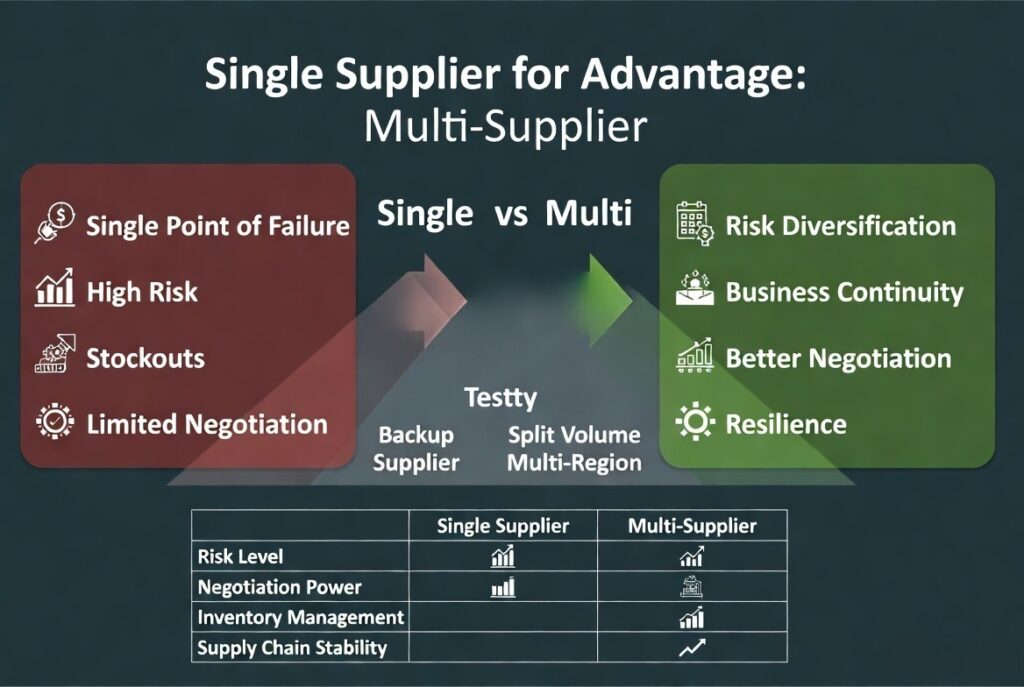
1. Single Point of Failure
If your only supplier faces delays, production issues, or external disruptions, your entire business is affected. You lose the ability to fulfill orders, which directly impacts revenue and customer satisfaction.
2. Inventory Fragility
With no backup source, even a small delay can lead to stockouts across all sales channels. This not only stops sales but can also affect your marketing campaigns, product rankings, and overall growth momentum.
3. External Risks (Tariffs & Global Events)
Recent tariff-related disruptions have shown how quickly external factors can impact supply chains. Costs can increase suddenly, shipments can be delayed, and suppliers may struggle to adapt.
4. Limited Negotiation Power
When you depend on a single supplier, you have less leverage in negotiations. Pricing, production timelines, and flexibility are largely controlled by the supplier.
📊 When Does Diversification Become Necessary?
There is no fixed revenue number where diversification becomes mandatory. Instead, the decision should be based on risk exposure and operational dependency.
✅ 1. Revenue Stability Indicator
If your business has reached a stage where:
- Revenue is consistent and growing
- A significant portion of income depends on one or two products
Then your risk level increases. At this point, relying on a single supplier becomes more dangerous because any disruption can significantly impact your earnings.
✅ 2. Inventory Risk Indicator (Most Important)
A more practical way to evaluate the need for diversification is to assess your inventory risk.
Ask yourself:
- Would a single delay stop most of my sales?
- Do I have no backup stock or alternative supplier?
If the answer is yes, diversification is no longer optional—it is necessary.
✅ 3. Product Category Risk
Certain product categories are inherently more vulnerable to supply chain disruptions.
High-risk categories:
- Trend-driven products with sudden demand spikes
- Seasonal products with limited selling windows
- Fast-selling items with high turnover
- Products with long manufacturing or shipping times
Lower-risk categories:
- Stable, evergreen products
- Locally available or easily replaceable goods
In many cases, product category risk plays a bigger role than revenue size in deciding whether to diversify.
🧠 Key Insight
The decision to diversify is not about how big your business is—it is about how exposed your business is to risk.
If one supplier controls your entire operation, your business is fragile. Diversification is about building resilience.
🔄 A Practical Approach to Supplier Diversification
Diversifying suppliers does not mean adding multiple suppliers overnight. Doing so can create confusion, quality issues, and operational inefficiencies.
Instead, follow a structured and gradual approach.
Step 1: Introduce a Backup Supplier
Start by identifying a second supplier who can act as a backup. This supplier does not need to handle daily operations immediately.
Purpose:
- Provide support during delays or emergencies
- Reduce dependency on a single source
Step 2: Test and Validate
Before relying on a new supplier, conduct proper testing:
- Order product samples
- Compare quality with your current supplier
- Evaluate shipping times and packaging
This ensures that the backup supplier meets your standards.
Step 3: Gradual Volume Distribution
Once the new supplier is validated, begin splitting your order volume.
Example:
- 70% orders → primary supplier
- 30% orders → secondary supplier
This reduces risk while maintaining operational stability.
Step 4: Multi-Region Strategy
If possible, work with suppliers in different regions. For example:
- One supplier in Asia
- One supplier in the UK, EU, or local market
This protects your business from region-specific disruptions such as tariffs, shipping delays, or regulatory changes.
🏭 Managing Quality Across Multiple Suppliers
One of the biggest concerns with diversification is maintaining consistent product quality.
✅ 1. Standardize Product Specifications
Create a detailed product specification document that includes:
- Materials
- Dimensions
- Weight
- Packaging requirements
- Branding elements
All suppliers must follow these exact specifications.
✅ 2. Sample Comparison
Order samples from each supplier and compare them carefully. Look for differences in:
- Build quality
- Packaging
- Finish and detailing
Only approve suppliers that meet your standards.
✅ 3. Quality Control Checklist
Develop a checklist to evaluate suppliers:
- Consistency in product quality
- Delivery reliability
- Communication responsiveness
- Packaging standards
✅ 4. Start with Small Orders
Do not shift large volumes immediately. Start with small batches and monitor performance.
✅ 5. Third-Party Inspections (Advanced Stage)
As your business scales, consider using third-party inspection services to verify product quality before shipment.
⚙️ Managing Operational Complexity
Diversification can increase complexity, but it can be controlled with proper systems.
Simplification Strategies:
1. Define Supplier Roles
Assign clear roles:
- Primary supplier → main operations
- Secondary supplier → backup or overflow
2. Maintain Safety Stock
Keep a small buffer inventory to handle unexpected delays.
3. Use Technology and Automation
Implement tools to:
- Track inventory levels
- Manage orders
- Sync stock across suppliers
📈 Real-World Scenario
Let’s compare two situations:
Scenario A: Single Supplier
- Supplier delay: 10 days
- Result:
- Stockout
- No sales
- Ads paused
- Customer complaints
Scenario B: Two Suppliers
- Supplier A delay: 10 days
- Supplier B active
Result:
- Partial fulfillment continues
- Reduced impact on revenue
- Business remains operational
👉 This clearly shows how diversification reduces risk.
🚨 When Diversification Becomes Non-Negotiable
You must diversify if you notice:
- Frequent stockouts
- Dependence on a single product or supplier
- Inconsistent lead times
- External risks like tariffs or shipping delays
- Revenue loss due to supply issues
If two or more of these apply, diversification should be implemented immediately.
⚖️ Balancing Simplicity and Stability
| Approach | Advantage | Risk |
| Single Supplier | Simple operations | High risk |
| Multi Supplier | Greater stability | More complexity |
The goal is to find a balance where your operations remain manageable while reducing risk.
🧭 Final Recommendation
Based on your situation:
Avoid:
- Relying entirely on one supplier
- Adding too many suppliers at once
Follow This Approach:
- Add one backup supplier
- Test thoroughly before scaling
- Gradually split order volume
- Standardize quality requirements
- Monitor supplier performance regularly
🏁 Final Thought
What you are experiencing is not a problem—it is a sign that your business is evolving.
You are moving from:
👉 Managing operations
to
👉 Building a resilient and scalable system
This is a crucial transition for long-term success.
🔑 The Real Answer
There is no fixed revenue threshold for diversification. The decision depends on:
- Risk exposure
- Product category
- Supply chain reliability
Diversification becomes essential when your business can no longer afford a single point of failure.
By taking a strategic and gradual approach, you can protect your business from disruptions while maintaining quality and operational efficiency.