Managing product catalogs has become one of the most time-consuming parts of running an online store.
For many merchants, agencies, and catalog managers, launching products is not simply about sourcing inventory or building a storefront. One of the biggest operational challenges happens long before a customer sees the product page:
organizing product information.
Businesses often receive supplier data in formats that are difficult to use directly.
Examples include:
- plain text documents
- spreadsheets with inconsistent formatting
- product specification files
- supplier catalogs
- bulk inventory exports
- PDF documents
- mixed-language content
- incomplete product descriptions
Instead of immediately publishing products, teams frequently spend hours—or even days—cleaning, rewriting, formatting, and optimizing information.
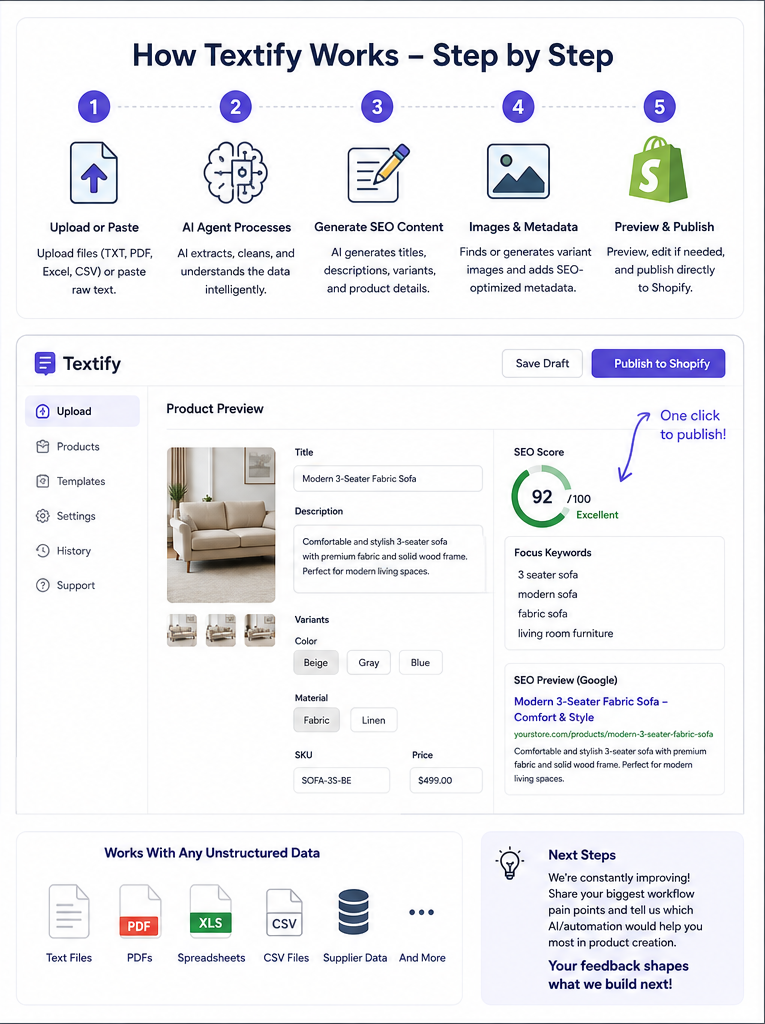
The concept discussed above introduces an approach designed to reduce that manual workload by transforming unstructured content into product listings that are organized, searchable, and prepared for publishing.
At its core, the idea is not simply about generating text.
It is about creating a more efficient workflow for product creation while maintaining consistency, structure, and search visibility across large catalogs.
Let’s explore why this challenge exists, why catalog preparation consumes so much time, and why businesses increasingly want more intelligent systems for product creation.
The Hidden Work Behind Product Publishing
From the outside, adding products to an online store may appear simple.
Customers usually see:
- product title
- images
- description
- pricing
- variants
- availability
But internally, preparing this information often requires significant effort.
A typical catalog upload process may involve:
Collecting supplier data.
Cleaning inconsistent formatting.
Creating product names.
Writing descriptions.
Organizing specifications.
Preparing variants.
Uploading images.
Optimizing content for search.
Reviewing everything before publishing.
When multiplied across hundreds or thousands of products, the workload grows quickly.
Why Supplier Data Is Often Difficult to Use
Many suppliers organize information for operational efficiency rather than storefront presentation.
As a result, product files frequently contain:
- technical terminology
- missing descriptions
- inconsistent formatting
- duplicate information
- incomplete specifications
- unclear naming structures
For example:
One supplier may send:
Product Name
Color
Weight
Dimensions
Another may send:
SKU codes
internal abbreviations
spreadsheet notes
Another may provide:
large PDF catalogs.
None of these formats are ideal for direct publishing.
The Challenge of Unstructured Information
Unstructured information refers to data that lacks consistent organization.
Unlike neatly formatted product records, unstructured files often contain:
paragraphs
tables
mixed formats
extra notes
supplier instructions
multiple languages
This creates extra manual work.
Teams must interpret information before publishing.
Why Product Creation Becomes Repetitive
Catalog expansion often involves repeating similar tasks.
Examples include:
rewriting titles
creating bullet points
adding specifications
formatting descriptions
creating product variations
preparing metadata
After hundreds of products, repetition becomes expensive.
Manual workflows slow growth.
Why Consistency Matters in Product Catalogs
Customers expect catalogs to feel organized.
Inconsistent product pages create problems.
Differences in:
format
tone
layout
naming
specifications
can reduce trust.
Consistency improves:
- professionalism
- readability
- navigation
- conversion potential
Standardized workflows help maintain quality.
The Growing Importance of Search Visibility
Search visibility has become a major factor in product discovery.
Product pages increasingly compete for attention.
Customers often discover products through:
search engines
marketplace search
category pages
internal site search
Content structure affects discoverability.
What Makes Product Content Search Friendly
Search-friendly content is not simply long descriptions.
Strong product pages usually include:
clear titles
organized details
relevant terminology
structured information
useful descriptions
clean formatting
This improves visibility and usability.
Why Large Catalog Businesses Face Bigger Challenges
Small stores may upload products manually.
Large catalogs create different problems.
Imagine:
100 products.
Now imagine:
50,000 products.
Manual optimization becomes difficult.
Businesses need scalable systems.
Why Bulk Catalog Work Often Delays Launches
Catalog preparation frequently becomes a bottleneck.
Businesses may already have:
inventory
pricing
supplier relationships
But products remain unpublished because content is unfinished.
Delayed catalog preparation slows revenue generation.
The Need for Faster Product Workflows
Businesses increasingly want workflows that reduce repetitive work.
Desired improvements often include:
faster uploads
less copying
fewer manual edits
more standardization
greater accuracy
The goal becomes helping teams focus on decisions instead of repetitive formatting.
Why Product Variants Add Complexity
Variants multiply catalog workload.
A single product may include:
colors
sizes
materials
bundles
regional versions
Each variation requires organized information.
Variant management becomes difficult when source data is inconsistent.
Why Images Matter Alongside Text
Product images influence both customer confidence and catalog quality.
Businesses managing large inventories often face challenges:
finding visuals
matching variants
maintaining consistency
organizing metadata
Image preparation becomes another operational layer.
Why Metadata Is Becoming More Important
Metadata refers to structured information attached to content.
Examples include:
titles
descriptions
categories
keywords
attributes
organized metadata improves:
searchability
catalog organization
customer navigation
Why Preview and Editing Remain Important
Automation alone rarely produces perfect results.
Businesses still want review processes.
Common expectations include:
preview content
make edits
adjust wording
approve changes
maintain brand standards
Human review remains valuable.
Why Merchants Want Flexible Editing
Different businesses prioritize different outcomes.
Some focus on:
speed
Others prioritize:
brand tone
Others emphasize:
technical accuracy
Flexible workflows allow teams to maintain control.
Why Agencies Benefit From Catalog Efficiency
Catalog agencies often manage multiple stores.
Challenges include:
different industries
different supplier formats
different languages
Reducing repetitive work improves efficiency across projects.
Why Freelancers Face Similar Challenges
Independent operators often manage:
small budgets
tight timelines
multiple responsibilities
Reducing manual catalog work allows more focus on growth activities.
Why Language Flexibility Matters
Modern commerce increasingly operates internationally.
Businesses may publish products across:
multiple regions
multiple customer groups
multiple languages
Content workflows become more complicated.
Consistency becomes harder to maintain manually.
Why Standardization Reduces Errors
Manual catalog work often creates:
missing specifications
duplicate entries
incorrect formatting
variant mistakes
Standardized workflows reduce variability.
The Relationship Between Speed and Quality
Businesses often assume speed reduces quality.
But structured workflows aim to improve both.
Good systems help teams:
move faster
maintain consistency
reduce repetitive effort
Quality still depends on review.
Why Product Operations Are Becoming Strategic
Catalog management used to feel administrative.
Today it affects:
customer experience
conversion rates
search visibility
operational speed
business growth
Product operations increasingly influence competitive advantage.
Why Faster Publishing Creates Opportunity
Reducing catalog preparation time helps businesses:
launch faster
test more products
expand categories
respond to market demand
Speed creates flexibility.
Why Businesses Still Need Oversight
Even advanced workflows require validation.
Businesses still need to confirm:
accuracy
brand alignment
product details
pricing
customer expectations
Efficiency should support decision-making—not replace it.
Why Catalog Quality Impacts Customer Trust
Customers notice poor product pages quickly.
Common issues include:
unclear descriptions
missing details
low-quality formatting
inconsistent product information
Better product preparation improves confidence.
The Bigger Shift in Commerce Operations
This discussion reflects a larger trend.
Businesses increasingly want systems that:
reduce repetitive work
organize information
accelerate publishing
improve consistency
support growth
Catalog creation is becoming more intelligent and process-driven.
Why Workflow Design Matters
The strongest product operations often focus less on producing content and more on designing efficient workflows.
Good workflows reduce:
manual effort
operational delays
catalog inconsistencies
This allows teams to spend more time improving products and serving customers.
Final Thought
Transforming raw files and unstructured information into organized product listings reflects a growing need in modern commerce.
Businesses no longer struggle only with obtaining products.
They increasingly struggle with preparing, organizing, and publishing information efficiently.
Reducing repetitive catalog work can improve:
speed
consistency
search visibility
operational scalability
But long-term success still depends on balancing efficiency with thoughtful review and strong customer communication.
Conclusion
The idea of converting raw supplier files and unstructured content into organized, search-friendly product listings highlights an important evolution in commerce operations.
Modern businesses increasingly manage large catalogs across multiple markets and customer groups.
Manual product preparation creates bottlenecks that slow growth and increase operational complexity.
By creating more structured workflows, businesses can:
reduce repetitive tasks
publish faster
improve catalog consistency
maintain better product organization
support long-term scalability
As commerce continues evolving, product creation is becoming less about manual entry and more about building efficient systems that transform information into customer-ready experiences.