A Practical Guide to Testing Ecommerce Products
Starting an ecommerce business in India often creates a difficult question for new sellers: How much inventory should you purchase for your first product test?
Buying too little can create stock shortages just when a product starts receiving orders. Buying too much can leave you with a large amount of unsold inventory if customers do not respond well to the product.
This decision becomes even more important in India because cash on delivery (COD) remains an important part of ecommerce purchasing behavior. A customer placing an order does not always mean that the sale will become actual revenue. The order still needs to be confirmed, shipped, delivered, and successfully received. Some orders may be cancelled, refused, or returned to the seller.
Because of this, the first inventory batch should not simply be based on how many products you think you can sell. It should be based on testing, actual order data, delivery performance, supplier lead time, and financial risk.
The discussion behind this topic focuses on an important principle: your first inventory purchase should help you learn about the product without exposing too much of your money.
Why the First Inventory Batch Is So Important
When launching a new product, there is usually uncertainty around almost everything.
You may not know how many people will be interested in the product. You may not know how many visitors will actually place orders. You may not know how many customers will accept their COD orders. You may also be uncertain about the return rate, shipping costs, product quality, or the supplier’s ability to replenish stock quickly.
This makes a large initial inventory purchase risky.
For example, imagine that a seller believes a product will become popular and purchases 1,000 units at once. The supplier offers a lower price because of the larger quantity.
On paper, this looks attractive.
However, after testing the product, the seller discovers that customers are not responding well. Advertising costs are high, confirmed orders are low, and a significant percentage of COD orders are returned.
The seller is now holding hundreds of units that may take months to sell.
The lower purchase price per unit does not necessarily make the decision cheaper.
The real cost includes the money locked into inventory, storage, shipping, returns, and the opportunity cost of having capital unavailable for other products.
This is why total financial risk is often more important than the lowest possible per-unit price.
Start Small Instead of Buying for the Best Unit Price
A common mistake among new ecommerce sellers is to focus heavily on getting the lowest possible product cost.
A supplier might offer one price for 50 units, a lower price for 500 units, and an even lower price for 1,000 units.
It can be tempting to immediately choose the larger quantity because the unit economics appear better.
But when you are testing a completely new product, you are not only buying inventory. You are also buying information.
A small initial batch allows you to discover:
- Whether customers actually want the product
- How many orders your advertising generates
- How many orders are successfully confirmed
- How many customers receive the product
- How many COD orders become RTO
- How much it costs to acquire an order
- Whether the product generates a sustainable profit
- Whether customers are satisfied with the product
Once you have this information, you can make a much more informed inventory decision.
The objective of the first batch is therefore not necessarily to maximize profit.
The objective is to validate the product while limiting downside risk.
The Difference Between an Order and a Successful Sale
This distinction is particularly important when selling through COD.
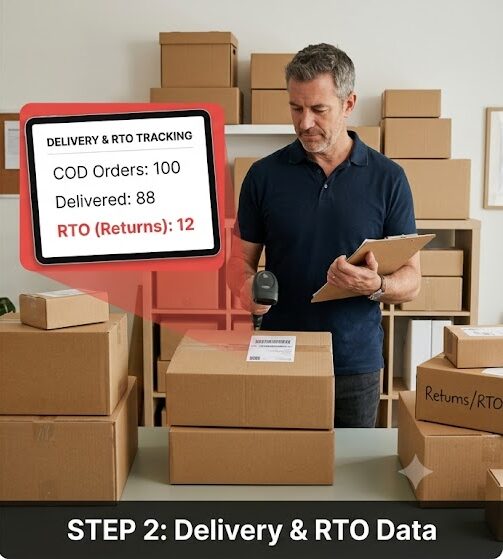
Suppose your store receives 100 COD orders.
It would be incorrect to assume that you have made 100 successful sales.
Some customers may not confirm their orders. Some may cancel before shipping. Some may refuse delivery. Others may not be available when the delivery is attempted.
Eventually, some of these orders may return to you.
This is known as return to origin, or RTO.
For inventory planning, you should therefore look beyond the number of orders placed.
A useful progression is:
Orders received → Confirmed orders → Shipped orders → Delivered orders → Successful sales
Tracking these stages gives you a clearer understanding of actual demand.
For example, suppose your first test produces:
- 100 orders
- 85 confirmed orders
- 80 shipped orders
- 60 delivered orders
- 20 RTO orders
The original figure of 100 orders might make the product appear extremely successful.
But the delivered-order figure tells a different story.
This is why inventory decisions should be based on actual operating data rather than excitement generated by initial order numbers.
Using Actual Sales Data to Estimate Inventory
One practical approach discussed in the community is to calculate your inventory requirement from the product’s actual order rate.
A simple starting point is:
Daily confirmed orders × Supplier reorder lead time + Small safety buffer
Suppose your product is receiving an average of 10 confirmed orders per day.
Your supplier requires 7 days to replenish your stock after you place a new order.
Your basic inventory requirement would therefore be:
10 × 7 = 70 units
You would then add a small buffer to account for products temporarily tied up in delivery, RTO processing, unexpected increases in demand, or minor supplier delays.
The exact buffer depends on the business.
The important point is that the inventory requirement is being calculated from real demand and replenishment time, rather than an arbitrary number.
Understanding Supplier Reorder Lead Time
Supplier lead time is one of the most important variables in inventory planning.
Lead time means the amount of time between placing a replenishment order and actually receiving the new stock.
For example, if your supplier can deliver new inventory within three days, you may not need to maintain a very large stock level.
If the supplier requires two or three weeks, you need more inventory to prevent stockouts.
Consider two sellers who both receive 10 confirmed orders per day.
Seller A can replenish inventory within three days.
Seller B needs fifteen days.
Their inventory requirements are very different.
Seller A may need approximately:
10 × 3 = 30 units
Seller B may need:
10 × 15 = 150 units
Therefore, the correct inventory quantity cannot be determined without considering the supplier’s ability to replenish stock.
Why a Small Buffer Matters
Inventory planning based only on daily orders and supplier lead time can still create problems.
Products are not always moving through the delivery system immediately.
Some units may already be shipped but not yet delivered. Some may be travelling back because of RTO. Unexpected demand may temporarily increase order volume. Suppliers can also experience delays.
This is why maintaining a small buffer can be useful.
The buffer should not be unnecessarily large.
Remember, the purpose of the buffer is to protect against normal uncertainty, not to justify purchasing a huge quantity of untested inventory.
A controlled buffer gives the seller some breathing room while keeping financial exposure manageable.
RTO Is a Critical Metric in the Indian Ecommerce Market
For COD-heavy businesses, RTO deserves special attention.
A COD order can create expenses even when the customer ultimately does not accept the package.
Depending on the business model, costs may include product handling, forward shipping, return shipping, packaging, and other operational expenses.
This means that a product with a high number of orders may still be financially unattractive if too many orders become RTO.
For example, Product A might generate 100 orders but only 65 successful deliveries.
Product B might generate 80 orders but achieve 72 successful deliveries.
Looking only at order volume could make Product A appear stronger.
Looking at successful deliveries and total costs provides a more complete picture.
Therefore, before increasing inventory, sellers should understand not only how many orders they receive, but also how many orders become successful deliveries.
Track the Numbers Before Scaling
A product test becomes much more useful when the seller records the important numbers.
At minimum, track:
- Advertising spend
- Orders received
- Confirmed orders
- Delivered orders
- RTO orders
- Product cost
- Forward shipping cost
- Return shipping cost
- Other operational costs
- Total revenue
- Overall profit or loss
These numbers allow you to understand whether the product is actually working.
For example, if you spend ₹10,000 on advertising and generate ₹30,000 in sales, that does not automatically mean you made ₹20,000.
You still need to account for product costs, shipping, returns, and other expenses.
The purpose of tracking is to calculate the real economics of the product.
Why Buying More Inventory Does Not Fix a Weak Product
Another important lesson is that inventory cannot solve a demand problem.
If customers are not interested in a product, purchasing 1,000 additional units will not make the product successful.
In fact, it can make the situation worse.
A seller may feel committed to selling the inventory simply because money has already been invested in it. This can lead to additional advertising expenditure, discounts, and storage costs.
A small initial batch gives you the freedom to stop.
If the product performs poorly, you can limit the damage and move on to another product.
If it performs well, you have evidence to justify increasing the next order.
This creates a much safer testing cycle.
Small Batch Testing Is About Learning
The first inventory batch should be viewed as a learning stage.
You are testing several assumptions simultaneously:
Product assumption: Do customers actually want it?
Pricing assumption: Are customers willing to pay the selling price?
Marketing assumption: Can you generate orders at an acceptable cost?
Delivery assumption: Do customers successfully receive the product?
Supplier assumption: Can the supplier maintain quality and replenish inventory consistently?
Profitability assumption: Does the complete business model make financial sense?
You may discover that the product itself is good but the selling price is too high.
Or the advertising may generate many orders, but the RTO rate may be too high.
Or the product may sell well but the supplier may not be able to replenish it quickly.
These discoveries are valuable because they prevent larger mistakes later.
When Should You Increase the Inventory Quantity?
Scaling inventory should happen after you have sufficient evidence that the product is working.
A seller can look for consistent patterns rather than relying on one successful day.
For example, if confirmed orders remain stable, delivery performance is acceptable, RTO is manageable, supplier quality is consistent, and the product generates sustainable profit, a larger inventory purchase may become more reasonable.
The next order can then be based on actual sales velocity.
Instead of saying, “I think I can sell 500 units,” you can say:
“We are consistently selling approximately 15 confirmed units per day, and the supplier takes seven days to replenish stock.”
That is a much stronger foundation for inventory planning.
Avoid Making Inventory Decisions Based Only on Courses or Opinions
The discussion also highlights a broader lesson for new ecommerce sellers.
There is no single inventory number that works for every product or every business.
A quantity that works for one seller may be completely inappropriate for another.
The right quantity depends on:
- Product demand
- Selling price
- Product cost
- Supplier lead time
- Delivery performance
- RTO rate
- Advertising performance
- Available working capital
- Storage capacity
- Replenishment reliability
This means sellers should be careful about blindly following a fixed formula presented as a universal answer.
Actual business data is more useful.
Your own order history can tell you more about your product than a generic recommendation.
A Practical First-Batch Strategy
A simple approach can be divided into several stages.
Stage 1: Purchase a Limited Quantity
Start with an amount that allows you to test the product without putting a large portion of your capital at risk.
Stage 2: Run a Controlled Test
Generate enough traffic and orders to understand customer response, while keeping spending under control.
Stage 3: Track Confirmed and Delivered Orders
Do not treat every order as revenue. Track the complete journey from order placement to successful delivery.
Stage 4: Calculate RTO
Measure how many orders return and understand how those returns affect your overall economics.
Stage 5: Calculate Actual Profitability
Include product costs, advertising expenses, shipping, returns, and other relevant costs.
Stage 6: Measure Daily Sales Velocity
Once the product has enough data, calculate the average number of confirmed orders received per day.
Stage 7: Plan Replenishment
Use daily demand and supplier lead time to determine the stock required until your next inventory shipment arrives.
Stage 8: Add a Controlled Buffer
Maintain a reasonable additional quantity for delivery delays, RTO movement, supplier delays, and short-term demand fluctuations.
Stage 9: Scale Gradually
Increase purchase quantities as the data becomes more reliable.
The Goal Is Controlled Growth
Successful inventory management is not about always having the largest possible stock.
It is about having enough stock to support demand without unnecessarily locking up capital.
For a new ecommerce product, uncertainty is highest at the beginning. Therefore, financial exposure should generally be controlled during the early testing stage.
As uncertainty decreases through real sales data, inventory decisions can become more confident.
This creates a cycle:
Small test → Collect data → Understand demand → Measure delivery and RTO → Calculate profitability → Reorder → Scale gradually
This approach gives sellers an opportunity to learn before committing significant capital.
Conclusion
Choosing the first inventory batch for an ecommerce product in India is not simply a question of deciding how many pieces to buy.
It is a question of balancing demand, cash flow, supplier lead time, delivery performance, RTO, and financial risk.
A large order may reduce the per-unit purchase price, but that benefit can disappear if the product fails to generate enough successful sales.
A smaller initial batch may have a higher unit cost, but it can provide something equally valuable: flexibility.
The most practical approach is to start with controlled inventory, collect real order and delivery data, monitor RTO, calculate genuine profitability, and then use those results to determine future inventory requirements.
Once daily confirmed orders and supplier lead time are known, inventory planning becomes much more straightforward. The seller can estimate how much stock is needed during the replenishment period and maintain a small buffer for normal uncertainty.
The central lesson is simple:
Do not buy inventory based only on how cheap each unit becomes at a larger quantity. Buy based on what the business has actually learned about demand and risk.
For new ecommerce sellers, the first batch should not be about making the biggest possible commitment. It should be about making a controlled commitment that produces useful information.
That information can then become the foundation for smarter purchasing, better cash-flow management, and gradual business growth.


0 Comments