Starting an online business is exciting, but one of the first challenges many entrepreneurs face is understanding licensing requirements.
That challenge becomes even more confusing when legal categories seem to overlap.
The discussion above revolves around a common question for new business owners in the UAE:
If you operate a dropshipping store, what type of business license should you actually obtain?
The store owner discovered an activity classification under Information Technology that appeared to describe websites acting as portals between buyers and sellers.
Because dropshipping often involves connecting customers with suppliers rather than physically handling inventory, the description initially seemed relevant.
However, responses in the discussion pointed in different directions.
Some suggested an e-commerce license.
Others believed the portal classification might apply.
Another response shifted into software-related licensing concepts that did not directly answer the original question.
No final answer emerged.
But the conversation highlights something important:
licensing for online business models can become confusing because modern commerce often combines retail, technology, marketing, and fulfillment into one operation.
Understanding the differences matters before launching.
Let’s explore why this confusion happens and how business owners can think about licensing decisions more clearly.
Why Business Licensing Matters for Online Stores
Many new entrepreneurs assume that because a business operates online, licensing requirements become simpler.
In reality, online businesses still operate as real commercial entities.
Licensing helps define:
business activities
regulatory scope
tax obligations
commercial permissions
consumer protection responsibilities
operational legitimacy
The license category influences what activities a business is officially allowed to perform.
That makes selecting the correct classification important.
Why Dropshipping Creates Licensing Confusion
Dropshipping does not fit neatly into traditional business categories.
Traditional retail businesses usually:
buy inventory
store products
sell products
fulfill orders
Traditional marketplaces usually:
connect buyers and sellers
facilitate discovery
earn commissions
do not directly own products
Dropshipping combines elements of both.
A store may:
market products
collect customer orders
manage customer relationships
coordinate fulfillment externally
This hybrid structure creates uncertainty.
Understanding the Core Dropshipping Model
At its foundation, dropshipping is a fulfillment structure rather than a business category.
Customers purchase through the store.
The business coordinates delivery.
Inventory may be held elsewhere.
That distinction matters because licensing often focuses on:
who sells
who invoices
who owns customer relationships
who fulfills obligations
Why the Portal Classification Appeared Relevant
The business activity mentioned in the discussion described websites that:
connect buyers and sellers
display products
facilitate discovery
operate as intermediaries
At first glance, this resembles dropshipping.
That creates understandable confusion.
But operational details determine whether the classification actually fits.
Marketplace vs Merchant: The Important Difference
One of the biggest distinctions in online commerce is:
marketplace model
versus
merchant model
Marketplace:
Multiple sellers participate.
Transactions may happen between users.
The platform facilitates discovery.
Merchant:
One business sells directly to customers.
Customers transact with the business.
Even if fulfillment happens externally, the store may still act as merchant.
This distinction often influences licensing.
Why Inventory Ownership Is Not Always the Key Factor
Many people assume:
No inventory = no retail license.
But inventory ownership alone does not define commercial activity.
Businesses may still control:
pricing
marketing
customer support
refunds
order acceptance
Brand responsibility remains important.
Why E-Commerce Licensing Is Commonly Suggested
One response recommended an e-commerce license.
This recommendation reflects a broader business principle.
If the company operates an online storefront and sells products to customers, an e-commerce classification often appears more directly aligned.
The exact applicability depends on regulatory interpretation.
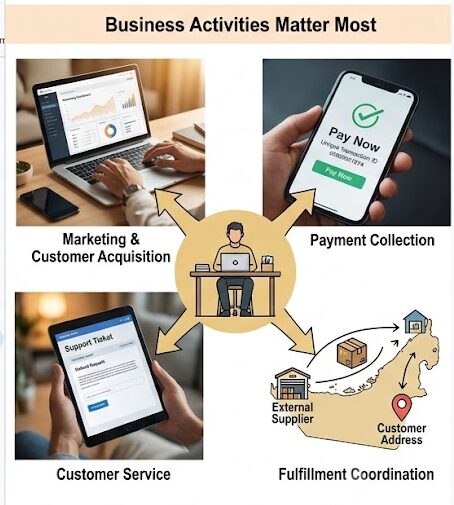
Why Business Activities Matter More Than Technology
Another reason entrepreneurs become confused is because they focus on platform technology.
Questions often become:
I sell through a website.
My supplier ships directly.
My storefront uses automation.
But regulators usually evaluate:
commercial activity
customer relationships
revenue generation
service delivery
Technology itself is not always the determining factor.
Why Product Type Can Affect Licensing
Business categories sometimes depend on what is being sold.
Examples may include:
consumer goods
industrial goods
digital products
health products
food items
regulated categories
Different product classes may create additional requirements.
Why Jurisdiction Selection Matters
Business licensing in the UAE may involve different jurisdictions.
Entrepreneurs often evaluate:
mainland operations
free zones
cross-border activity
international selling
Operational goals affect structure.
Why Entrepreneurs Should Think Beyond Launch Day
Many businesses choose licenses only for immediate needs.
But long-term plans matter.
Questions may include:
Will inventory be held later?
Will local fulfillment be added?
Will wholesale channels expand?
Will marketplaces be introduced?
Planning reduces future restructuring.
Why Definitions Around Brokerage Create Confusion
The discussion referenced brokerage-style descriptions.
Brokerage businesses typically:
facilitate transactions
earn commissions
do not become direct sellers
Dropshipping businesses often appear similar externally.
But operational responsibilities differ.
Understanding that distinction matters.
Why Customer Responsibility Matters
One useful way to think about licensing is:
Who does the customer believe they purchased from?
If customers:
contact the store
request refunds
expect support
trust the store
then operational responsibility may align differently than pure marketplace models.
Why Business Models Continue Evolving Faster Than Regulations
Modern commerce evolves rapidly.
Business models now combine:
retail
software
fulfillment
marketing
platform services
This creates gray areas.
Regulatory categories sometimes lag behind operational innovation.
Why Official Confirmation Is Important
One of the strongest conclusions from the discussion remains valid.
Community advice can provide direction.
But final confirmation should come from the appropriate authority.
Licensing decisions have long-term implications.
Why Misclassification Creates Risks
Operating under the wrong activity category may create challenges.
Examples include:
banking complications
compliance issues
operational restrictions
renewal challenges
commercial limitations
Correct setup reduces future friction.
Why Store Structure Influences Classification
Questions that may influence business structure include:
Do you own customer acquisition?
Do you collect payment?
Do customers interact only with your brand?
Do suppliers remain invisible?
Answers influence interpretation.
Why Software Licensing Advice Was Not Central
One reply moved into software and development concepts.
While useful in other contexts, that discussion appears separate from the licensing question.
Operating software and operating a commercial storefront are different topics.
This illustrates how online business discussions sometimes mix unrelated operational areas.
Why New Entrepreneurs Often Overlook Compliance
Many first-time founders focus on:
store design
marketing
products
advertising
Licensing feels administrative.
But proper foundations reduce operational stress later.
Why International Selling Adds Complexity
Selling internationally introduces additional considerations.
Businesses may need to think about:
cross-border fulfillment
tax obligations
customer jurisdiction
commercial rules
Growth changes requirements.
Why Documentation Matters
Once activity categories are identified, maintaining organized records supports smoother operations.
Examples include:
supplier agreements
operational descriptions
commercial scope
customer policies
Clear documentation helps support business decisions.
Why Long-Term Flexibility Matters
Business models often evolve.
A company may begin with:
pure dropshipping
Then expand into:
private inventory
hybrid fulfillment
wholesale
marketplace operations
Choosing adaptable structures may reduce friction.
The Bigger Lesson About Licensing
The discussion is not only about choosing a license.
It reflects a broader challenge facing modern entrepreneurs:
today’s online businesses rarely fit neatly into old categories.
Understanding what the business actually does operationally matters more than labels.
Final Thought
The conversation highlights an important lesson for anyone launching an online store in the UAE.
Dropshipping is not simply a website activity, a software activity, or a marketplace activity.
It is a business model whose licensing requirements depend on how operations are structured.
The most practical path is to evaluate:
who sells
who collects payment
who manages customers
who fulfills obligations
Then confirm those activities with the relevant licensing authority before launch.
Because the right business structure is not just about opening a store—
it is about creating a foundation that supports sustainable growth.
Conclusion
The licensing discussion reflects a common challenge faced by new online merchants.
While multiple interpretations emerged, the core takeaway remains clear:
business activity should guide licensing decisions—not assumptions about technology or fulfillment.
Before operating, entrepreneurs should verify:
commercial activity classification