Choosing the right supplier is one of the most important decisions in any product-based business. Whether a business sells online, operates a retail store, runs a wholesale operation, or manages a growing brand, supplier reliability directly affects customer satisfaction, profit margins, inventory planning, and long-term reputation.
A supplier is not simply a company that provides products. A supplier becomes part of the business operation. Their ability to maintain product quality, meet delivery deadlines, handle problems, and communicate clearly can determine whether a business runs smoothly or constantly faces customer complaints.
The discussion focuses on a simple but important question: what should business owners ask potential suppliers before placing an order? The early responses highlight three major areas: consistent product quality, reliable delivery timelines, and clear return or replacement policies. Although no complete checklist is provided, these points form the foundation of effective supplier screening.
Before committing money to inventory, business owners should gather detailed information, request written confirmation, and evaluate whether a supplier can support their business consistently. A low product price may look attractive at first, but poor quality, late shipments, damaged goods, or unclear policies can create larger costs later.
This article explains why supplier questions matter, what topics should be discussed before ordering, and how businesses can reduce risk when choosing suppliers.
Why Supplier Screening Is Important
Many businesses focus heavily on product selection, pricing, and marketing. These areas are important, but supplier performance often determines whether those efforts succeed.
A business may have a strong website, attractive product photos, and effective advertising. However, if products arrive late, damaged, incomplete, or inconsistent, customers may lose trust quickly.
Supplier problems can affect:
- Customer reviews
- Refund requests
- Return costs
- Inventory availability
- Cash flow
- Brand reputation
- Repeat purchases
- Advertising performance
For this reason, supplier selection should be treated as a strategic business decision rather than a simple purchasing task.
The Importance of Product Quality
The first major topic in the discussion is product quality.
A supplier may provide an excellent sample, but the quality of larger production batches may be different. This is why businesses should ask detailed questions about how quality is maintained over time.
Important questions include:
- Are products inspected before shipping?
- What quality checks are performed?
- How often are products tested?
- Can the supplier provide product specifications?
- Are materials consistent across batches?
- How are defects handled?
- Can the supplier provide photos or videos of the production process?
Consistent quality is especially important for products that customers use frequently or expect to last for a long time.
For example, a small defect in a decorative item may be disappointing but manageable. A defect in a baby product, electronic item, beauty product, or fragile item may create serious customer concerns.
Why Samples Are Not Enough
Many business owners request samples before placing a large order.
Samples are useful because they allow businesses to inspect product quality, packaging, size, materials, and overall appearance.
However, a sample should not be treated as a complete guarantee.
A supplier may send their best available item as a sample, while the final production batch may vary.
Businesses should ask whether the final order will match the approved sample.
It is also helpful to keep photos, notes, and measurements from the sample. These records can be used later if there is a disagreement about product quality.
Questions About Manufacturing Standards
Businesses should understand how products are made.
Questions may include:
- Where are the products manufactured?
- Is production handled in-house or outsourced?
- What materials are used?
- Are there quality standards in place?
- Are products tested before shipment?
- Can production details be shared?
These questions help businesses understand whether the supplier has control over the production process.
Suppliers who manufacture products directly may have more control over quality than suppliers who simply source from multiple factories.
However, both types of suppliers can be reliable if they communicate clearly and maintain good quality processes.
Delivery Reliability and Shipping Timelines
The second major issue raised in the discussion is shipping reliability.
Late deliveries can create serious business problems.
If inventory arrives late, a business may run out of stock. Customers may then receive delayed orders, cancel purchases, or leave negative reviews.
Shipping delays can also affect marketing campaigns.
For example, a business may launch a promotion expecting inventory to arrive before the campaign begins. If the shipment is delayed, the business may spend money attracting customers without having enough stock to fulfill orders.
Before placing an order, businesses should ask:
- What is the usual production time?
- What is the estimated shipping time?
- Are delivery timelines guaranteed?
- What causes delays?
- How are delays communicated?
- Which shipping methods are available?
- Can tracking information be provided?
Clear answers help businesses plan inventory more accurately.
Understanding Production Lead Times
Production lead time refers to the time required to prepare products before shipping.
This may include:
- Manufacturing
- Packaging
- Labeling
- Quality checks
- Customization
- Warehouse preparation
Lead times can vary depending on product type, order size, season, and supplier capacity.
Businesses should ask suppliers whether the lead time changes during busy periods.
For example, holidays, factory closures, and high-demand seasons can increase production delays.
A supplier may normally complete an order in two weeks but require six weeks during peak periods.
Knowing this in advance helps businesses avoid stock shortages.
Questions About Minimum Order Quantities
Minimum order quantity refers to the smallest quantity a supplier is willing to sell.
Some suppliers require large orders, while others allow smaller test orders.
Businesses should ask:
- What is the minimum order quantity?
- Can smaller trial orders be placed?
- Does the minimum quantity change for custom products?
- Are mixed product orders allowed?
- Are there discounts for larger orders?
For new businesses, smaller test orders can reduce risk.
Instead of investing heavily in untested products, businesses can begin with a limited quantity and evaluate customer demand.
Pricing and Payment Terms
Price is an important factor, but businesses should look beyond the basic product cost.
Before placing an order, they should understand all possible expenses.
Questions may include:
- What is the unit price?
- Are there discounts for larger orders?
- Are packaging costs included?
- Are shipping costs included?
- Are taxes or duties included?
- Are there additional handling fees?
- What payment methods are accepted?
- Is a deposit required?
Some suppliers request full payment before production begins. Others may accept a deposit followed by final payment before shipment.
Businesses should avoid making assumptions. Every cost should be confirmed in writing.
Packaging and Product Protection
Packaging is especially important for fragile, bulky, premium, or gift-oriented products.
Poor packaging can result in damaged goods, even if the product itself is well made.
Businesses should ask:
- How are products packaged?
- Are fragile items protected?
- Can custom packaging be added?
- Are labels included?
- Can branded inserts be added?
- Are packaging materials suitable for international shipping?
For fragile products, it may be useful to request photos or videos showing how items are packed.
This can help businesses evaluate whether the packaging is strong enough for transportation.
Return, Damage, and Replacement Policies
The discussion specifically emphasizes asking about return, damage, and replacement policies.
This is one of the most important areas to clarify before placing an order.
Problems may not appear during a sample order. Damage can occur during transportation, or a large batch may contain defects that were not visible in the sample.
Businesses should ask:
- What happens if products arrive damaged?
- What happens if products are defective?
- Does the supplier offer replacements?
- Does the supplier offer refunds?
- Who pays return shipping costs?
- How quickly are claims handled?
- What evidence is required?
These questions should be answered clearly and in writing.
Without written terms, suppliers may refuse responsibility after payment has been made.
Why Written Agreements Matter
Verbal promises are not enough.
Suppliers may communicate through messages, calls, or emails, but important terms should always be documented.
Written confirmation should include:
- Product specifications
- Quantity
- Price
- Delivery timeline
- Shipping method
- Payment terms
- Return policy
- Replacement policy
- Quality standards
Written agreements reduce confusion and provide evidence if problems occur later.
Communication Quality
A supplier’s communication style often reveals how they will handle future problems.
Before placing an order, businesses should evaluate:
- How quickly the supplier responds
- Whether answers are clear
- Whether they provide complete information
- Whether they avoid difficult questions
- Whether they are willing to share documents
Slow or unclear communication before an order may become worse after payment is made.
Reliable suppliers usually respond professionally and provide transparent information.
Asking About Inventory Availability
Some suppliers keep products in stock, while others manufacture products only after receiving an order.
Businesses should ask:
- Is the product currently in stock?
- How many units are available?
- How often is inventory updated?
- What happens if stock runs out?
- Can inventory be reserved?
This is important for businesses that rely on consistent availability.
A product may sell well, but if the supplier frequently runs out of stock, the business may struggle to meet customer demand.
Questions About Customization
Many businesses want to create a unique brand experience.
Customization options may include:
- Custom labels
- Branded packaging
- Logo printing
- Product color options
- Custom inserts
- Private labeling
Before ordering, businesses should ask:
- What customization options are available?
- What is the minimum order quantity for customization?
- How much does customization cost?
- How long does customization take?
- Can a sample be provided before full production?
Customization can help businesses stand out, but it may also increase cost and lead time.
Supplier Certifications and Compliance
Some products require safety testing, certifications, or compliance documents.
This is especially important for:
- Children’s products
- Electronics
- Cosmetics
- Food products
- Health-related products
- Protective equipment
Businesses should ask:
- Does the product meet required safety standards?
- Can certificates be provided?
- Are test reports available?
- Are materials safe for the intended use?
- Are products legally allowed to be sold in the target market?
Selling products without proper compliance can create legal and financial risks.
Supplier Reputation and References
Before placing a large order, businesses should research the supplier.
Useful questions include:
- How long has the supplier been operating?
- Can they provide customer references?
- Do they work with other businesses in the same market?
- Are there public reviews?
- Do they have a professional website or company profile?
A supplier with a long operating history and positive customer feedback may be more reliable than a new supplier with limited information.
Placing a Test Order
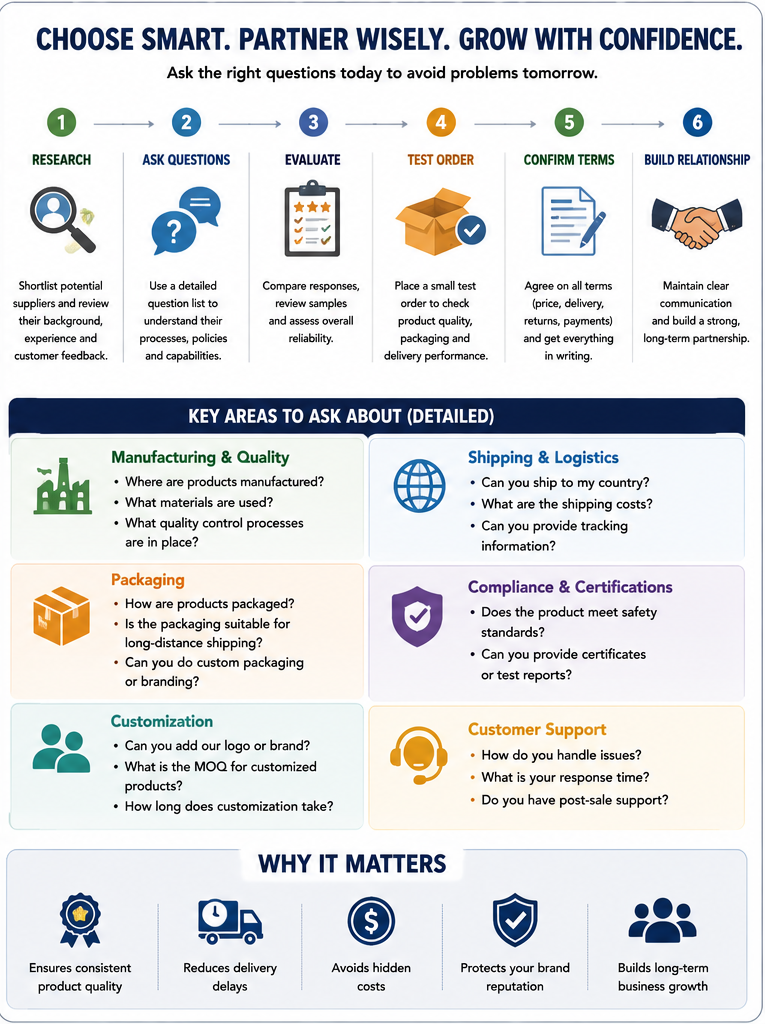
One of the safest ways to evaluate a supplier is by placing a small test order.
A test order allows businesses to check:
- Product quality
- Packaging
- Delivery speed
- Communication
- Shipping reliability
- Customer service
Testing reduces risk before committing to larger inventory purchases.
For bulky or fragile products, a test order is especially important because damage and shipping problems may only become visible during real transportation.
Evaluating the Full Cost of Supplier Problems
A cheap supplier is not always the most profitable supplier.
A supplier with lower prices may create hidden costs through:
- Product defects
- Late shipments
- Customer refunds
- Negative reviews
- Replacement costs
- Lost sales
- Time spent resolving issues
Businesses should evaluate the total cost of working with a supplier, not just the product price.
Building Long-Term Supplier Relationships
Strong supplier relationships can create advantages over time.
Reliable suppliers may offer:
- Better pricing
- Faster communication
- Priority production
- Flexible payment terms
- Better customization options
However, these benefits usually develop after trust has been built.
Businesses should treat suppliers professionally, communicate clearly, and pay invoices on time.
Conclusion
The discussion highlights three essential areas that every business should examine before placing an order with a supplier: product quality, delivery reliability, and clear return or replacement policies. These areas may appear simple, but they have a major impact on customer satisfaction, business reputation, and long-term profitability.
Before committing to inventory, businesses should ask detailed questions about manufacturing standards, quality checks, shipping timelines, packaging, payment terms, damage claims, and communication processes. Most importantly, important terms should be confirmed in writing.
A reliable supplier can help a business grow with confidence. An unreliable supplier can create delays, refunds, customer complaints, and financial losses. By asking the right questions, placing small test orders, and carefully evaluating supplier communication, businesses can reduce risk and build stronger supply chains.