The request described above may sound like a small interface improvement at first.
A merchant wants predefined list-type metafield options to appear as native checkboxes directly inside the product editor instead of opening a separate selection window and choosing values one by one.
The example provided is simple:
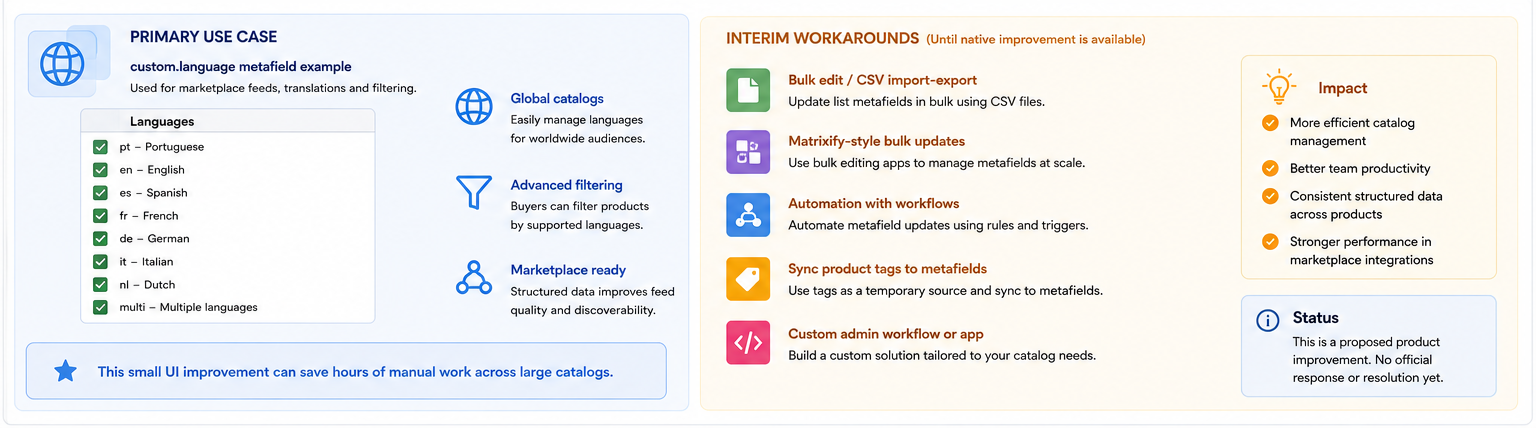
A custom language field with selectable values such as:
pt
en
es
fr
de
it
nl
multi
The merchant’s argument is straightforward:
when managing structured catalog information at scale, the current interaction model creates unnecessary effort.
Although this looks like a user interface request, it actually touches on a much larger topic—
how structured product data should be managed efficiently as catalogs become larger, more multilingual, and increasingly connected across marketplaces and business systems.
This discussion highlights an important reality in modern commerce:
small workflow improvements can create meaningful operational gains.
Let’s explore why this request matters and what it reveals about the future of catalog management.
The Evolution of Product Information Management
Managing products used to be relatively simple.
Stores typically maintained:
title
price
description
images
inventory
The number of editable fields was limited.
Modern commerce environments look completely different.
Products increasingly contain:
attributes
custom properties
regional information
translation settings
marketplace requirements
channel-specific content
technical specifications
compliance data
As catalogs expand, merchants need faster ways to interact with structured information.
Why Custom Product Data Has Become Essential
Modern stores rarely operate using only default product information.
Businesses often rely on additional fields to support:
search visibility
catalog organization
marketplace requirements
automation
customer experience
internal operations
Custom fields increasingly become operational infrastructure.
Why List-Based Fields Are Popular
List fields solve an important problem.
Instead of forcing merchants to type values manually, stores define controlled choices.
This creates consistency.
For example:
Languages:
English
French
Spanish
Materials:
Cotton
Polyester
Leather
Regions:
Europe
Asia
North America
Controlled options improve data quality.
The Hidden Cost of Extra Clicks
The request focuses heavily on interaction design.
Today’s process requires:
open field
launch selection window
choose values
confirm
close
repeat
This workflow seems manageable for one product.
But operations scale differently.
Why Small Workflow Delays Become Large Operational Costs
Consider a merchant managing:
500 products
10 selectable attributes
multiple updates weekly
Even a few extra clicks per update become substantial.
Small friction repeated thousands of times becomes meaningful.
Why Checkbox Interfaces Feel Faster
Checkboxes reduce interaction overhead.
Users can:
see options immediately
make multiple selections quickly
understand current values visually
move faster
Visibility improves efficiency.
Why Immediate Visibility Improves Decision Making
Checkbox layouts provide context.
Users instantly see:
available choices
selected values
missing values
This reduces mental effort.
Decision speed increases.
Why Modal-Based Interfaces Become Limiting
Separate selection windows are useful in some scenarios.
But they create interruptions.
Users must repeatedly:
open
select
confirm
return
This breaks editing flow.
Why Catalog Teams Depend on Momentum
Catalog management often involves repetitive work.
Teams may process:
hundreds of products
language updates
feed requirements
regional expansion
Workflow interruptions slow throughput.
Why Structured Data Is Becoming More Important
The example in the discussion references language-related structured data.
This reflects a larger shift.
Commerce increasingly depends on structured information for:
marketplaces
localization
search
filtering
analytics
Structured data creates consistency.
Why Language Management Is Growing More Complex
Many stores now operate internationally.
Products may require:
multiple languages
market-specific content
localized metadata
regional compliance
Managing this manually becomes difficult.
Why Consistency Matters Across Large Catalogs
Manual entry introduces risk.
Examples include:
spelling differences
inconsistent labels
missing values
duplicate definitions
Controlled selections reduce these issues.
Why Marketplace Requirements Drive Better Structure
Many external selling environments expect standardized information.
Examples include:
attribute consistency
language declarations
category alignment
search compatibility
Structured fields simplify compliance.
Why Product Filtering Depends on Clean Data
Filtering only works when product data stays organized.
For example:
Show products available in French.
Display multilingual products.
Exclude unsupported language options.
Structured fields improve discoverability.
Why Product Editing Experience Impacts Data Quality
Complicated workflows often reduce data accuracy.
Users may:
skip updates
leave fields incomplete
delay maintenance
Simple editing improves adoption.
Why Merchant Expectations Continue Changing
Modern merchants increasingly expect interfaces that feel:
visual
fast
contextual
efficient
Editing experiences now influence satisfaction.
Why Bulk Catalog Operations Require Better Input Models
As stores scale, batch workflows become critical.
Merchants increasingly prioritize:
fewer clicks
bulk updates
visibility
editing speed
Input design becomes operationally important.
Why Structured Data Supports Automation
Structured fields create reliable inputs.
Businesses can use clean data to support:
catalog logic
content generation
inventory workflows
publishing decisions
Organization enables scale.
Why Product Teams Often Start With Workarounds
The discussion mentioned interim solutions.
This reflects a common pattern.
When native workflows feel restrictive, businesses create operational layers.
Examples include:
imports
bulk processing
automation
custom interfaces
Workarounds solve short-term problems.
But native experiences usually remain preferable.
Why Better Editing Creates Better Adoption
Features only create value if merchants actually use them.
Complex workflows reduce participation.
Simple interfaces encourage consistency.
Why Visual Input Methods Improve Confidence
Checkboxes provide immediate feedback.
Users know:
what exists
what is selected
what changed
This reduces mistakes.
Why Metadata Is Becoming More Strategic
Additional product information increasingly drives:
search ranking
market expansion
catalog intelligence
buyer experiences
Metadata is no longer secondary.
Why Product Administration Is Becoming a Competitive Advantage
Stores that manage information efficiently often move faster.
Advantages include:
quicker launches
better consistency
fewer errors
improved discoverability
Operational speed matters.
Why Large Catalogs Amplify Every Limitation
Small stores may tolerate friction.
Large catalogs magnify every inefficiency.
What feels minor at 50 products becomes painful at 50,000.
Why Flexible Editing Experiences Matter
Different businesses manage products differently.
Some need:
simple text fields
multi-select options
visual controls
bulk interactions
Flexibility improves usability.
Why This Request Reflects a Bigger Trend
This discussion is not really about checkboxes.
It reflects a broader expectation:
business users increasingly want interfaces designed around speed and structured workflows rather than generic data entry.
That shift is becoming more visible across commerce operations.
The Bigger Lesson About Catalog Management
Catalog quality does not depend only on data models.
It depends on how easily people can maintain those models.
The easier it becomes to manage structured information—
the more valuable that information becomes.
Final Thought
The request for native checkbox selection highlights how seemingly small interface improvements can create meaningful operational impact.
As product catalogs become larger and more structured, merchants increasingly need workflows that minimize friction while maintaining consistency.
Better selection interfaces can support:
faster editing
cleaner product data
stronger marketplace readiness
simpler catalog maintenance
Because modern commerce increasingly depends not just on having structured data—
but on making structured data easy to manage.
Conclusion
The discussion around native checkbox support for list metafields reflects growing demand for faster and more intuitive product management experiences.
Merchants managing structured catalogs want tools that allow them to:
update information quickly
reduce repetitive clicks
maintain consistent data
support multilingual operations
improve filtering and discoverability
As commerce systems continue evolving, usability and structured data management will likely become increasingly connected.