Modern eCommerce fulfillment has become far more complex than simply packing products into boxes and sending them to customers. Today’s online stores often manage:
- Pre-orders
- Backorders
- Multi-location inventory
- Supplier delays
- Third-party logistics providers
- International shipping
- Mixed inventory availability
As fulfillment systems become more advanced, businesses increasingly rely on automated order handling to process shipments quickly and efficiently.
However, the discussion above highlights a growing frustration among merchants:
automatic split shipments for mixed inventory orders.
The issue centers around orders that contain both:
- In-stock items ready to ship immediately
and - Pre-order or backorder items that are not yet available
Many eCommerce systems automatically divide these orders into:
- “Ships now”
- “Ships later”
At first glance, this sounds helpful. Customers receive available products faster while waiting for delayed items separately.
But for many merchants, especially smaller businesses, this automatic behavior creates major operational, financial, and customer-service challenges.
The feature request discussed here asks for something relatively simple:
merchant-controlled shipment behavior.
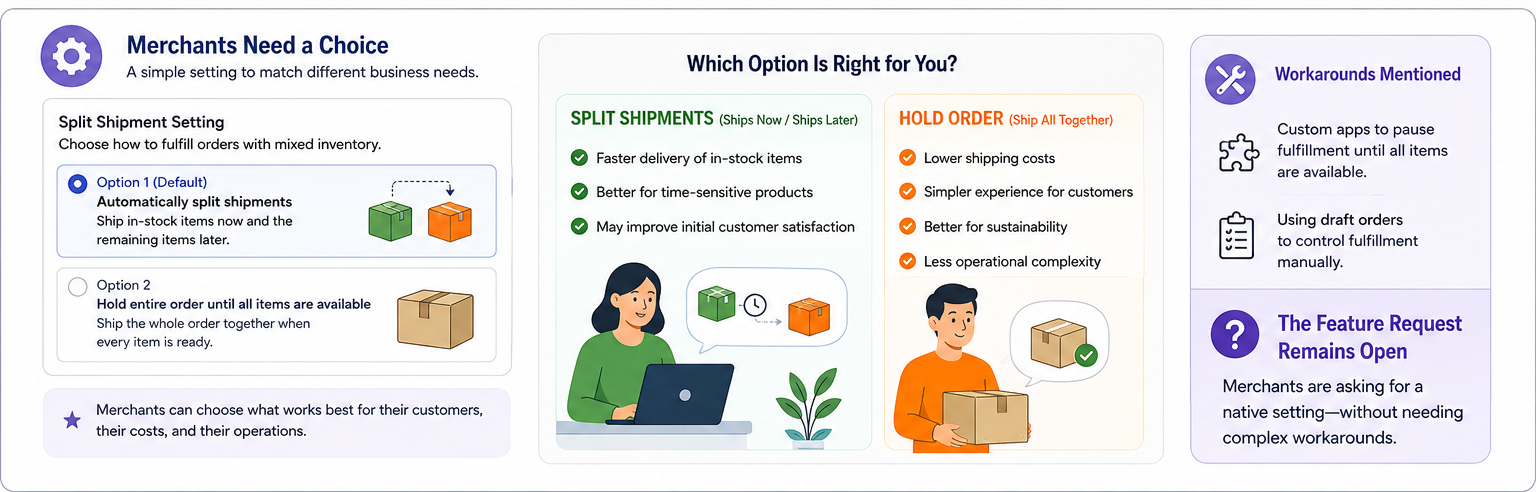
Specifically, merchants want the ability to choose between:
- Automatically splitting shipments
or - Holding the full order until all items become available
The discussion remains unresolved, but it highlights a broader operational issue in modern commerce:
businesses increasingly need flexible fulfillment logic instead of rigid automation rules.
Let’s explore why split shipments create so many challenges, why merchants want more control, and why fulfillment flexibility is becoming increasingly important in eCommerce operations.
The Rise of Complex Inventory Models
Traditional retail once operated using simple inventory systems.
Products were either:
- In stock
or - Out of stock
If an item was unavailable, customers simply could not purchase it.
Modern commerce operates very differently.
Businesses now commonly use:
- Pre-orders
- Backorders
- Incoming inventory forecasting
- Supplier-based fulfillment
- Made-to-order production
- Multi-warehouse shipping
- Hybrid inventory systems
This creates situations where customers purchase orders containing:
- Some products available immediately
- Some products arriving later
The question becomes:
how should these mixed orders be fulfilled?
Why Automatic Split Shipments Exist
Automatic split shipments were originally designed to improve customer experience.
The logic seems straightforward:
- Ship available items immediately
- Avoid making customers wait unnecessarily
- Deliver part of the order faster
From a customer satisfaction perspective, this can sometimes make sense.
Customers often appreciate receiving available products sooner rather than waiting weeks for one delayed item.
For large retailers with massive shipping infrastructure, split shipments are relatively manageable.
But smaller merchants often experience the opposite effect.
Why Split Shipments Hurt Small Businesses
Large enterprise retailers can absorb additional shipping costs more easily.
Smaller merchants usually cannot.
Every additional shipment creates:
- Another shipping label
- Another packaging cost
- Another fulfillment process
- Another carrier charge
- Another operational step
Margins shrink quickly when multiple parcels are required for a single order.
For smaller stores, shipping costs already represent one of the largest operational expenses.
Automatic split fulfillment can turn profitable orders into low-margin or even unprofitable transactions.
Why Customers Often Prefer Combined Shipping
One of the most important points raised in the discussion was customer behavior.
According to the merchant:
many customers reportedly ask to combine shipments instead of receiving separate deliveries.
This is extremely important.
It reveals a disconnect between:
automated fulfillment assumptions
and
actual customer preferences.
Customers may prefer waiting slightly longer if it means:
- One shipment
- One delivery experience
- Less confusion
- Lower shipping charges
- Fewer tracking numbers
This becomes especially true when:
- Delays are small
- Products belong together
- Shipping fees are high
Automation may prioritize speed while customers prioritize simplicity.
Why Shipping Costs Are Becoming a Bigger Problem
Shipping expenses have increased significantly in recent years.
Businesses now face:
- Higher carrier pricing
- Fuel surcharges
- International shipping volatility
- Packaging material costs
- Warehouse labor expenses
Every extra parcel increases operational pressure.
For smaller businesses operating with limited margins, unnecessary split shipments become financially damaging.
Why Duplicate Shipping Charges Frustrate Customers
The discussion mentioned another major issue:
customers requesting refunds for duplicate shipping charges.
This creates customer-service friction.
Customers often feel frustrated when:
- One order becomes multiple shipments
- Shipping costs feel excessive
- Delays create confusion
Even when businesses explain the operational reason, the experience may still feel inconvenient.
This increases:
- Support tickets
- Refund requests
- Operational workload
- Customer dissatisfaction
Why Sustainability Concerns Matter More Today
Another important concern raised was sustainability.
Modern customers increasingly care about:
- Packaging waste
- Carbon emissions
- Shipping efficiency
- Environmental impact
Multiple parcels for one order create:
- More cardboard
- More filler materials
- More transportation emissions
- More delivery attempts
Many businesses actively want to reduce unnecessary packaging and transportation.
Split shipments can conflict with sustainability goals.
Why Operational Complexity Increases
The discussion also mentioned third-party logistics providers and external fulfillment systems.
This is extremely important.
Modern businesses often rely on:
- Warehouse providers
- Shipping integrations
- External fulfillment software
- Multi-location inventory systems
Split shipments complicate these workflows significantly.
Instead of one fulfillment process, businesses must manage:
- Multiple pick lists
- Multiple shipments
- Multiple tracking events
- Multiple delivery timelines
Complexity increases rapidly.
Why Mixed Inventory Orders Are Increasing
Mixed inventory orders are becoming more common because businesses increasingly use:
- Pre-order launches
- Restocking models
- Supplier inventory systems
- Seasonal inventory releases
- Made-to-order production
Customers frequently purchase combinations of:
- Available products
- Upcoming products
- Delayed products
This makes flexible fulfillment rules increasingly necessary.
Why Fulfillment Preferences Differ Between Businesses
Not every business wants the same fulfillment behavior.
Some businesses prioritize:
- Fast partial delivery
Others prioritize:
- Combined shipping efficiency
The problem is not automatic splitting itself.
The problem is lack of merchant choice.
Businesses want control over fulfillment strategy based on:
- Margins
- Customer expectations
- Product types
- Shipping costs
- Operational workflows
Why Merchant-Controlled Fulfillment Matters
The feature request specifically asked for a merchant-controlled setting.
This is important because fulfillment needs vary dramatically.
For example:
Luxury Brands
May prefer:
- One premium delivery experience
- Elegant combined packaging
Subscription Businesses
May prioritize:
- Consolidated shipments
Fast Retail Brands
May prioritize:
- Immediate partial delivery
Small Handmade Businesses
May need:
- Cost-efficient batching
No single fulfillment strategy fits every business model.
Why Operational Flexibility Is Becoming Essential
Modern commerce increasingly depends on operational flexibility.
Businesses now require:
- Dynamic inventory systems
- Flexible shipping rules
- Custom fulfillment logic
- Multi-channel coordination
Rigid automation often fails to reflect real operational needs.
Merchants increasingly want configurable systems instead of fixed workflows.
The Hidden Cost of Automation
Automation is often marketed as operational improvement.
But automation without flexibility can create hidden costs.
In this case:
automatic split shipments may create:
- Higher expenses
- More support tickets
- More operational steps
- Customer confusion
Automation works best when businesses can customize behavior according to their operational reality.
Why Customer Expectations Must Be Managed Carefully
Split shipments can confuse customers if communication is unclear.
Customers may wonder:
- Why did my order arrive partially?
- Why do I have multiple tracking numbers?
- Why was I charged more shipping?
- Is the rest of my order delayed?
- Did something go wrong?
Without strong communication, trust can decline.
Why Combined Fulfillment Sometimes Improves Experience
Although faster shipping is usually considered positive, combined fulfillment can actually improve customer experience in many cases.
Customers often appreciate:
- Simplicity
- Predictability
- Single-package convenience
Especially when:
- Delays are minor
- Shipping costs are high
- Products belong together
This is why merchant flexibility matters so much.
Why Workarounds Are Not Ideal
Some replies suggested workarounds such as:
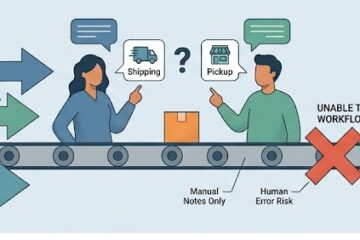
- Manual order management
- Draft order systems
- Custom fulfillment workflows
While technically possible, workarounds create new problems:
- Extra labor
- Increased complexity
- Maintenance requirements
- Human error risk
Businesses generally prefer native operational controls instead of patchwork solutions.
Why Multi-Parcel Fulfillment Creates Warehouse Challenges
Warehouse operations become more difficult with split shipments.
Each additional parcel requires:
- Separate packing
- Separate labeling
- Separate quality checks
- Separate tracking management
This increases:
- Labor costs
- Fulfillment time
- Error potential
For businesses using external warehouses, extra shipments may also create additional fulfillment fees.
Why Shipping Efficiency Impacts Profitability
Shipping efficiency directly affects profitability.
Businesses constantly balance:
- Delivery speed
- Shipping cost
- Customer satisfaction
- Operational simplicity
Automatic split fulfillment may improve one metric while damaging others.
For many merchants, consolidated shipping provides a better overall balance.
Why eCommerce Infrastructure Is Evolving
This discussion reflects a larger evolution in commerce infrastructure.
Modern businesses increasingly expect:
- Flexible automation
- Configurable workflows
- Operational customization
Standardized fulfillment systems no longer satisfy every business model.
Commerce operations are becoming increasingly personalized.
Why Merchant Feedback Like This Matters
Feature requests like this reveal important operational gaps.
The request is not asking for highly advanced functionality.
It is asking for:
merchant choice.
That reflects a broader industry trend:
businesses want platforms to adapt to operational strategy instead of forcing fixed fulfillment logic.
Why Customer Communication Is Still Critical
Regardless of fulfillment strategy, communication remains essential.
Customers should clearly understand:
- Which items are delayed
- Whether orders will split
- Estimated delivery timelines
- Shipping expectations
Transparent communication reduces:
- Confusion
- Refund requests
- Support tickets
- Frustration
The Bigger Lesson About Modern Fulfillment
This issue highlights an important truth:
modern fulfillment is no longer only about shipping products quickly.
It is about balancing:
- Cost efficiency
- Customer experience
- Sustainability
- Operational simplicity
- Inventory flexibility
Businesses increasingly need fulfillment systems that support different operational priorities.
Final Thought
The request for merchant-controlled split shipment settings reflects a growing need for flexibility in modern eCommerce fulfillment.
Automatic split shipments may benefit some businesses, but for many merchants they create:
- Higher shipping costs
- Increased customer-service workload
- Sustainability concerns
- Operational complexity
The core issue is not whether split shipments are good or bad.
The real issue is that businesses want the ability to choose the fulfillment strategy that best matches their operational model and customer expectations.
As eCommerce operations become more sophisticated, merchants increasingly expect configurable workflows instead of rigid automated behavior.
Conclusion
The discussion around automatic split shipments highlights a major operational challenge in modern eCommerce fulfillment.
Businesses increasingly manage:
- Mixed inventory availability
- Pre-orders
- Backorders
- Multi-location shipping
- Complex fulfillment workflows
While automatic split shipments may improve delivery speed in some situations, they can also create:
- Higher shipping expenses
- Increased packaging waste
- Customer confusion
- Greater operational complexity
Many merchants now want more control over how mixed inventory orders are fulfilled.
A flexible fulfillment setting allowing businesses to either:
- Split shipments automatically
or - Hold orders until all items are available
would provide significantly better operational control for many growing stores.
As modern commerce continues evolving, fulfillment flexibility is becoming just as important as fulfillment speed itself.