Starting an online coffee business sounds exciting at first. Specialty coffee continues growing worldwide, consumers increasingly appreciate premium beans, and many people want to support local roasters instead of buying mass-produced supermarket coffee.
For beginners entering eCommerce, selling high-end local coffee through an online store can feel like a perfect business opportunity:
- Passion-driven
- Product-focused
- Community-oriented
- Scalable
- Lifestyle-friendly
But once new entrepreneurs begin researching how to actually launch the business, they quickly discover that selling specialty coffee online is far more complicated than simply building a storefront and listing products.
The discussion above highlights several important beginner concerns:
- How to work with local coffee roasters
- Whether dropshipping is possible
- How fulfillment should work
- Who controls branding
- Whether private labeling is necessary
- How to avoid losing customers directly to coffee producers
The conversation remains unresolved because there is no single perfect solution. The right approach depends heavily on:
- Budget
- Branding goals
- Risk tolerance
- Supplier relationships
- Long-term business vision
However, the discussion reveals an important truth about modern eCommerce:
building a successful coffee brand is not only about selling coffee.
It is about ownership, customer relationships, fulfillment control, and brand positioning.
Let’s explore why specialty coffee businesses face these challenges, why supplier cooperation matters so much, and why branding strategy becomes one of the most important decisions for long-term growth.
Why Specialty Coffee Is Attractive for New Online Businesses
Coffee is one of the most consumed products in the world.
But specialty coffee has evolved far beyond being just a daily beverage.
Modern consumers increasingly care about:
- Bean origin
- Roast quality
- Ethical sourcing
- Brewing experience
- Flavor profiles
- Small-batch production
- Local businesses
This creates opportunities for smaller online brands to compete through:
- Curation
- Storytelling
- Quality selection
- Community identity
Unlike large commercial coffee brands, smaller specialty coffee businesses often succeed through authenticity and niche positioning.
For beginners, this makes the market feel approachable.
The First Real Challenge: Supplier Permission
One of the most important points raised in the discussion was the need to obtain permission from coffee producers before reselling their products.
This may sound obvious, but many beginners overlook it.
Not every roaster wants third-party sellers distributing their coffee online.
Roasters may worry about:
- Brand control
- Pricing consistency
- Product freshness
- Customer experience
- Market competition
- Unauthorized resale
Before anything else, sellers must establish trust and clear agreements with suppliers.
Without supplier cooperation, the business cannot function sustainably.
Why Many Local Roasters Do Not Understand eCommerce
Another important issue mentioned is that many local coffee producers may not understand online commerce systems.
Small roasters often focus primarily on:
- Roasting quality
- Café operations
- Wholesale partnerships
- Local retail sales
They may not have experience with:
- Online order fulfillment
- Dropshipping systems
- Inventory syncing
- Shipping workflows
- Digital customer service
This creates communication and operational challenges.
A beginner seller may assume the roaster can simply ship products directly to customers, while the producer may have no infrastructure to support that process efficiently.
The Appeal of Dropshipping
Dropshipping is attractive to beginners because it lowers financial risk.
With dropshipping:
- Sellers do not hold inventory
- Products ship directly from suppliers
- Startup costs remain lower
- Storage requirements disappear
For new entrepreneurs, this reduces fear significantly.
They avoid:
- Unsold inventory
- Warehousing costs
- Packaging operations
- Large upfront purchases
In theory, this sounds ideal.
The Limitations of Dropshipping for Premium Coffee
However, specialty coffee creates unique challenges for dropshipping.
Coffee freshness matters heavily.
Customers purchasing premium coffee expect:
- Fresh roasting dates
- Fast shipping
- Careful packaging
- Consistent quality
When sellers rely entirely on suppliers for fulfillment, they lose significant control over:
- Packaging quality
- Shipping speed
- Brand presentation
- Customer experience
This becomes risky for premium positioning.
High-end coffee buyers are often extremely quality-sensitive.
Why Customer Experience Matters So Much in Coffee
Coffee is not only a product.
It is an experience.
Specialty coffee customers often care deeply about:
- Packaging aesthetics
- Unboxing experience
- Brewing instructions
- Brand storytelling
- Roast details
- Flavor descriptions
This emotional connection is harder to control in pure dropshipping models.
The more premium the product, the more important brand experience becomes.
Why Holding Inventory Provides More Control
The discussion also explored holding inventory instead of relying entirely on supplier shipping.
Holding inventory gives businesses greater control over:
- Packaging
- Branding
- Fulfillment speed
- Customer communication
- Quality inspection
- Marketing inserts
This creates a more consistent customer experience.
Businesses can build stronger brand identity because customers interact primarily with the store brand rather than the producer directly.
The Risk of Inventory Ownership
However, holding inventory introduces major operational responsibilities.
Businesses now need:
- Upfront capital
- Storage space
- Inventory forecasting
- Packaging systems
- Shipping operations
- Fulfillment management
This increases financial risk significantly.
Coffee also has shelf-life limitations.
Unsold inventory can lose freshness over time, especially premium specialty beans.
For beginners, this risk feels intimidating.
Why Fulfillment Becomes a Major Operational Decision
The discussion mentioned third-party fulfillment as another option.
This approach attempts to balance:
- Operational convenience
- Inventory control
- Scalability
Instead of shipping products personally, businesses use external warehouses or fulfillment providers.
This reduces some logistical pressure while still allowing:
- Inventory ownership
- Brand packaging
- Centralized fulfillment
But fulfillment outsourcing introduces:
- Additional costs
- Operational dependencies
- Inventory coordination challenges
Choosing fulfillment strategy becomes one of the most important operational decisions for growing coffee businesses.
The Subscription Coffee Business Model
The conversation later shifted toward subscription coffee businesses.
Subscription models are especially popular in specialty coffee because they create:
- Recurring revenue
- Predictable demand
- Customer retention
- Long-term relationships
Customers enjoy:
- Discovering new roasts
- Curated selections
- Convenience
- Consistent delivery schedules
For businesses, subscriptions improve revenue stability significantly.
The Branding Problem With Reselling Roaster Products
One of the most important concerns raised was customer loyalty.
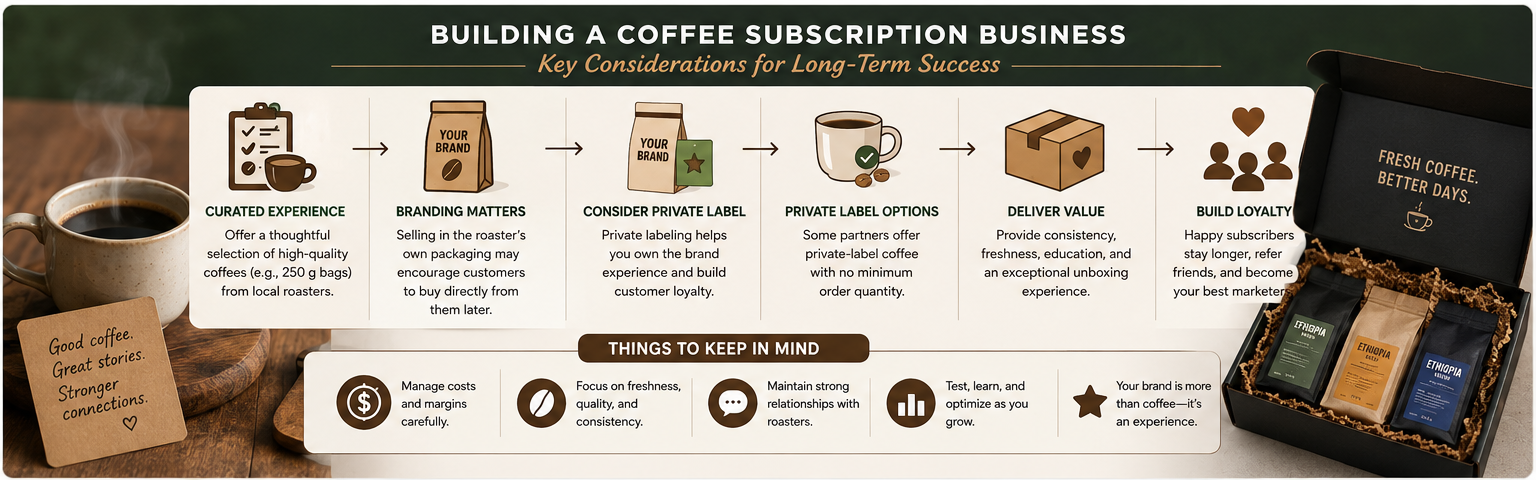
If businesses sell coffee using the original roaster’s branding, customers may eventually bypass the reseller completely.
For example:
- Customers discover the roaster
- Customers recognize the producer brand
- Customers later purchase directly from the source
This weakens long-term customer ownership.
The reseller becomes more of a temporary discovery channel instead of a lasting brand.
Why Brand Ownership Matters
This is where private labeling enters the discussion.
Private labeling allows businesses to sell products under their own brand identity instead of the producer’s branding.
This creates stronger:
- Brand recognition
- Customer loyalty
- Differentiation
- Long-term positioning
Customers associate the product experience with the seller’s brand rather than the original supplier.
This becomes extremely important for subscription businesses.
Why Private Labeling Appeals to Growing Brands
Private labeling helps businesses build stronger market identity.
Instead of becoming “another reseller,” businesses can create:
- Unique packaging
- Distinct storytelling
- Curated experiences
- Premium positioning
Customers remember the store brand rather than individual roasters.
This improves customer retention potential.
The Trade-Offs of Private Labeling
However, private labeling introduces additional complexity.
Businesses now need:
- Packaging design
- Label compliance
- Brand development
- Production coordination
- Marketing consistency
Some suppliers may not offer private labeling at all.
Others may require:
- Minimum order quantities
- Larger commitments
- Higher upfront costs
For beginners, this can feel overwhelming.
Why Curation Can Still Be Valuable
Even without private labeling, curated coffee businesses can still succeed.
Some businesses focus heavily on:
- Discovery experiences
- Coffee education
- Community engagement
- Subscription convenience
In these cases, the value comes not only from the product itself, but from:
- Selection expertise
- Trust
- Personalization
- Experience design
Customers may remain loyal to the curator even if they recognize the original roasters.
Why Supplier Relationships Become Critical
One major lesson from the discussion is that supplier relationships matter tremendously.
Successful coffee businesses often depend heavily on:
- Communication
- Mutual trust
- Shared expectations
- Clear operational agreements
Strong supplier relationships help businesses:
- Maintain consistency
- Solve fulfillment issues
- Coordinate inventory
- Manage quality expectations
Without strong partnerships, operational problems increase rapidly.
Why Beginners Often Underestimate Operations
Many beginners focus heavily on:
- Website design
- Branding
- Marketing
But operational systems usually determine long-term sustainability.
Coffee businesses must carefully manage:
- Freshness
- Shipping timing
- Inventory rotation
- Packaging
- Supplier coordination
Operational reliability directly affects customer trust.
Why Margins Matter So Much
Coffee businesses often operate with tighter margins than beginners expect.
Expenses include:
- Product sourcing
- Packaging
- Shipping
- Storage
- Marketing
- Customer acquisition
Dropshipping reduces some costs but lowers margins.
Inventory ownership increases margins but increases risk.
Every business model involves trade-offs.
Why Beginners Need Clear Priorities
The discussion remains unresolved because the “best” approach depends entirely on business priorities.
For example:
Lowest Financial Risk
Dropshipping may work best.
Strongest Brand Ownership
Private labeling may work best.
Maximum Customer Experience Control
Inventory ownership may work best.
Simplest Operations
Third-party fulfillment may work best.
There is no universal solution.
Why Coffee Businesses Depend Heavily on Trust
Specialty coffee buyers are often highly loyal once trust is established.
Customers return repeatedly when they believe:
- Quality is consistent
- Recommendations are trustworthy
- Fulfillment is reliable
- Brand identity feels authentic
Building trust takes time, but it becomes a major competitive advantage.
The Bigger Lesson About eCommerce
This discussion reflects a broader reality about modern online business:
owning customer relationships matters more than simply listing products online.
Successful businesses usually control:
- Branding
- Customer experience
- Communication
- Fulfillment quality
- Positioning
The deeper the brand relationship, the harder it becomes for customers to switch elsewhere.
Final Thought
The discussion around selling high-end local coffee online highlights the complex decisions beginners face when entering specialty eCommerce.
At first, selling premium coffee may appear straightforward.
But the reality quickly becomes more complicated once businesses begin managing:
- Supplier relationships
- Branding
- Fulfillment
- Inventory
- Customer retention
- Operational control
Dropshipping offers simplicity and lower risk, but reduces control.
Inventory ownership improves branding and customer experience, but increases operational responsibility.
Private labeling strengthens brand ownership, but requires greater investment and coordination.
Ultimately, the right path depends on what the business values most:
- Low risk
- High control
- Strong branding
- Scalability
- Simplicity
- Long-term customer ownership
Conclusion
Building an online specialty coffee business involves much more than selling coffee products through an eCommerce storefront.
Businesses must carefully balance:
- Supplier cooperation
- Fulfillment strategy
- Inventory management
- Brand ownership
- Customer experience
- Long-term differentiation
The discussion reveals that modern coffee businesses increasingly compete not only through product quality, but through branding, operational reliability, and customer trust.
Whether using dropshipping, holding inventory, third-party fulfillment, or private labeling, the most successful coffee businesses are usually the ones that create strong customer relationships while maintaining operational consistency.
In the growing specialty coffee market, long-term success depends not only on what coffee is being sold, but on who ultimately owns the customer relationship behind the purchase.