The rise of eCommerce has created enormous opportunities for creators, artists, designers, and small businesses to sell custom products online without needing a large warehouse or manufacturing facility. Products like:
- standees
- enamel pins
- stickers
- shirts
- mugs
- posters
- phone cases
- acrylic products
have become extremely popular in creator-driven online stores.
At the same time, many beginners entering eCommerce are confused about how dropshipping works when products are custom-made instead of mass-produced.
Traditional dropshipping usually involves selling ready-made products sourced from suppliers. But custom products introduce a completely different workflow because each order may include:
- custom artwork
- personalized text
- uploaded customer photos
- unique designs
- made-to-order production
The discussion above focuses on explaining how dropshipping applies to custom merchandise and personalized products.
The main clarification is important:
dropshipping simply means selling products without holding inventory yourself.
For custom products, this process is often connected to print-on-demand fulfillment systems, where products are only manufactured after a customer places an order.
This model has become extremely attractive because it allows creators and entrepreneurs to launch online businesses with:
- lower upfront costs
- reduced inventory risk
- minimal storage requirements
- scalable fulfillment operations
However, while the model sounds simple on the surface, there are many operational decisions involved:
- choosing suppliers
- deciding between self-fulfillment and third-party fulfillment
- managing customization workflows
- handling quality control
- balancing branding and shipping speed
The discussion remains informational rather than conclusive because the “best” solution depends entirely on the seller’s goals, budget, product complexity, and operational preferences.
Let’s explore how custom-product dropshipping actually works, why print-on-demand has become so popular, and what businesses should consider before launching a custom merchandise store.
What Dropshipping Actually Means
One of the biggest misconceptions in eCommerce is that dropshipping refers to a specific product type.
It does not.
Dropshipping is simply a fulfillment model.
In a traditional retail business:
- the seller buys inventory upfront
- stores products physically
- ships orders manually
In dropshipping:
- products are fulfilled by a third party
- the seller does not store inventory personally
- suppliers handle production and shipping
The seller primarily focuses on:
- marketing
- storefront management
- branding
- customer acquisition
This operational model dramatically lowers the barrier to starting an online business.
How Custom Products Change the Workflow
Custom products introduce a major difference compared to standard dropshipping.
Traditional dropshipping often involves:
- pre-manufactured products
- fixed inventory
- standardized packaging
Custom products require production after the order is placed.
This creates a print-on-demand workflow.
For example:
- a customer uploads artwork
- chooses customization options
- places an order
- the product is then manufactured specifically for that customer
The item may not physically exist before purchase.
This changes inventory management completely.
Why Print-on-Demand Became So Popular
Print-on-demand became popular because it solved several major problems for creators and small businesses.
Traditionally, custom merchandise required:
- bulk manufacturing
- large upfront investment
- storage space
- inventory forecasting
- minimum order quantities
This created significant financial risk.
Businesses had to guess:
- which designs would sell
- how much inventory to order
- which sizes or variants customers wanted
Unsold inventory became a major problem.
Print-on-demand dramatically reduced this risk.
Products are manufactured only after a customer buys them.
Why Custom Merchandise Is Growing Rapidly
Custom products have become increasingly popular because customers value personalization and niche branding.
Modern buyers often want:
- unique designs
- fandom merchandise
- personalized gifts
- creator products
- small-batch items
- custom artwork
This has created huge opportunities for:
- artists
- influencers
- content creators
- niche brands
- small independent businesses
Custom merchandise allows businesses to differentiate themselves instead of competing purely on price.
Common Custom Products in Modern eCommerce
The discussion specifically mentioned:
- standees
- enamel pins
- stickers
- shirts
These products are especially popular because they work well for:
- fandom culture
- creator communities
- gaming audiences
- anime merchandise
- independent artists
- event branding
They are also relatively lightweight and visually driven, which makes them ideal for online sales.
Understanding Print-on-Demand Fulfillment
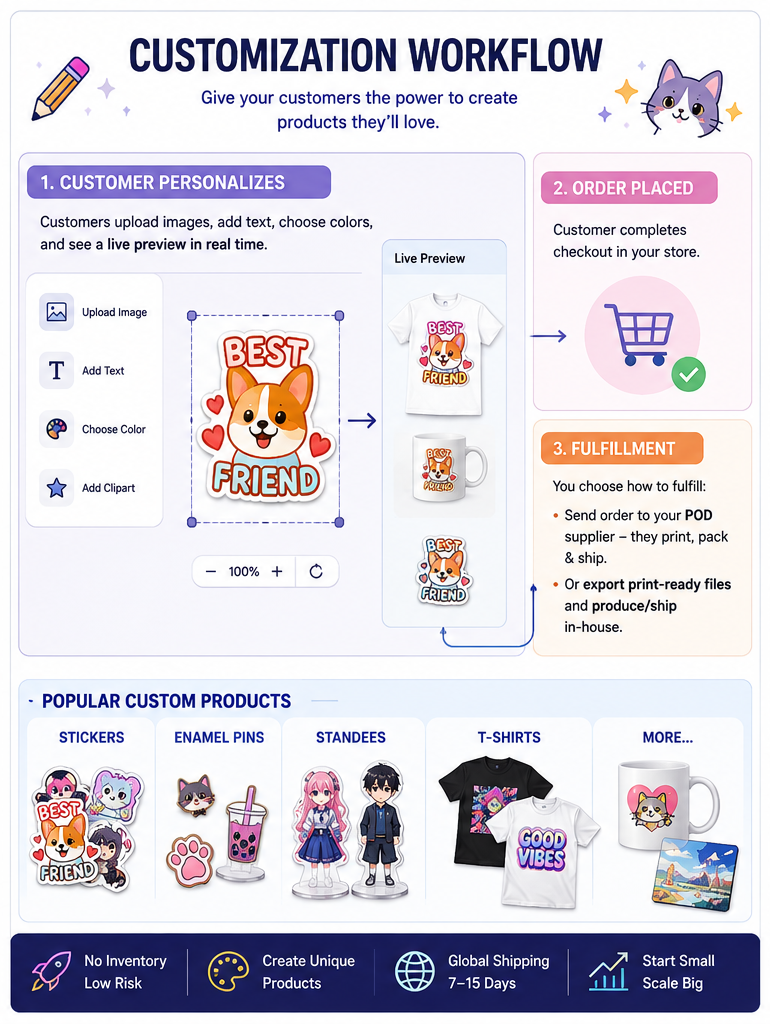
In a print-on-demand workflow:
- A customer places an order.
- The design is sent to a supplier.
- The supplier manufactures the product.
- The supplier ships directly to the customer.
The seller never physically handles the product.
This creates several advantages:
- lower startup costs
- reduced inventory risk
- easier scaling
- simplified logistics
However, it also creates limitations:
- lower profit margins
- less packaging control
- dependency on suppliers
- longer fulfillment times
Why Supplier Selection Matters So Much
One of the most important decisions in custom-product dropshipping is choosing reliable suppliers.
The supplier directly affects:
- print quality
- product durability
- shipping speed
- packaging presentation
- customer satisfaction
Since the seller often never sees the product personally, supplier reliability becomes critical.
Poor-quality suppliers can damage:
- customer trust
- reviews
- refund rates
- long-term brand reputation
The Trade-Off Between Convenience and Control
The discussion outlined three common approaches:
- third-party fulfillment
- self-fulfillment
- hybrid fulfillment
Each model offers different advantages and disadvantages.
Option 1: Third-Party Print-on-Demand Fulfillment
This is the most beginner-friendly approach.
The supplier handles:
- production
- packaging
- shipping
The seller mainly manages:
- branding
- storefront
- marketing
Advantages include:
- low startup costs
- no inventory storage
- easy scalability
- reduced operational workload
But disadvantages include:
- lower margins
- less customization control
- limited packaging branding
- slower shipping in some regions
Option 2: Self-Fulfillment
Some businesses choose to:
- manufacture products themselves
or - order products in advance and ship manually
This provides much greater control over:
- quality
- packaging
- branding
- customer experience
Advantages include:
- higher margins
- stronger brand identity
- better packaging customization
- improved quality control
But self-fulfillment also requires:
- storage space
- operational labor
- shipping management
- upfront inventory investment
This model is more complex operationally.
Option 3: Hybrid Fulfillment
Many businesses eventually adopt hybrid systems.
For example:
- standard products use third-party fulfillment
- premium items are handled internally
Or:
- high-volume designs are stocked
- experimental designs remain print-on-demand
Hybrid systems offer flexibility but increase operational complexity.
Why Personalization Changes Everything
One major point highlighted in the discussion was customization workflows.
Modern custom-product stores increasingly allow customers to:
- upload photos
- add custom text
- modify designs
- preview products live
This creates a much more interactive shopping experience.
But it also introduces technical and operational complexity.
Why Live Product Previews Matter
Customers buying personalized products want confidence before ordering.
Live previews help customers:
- visualize the final product
- reduce ordering mistakes
- feel more engaged emotionally
This improves:
- conversion rates
- customer satisfaction
- purchase confidence
Especially for personalized gifts and custom merchandise.
Why File Management Becomes Important
Custom-product businesses often handle:
- uploaded images
- design files
- production templates
- print-ready exports
This creates additional operational considerations around:
- file quality
- formatting
- production compatibility
- customer-upload management
Businesses need workflows that reduce production errors.
Why Shipping Speed Is a Major Challenge
One common downside of print-on-demand systems is slower fulfillment speed.
Since products are manufactured after purchase:
- production takes time
- shipping may begin later
- delivery windows become longer
Customers increasingly expect fast shipping, so businesses must communicate timelines clearly.
Why Branding Is Harder With Third-Party Fulfillment
Brand identity matters heavily in custom merchandise businesses.
When third-party suppliers handle fulfillment, sellers may lose control over:
- packaging presentation
- inserts
- unboxing experience
- brand consistency
This is why some businesses eventually transition toward partial self-fulfillment.
Why Profit Margins Can Be Lower
Print-on-demand convenience comes at a cost.
Suppliers charge for:
- manufacturing
- printing
- fulfillment
- shipping
As a result, profit margins are often lower than bulk manufacturing models.
Businesses compensate by focusing on:
- niche audiences
- strong branding
- premium designs
- creator communities
Why Niche Branding Matters So Much
Custom-product stores succeed most often when targeting specific communities or interests.
Examples include:
- gaming communities
- anime fans
- pet lovers
- musicians
- creators
- fandom culture
Strong niche branding helps businesses stand out in crowded markets.
Why Quality Control Is Critical
Customers purchasing custom products expect:
- accurate printing
- durable materials
- good color quality
- reliable packaging
Quality problems create strong emotional disappointment because personalized products feel more personal than generic items.
Businesses should test products thoroughly before scaling operations.
Why Many Beginners Start With Print-on-Demand
For beginners, print-on-demand offers a relatively safe entry into eCommerce.
It reduces:
- financial risk
- inventory costs
- operational complexity
This allows sellers to validate:
- product demand
- branding ideas
- audience interest
before investing heavily into inventory or manufacturing.
Why Scaling Changes Operational Needs
As businesses grow, fulfillment needs often evolve.
Successful stores may eventually:
- negotiate private manufacturing
- hold inventory
- improve packaging
- speed up fulfillment
- strengthen brand identity
Many brands start with print-on-demand but later transition into more controlled fulfillment models.
The Bigger Lesson About Modern eCommerce
The discussion ultimately reflects a major shift in online commerce:
modern businesses increasingly prioritize flexibility over traditional retail infrastructure.
Today, creators can launch businesses with:
- minimal startup costs
- global reach
- custom products
- scalable fulfillment
without needing large warehouses or manufacturing facilities.
This has democratized entrepreneurship significantly.
Final Thought
The discussion around custom-product dropshipping highlights how modern fulfillment systems have transformed online business opportunities.
Custom products like:
- standees
- stickers
- enamel pins
- shirts
can now be sold globally without requiring businesses to hold large inventories or manage complex manufacturing systems themselves.
Print-on-demand fulfillment allows creators and entrepreneurs to focus more on:
- branding
- creativity
- audience building
- customer experience
while third-party suppliers handle production and shipping.
However, every fulfillment model involves trade-offs between:
- convenience
- control
- scalability
- margins
- branding
The best approach depends entirely on the seller’s business goals, operational preferences, and long-term vision.
Conclusion
The conversation about dropshipping custom products reveals how modern eCommerce has evolved beyond traditional inventory-based retail systems.
Custom-product fulfillment now offers multiple operational paths including:
- third-party print-on-demand fulfillment
- self-fulfillment
- hybrid systems
Each approach provides different advantages related to:
- startup cost
- operational control
- branding
- scalability
- shipping speed
As personalized products continue growing in popularity, businesses increasingly need fulfillment systems capable of supporting:
- custom uploads
- live previews
- made-to-order production
- flexible shipping workflows
The discussion remains open-ended because there is no universal “best” model.
Success depends on balancing convenience, product quality, branding, customer experience, and operational efficiency in a way that matches the business’s long-term goals.