Modern eCommerce has changed dramatically over the past few years.
Customers no longer follow a traditional buying journey where they search for a product, compare multiple websites, and make a carefully researched purchase.
Today, many buying decisions begin inside fast-moving social environments.
People discover products while scrolling short-form videos, watching creators, viewing trends, or reacting to content in real time.
This shift has changed the role of the product page.
A product page is no longer just a place to display information.
It has become the conversion engine that turns attention into action.
The discussion above focuses on a growing challenge for merchants:
how to design product pages that convert visitors arriving from real-time social channels.
The recommendations shared center around speed, clarity, social proof, trust, visual communication, and urgency.
But behind those recommendations is a larger lesson:
modern customers behave differently than traditional online shoppers.
Let’s explore why real-time traffic behaves differently, what customers expect when arriving from social content, and why product pages increasingly need to be designed around attention rather than information overload.
The Shift From Search-Based Shopping to Discovery-Based Shopping
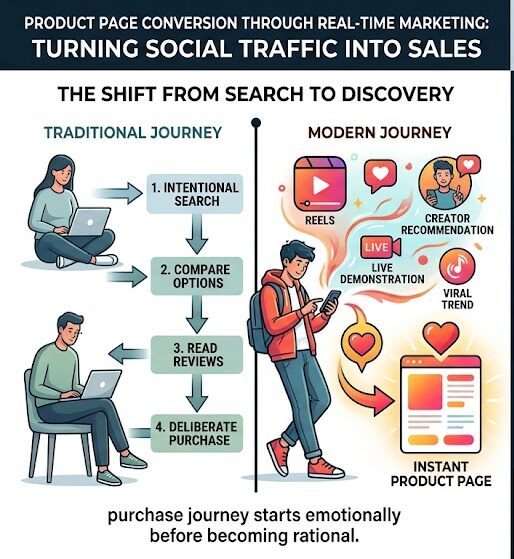
Traditional eCommerce largely depended on intentional behavior.
Customers would:
Search for a product.
Compare options.
Read reviews.
Purchase.
Today, discovery increasingly happens first.
Customers encounter products unexpectedly.
A short video.
A creator recommendation.
A viral trend.
A live demonstration.
An engaging story.
The purchase journey starts emotionally before becoming rational.
This changes how product pages must work.
Why Social Traffic Behaves Differently
Visitors arriving from real-time content often make decisions quickly.
Unlike search visitors, they may not arrive with deep product knowledge.
Instead, they arrive with:
curiosity
interest
emotion
impulse
They expect the product page to immediately continue the experience they just came from.
If expectations break, conversion drops.
The First Few Seconds Matter More Than Ever
When someone lands on a product page from social content, attention is fragile.
Customers typically decide very quickly whether to continue exploring.
This means the first visible section becomes extremely important.
Customers should instantly understand:
What is this?
Why should I care?
What do I do next?
Confusion creates exits.
Why Above-the-Fold Design Drives Conversion
The area visible immediately after landing often determines whether users stay.
Strong layouts usually prioritize:
clear messaging
strong visuals
visible purchase actions
minimal friction
Customers should not need to scroll extensively before understanding value.
Why Clarity Outperforms Complexity
Many businesses overload product pages.
Examples include:
long introductions
large paragraphs
too many design elements
complicated layouts
Social traffic generally rewards simplicity.
Customers want immediate understanding.
Clear communication reduces hesitation.
The Importance of Fast Loading Experiences
Speed strongly influences customer behavior.
Social traffic tends to be impatient.
Customers expect content to appear instantly.
Delays interrupt momentum.
Slow experiences increase abandonment.
Fast product experiences support impulse purchasing behavior.
Why Attention Is a Limited Resource
Modern consumers process enormous amounts of content daily.
Every product page competes not only with other stores but with:
videos
messages
notifications
entertainment
Customers filter information aggressively.
Strong pages reduce cognitive effort.
Why Visual Communication Matters More Than Long Explanations
Product visuals increasingly carry conversion responsibility.
Customers want to see:
results
context
usage
outcomes
Visual clarity reduces uncertainty.
Images should communicate quickly.
Why Social Proof Influences Buying Decisions
One of the strongest recommendations in the discussion involved social proof.
People often trust customers more than brands.
Social proof reduces perceived risk.
Examples include:
customer experiences
community activity
purchase behavior
visible engagement
Customers feel safer when others appear confident.
Why Authenticity Matters
Modern audiences detect overly polished content quickly.
Social audiences often respond better to content that feels:
natural
human
relatable
realistic
Trust builds faster when experiences feel genuine.
Why Customer Reviews Matter Beyond Ratings
Reviews do more than create credibility.
They answer questions.
Customers often look for:
results
quality expectations
delivery experiences
real-world use cases
Reviews reduce uncertainty.
Why Dynamic Activity Creates Momentum
Real-time experiences can influence purchasing behavior.
Examples include signals that suggest:
activity
interest
engagement
fresh demand
These signals create energy around products.
Customers often interpret activity as validation.
Why Benefit Communication Should Be Simple
Another major recommendation involved presenting benefits clearly.
Customers rarely buy features.
They buy outcomes.
Benefits answer:
What problem does this solve?
How does life improve?
Why choose this?
Simple messaging improves understanding.
Why Short Information Blocks Convert Better
Customers often scan before reading.
Large paragraphs increase friction.
Short sections improve usability.
Effective content usually becomes easier to process.
Why Process Simplicity Increases Confidence
Customers want to understand quickly:
How does this work?
Complicated explanations increase uncertainty.
Simple process explanations reduce decision fatigue.
Why Trust Elements Reduce Purchase Anxiety
Trust remains one of the strongest conversion factors.
Customers want reassurance.
Questions often include:
Will it arrive?
Can I return it?
Is payment secure?
What if something goes wrong?
Trust reduces hesitation.
Why Transparency Supports Higher Conversion
Customers increasingly value clarity.
Hidden information creates friction.
Clear expectations improve confidence.
Examples include:
delivery information
return expectations
purchase guarantees
Simple communication improves perceived reliability.
Why Pricing Presentation Matters
Pricing influences decision speed.
Customers evaluate:
value
comparison
purchase justification
Clear pricing reduces confusion.
Complex offers increase abandonment.
Why Bundles Influence Decision Making
Grouped offers simplify choices.
Customers often prefer:
ready-made selections
perceived savings
reduced effort
Bundles can improve perceived value.
Why Visual Freshness Creates Engagement
Dynamic presentation attracts attention.
Customers respond positively to experiences that feel active.
Examples include:
updated visuals
current promotions
fresh content
Visual energy supports conversion.
Why Scarcity Influences Behavior
Urgency was another recommendation discussed.
Customers sometimes delay decisions.
Scarcity encourages action.
Examples include:
limited availability
time-sensitive opportunities
exclusive access
However, urgency should remain authentic.
Artificial pressure reduces trust.
Why Calls to Action Matter
Customers should always know the next step.
Strong calls to action reduce friction.
Good direction improves movement through the purchase journey.
Customers should not need to guess.
Why Context Matters for Social Visitors
Visitors arriving from social environments already carry emotional momentum.
Product pages should continue that energy.
If social content promises excitement but product pages feel disconnected, conversion drops.
Consistency matters.
Why Mobile Experience Is Critical
Many real-time visitors arrive on mobile devices.
Mobile experiences require:
clean layouts
fast interactions
easy navigation
small friction points create exits.
Why Customer Intent Changes Rapidly
Social visitors often have weaker initial purchase intent.
Product pages must build confidence quickly.
This requires:
clarity
speed
visual communication
trust
simple decision-making
Why Conversion Is About Reducing Uncertainty
Customers rarely purchase because information exists.
They purchase because uncertainty decreases.
Good product pages answer concerns before questions appear.
Why Product Pages Are Becoming Experience Pages
Modern product pages increasingly combine:
storytelling
trust
education
social validation
visual engagement
They become experiences—not catalogs.
Why Real-Time Marketing Requires Operational Alignment
Marketing alone cannot create conversions.
Operations must support expectations.
If urgency promises fast delivery but fulfillment cannot support it, trust suffers.
Alignment matters.
The Bigger Lesson About Modern Commerce
The discussion reflects a broader transformation.
Attention has become one of the most valuable business resources.
Product pages are no longer passive destinations.
They actively shape purchasing decisions.
Businesses that understand customer behavior increasingly design pages around:
speed
clarity
trust
simplicity
Final Thought
Real-time social traffic creates enormous opportunities for businesses, but attention disappears quickly.
Customers arriving from short-form content expect immediate clarity, fast experiences, and strong confidence signals.
Product pages that communicate value quickly, reduce uncertainty, and maintain momentum are increasingly positioned to convert more effectively.
Because modern conversion is not simply about presenting information—
it is about helping customers feel confident enough to act.
Conclusion
The discussion around product page conversion highlights how customer expectations continue evolving.
Real-time traffic behaves differently from traditional search-driven shopping.
Successful product pages increasingly focus on:
fast experiences
clear value communication
authentic trust signals
strong visual storytelling
simple decision paths
Businesses that adapt product experiences to modern customer behavior are better positioned to transform attention into sustainable growth.