Creating successful marketing content is no longer about producing as many advertisements, social posts, or promotional graphics as possible. In today’s competitive digital environment, businesses must create content that captures attention, communicates value, builds trust, and motivates people to take action. Whether the goal is increasing sales, generating leads, improving brand awareness, or growing an online community, the quality of marketing creatives plays a major role in achieving those objectives.
However, consistently producing high-quality content can be challenging. Many marketers, business owners, and content creators struggle with limited time, creative fatigue, inconsistent messaging, and constantly changing consumer preferences. Starting every campaign from scratch often leads to wasted effort, slower production, and inconsistent branding.
The discussion focuses on practical workflows for creating better marketing and content creatives while maintaining quality and improving efficiency. Participants generally agree that the most effective approach begins with research, followed by defining a clear message before designing visuals. They also recommend using artificial intelligence for brainstorming and initial ideas, while emphasizing that human review and refinement remain essential. Another recurring recommendation is to create repeatable systems rather than reinventing the process for every campaign. Above all, participants believe that continuous testing and gradual improvements lead to better results than relying solely on personal opinions or complete redesigns.
This article explores an effective workflow for developing stronger marketing creatives, explains why research should come before design, and highlights the importance of continuous testing and structured processes.
Why Marketing Workflows Matter
Many businesses treat content creation as a series of isolated tasks. They create one advertisement today, a social media graphic tomorrow, and an email campaign next week, often without following a consistent process.
This approach creates several problems:
- Inconsistent messaging
- Uneven visual branding
- Slower production
- Higher design costs
- Difficulty measuring success
- Repeated mistakes
- Creative burnout
A structured workflow solves these challenges by providing a repeatable process that can be used for every campaign.
Instead of wondering where to begin each time, marketers follow the same sequence of steps, making the creative process faster and more consistent.
Start With Understanding the Audience
The strongest recommendation from the discussion is to begin with audience research.
Before creating headlines, graphics, or videos, businesses should understand exactly who they are trying to reach.
Important questions include:
- Who is the ideal customer?
- What problems are they trying to solve?
- What motivates them to buy?
- What concerns prevent them from purchasing?
- What language do they naturally use?
- What type of content do they engage with most?
The better a business understands its audience, the easier it becomes to create relevant marketing messages.
Rather than promoting product features alone, successful marketing connects those features to real customer needs.
Study Competitors Without Copying
Competitor research is another important step.
This does not mean copying another company’s advertisements or content.
Instead, marketers should study:
- Messaging styles
- Visual presentation
- Product positioning
- Customer engagement
- Frequently asked questions
- Common promotional offers
- Popular content formats
Competitor research helps identify industry expectations while revealing opportunities to stand out.
For example, if every competitor focuses only on product specifications, a business may choose to highlight customer experiences or practical benefits instead.
The goal is differentiation, not imitation.
Identify Customer Pain Points
Successful marketing speaks directly to customer problems.
Instead of beginning with product descriptions, marketers should identify the challenges customers experience before purchasing.
Examples include:
- Saving time
- Reducing costs
- Improving efficiency
- Increasing convenience
- Reducing stress
- Solving technical problems
- Improving productivity
Once these pain points are clearly defined, marketing messages become much more relevant.
Customers are generally more interested in solutions than features.
Define the Core Message First
A recurring recommendation in the discussion is to establish the core message before designing visuals.
Many businesses begin by creating attractive graphics and only later think about the actual message.
This often results in visually appealing content with little persuasive value.
Before creating any design, marketers should clearly answer three questions:
- What is the main message?
- What is the biggest customer benefit?
- What action should the customer take?
Everything else should support these answers.
A clear message makes every creative asset stronger.
Focus on Benefits Rather Than Features
Customers usually care more about outcomes than technical specifications.
For example, instead of saying:
- High-capacity battery
A stronger benefit might be:
- Stay productive all day without charging.
Similarly:
Instead of:
- Advanced security technology
A benefit could be:
- Protect your personal information with greater confidence.
Benefits explain why a feature matters.
This makes marketing more persuasive.
Create a Strong Call to Action
Every creative should guide the audience toward a clear next step.
Examples include:
- Learn more
- Shop now
- Request a quote
- Download the guide
- Start today
- Book a consultation
- Contact our team
A weak or confusing call to action can reduce campaign performance even if the creative itself is attractive.
The call to action should be simple, visible, and directly connected to the campaign objective.
Use Artificial Intelligence for Brainstorming
Participants in the discussion recommend using artificial intelligence as a productivity assistant rather than a replacement for creativity.
Artificial intelligence can help generate:
- Headline ideas
- Content outlines
- Marketing angles
- Product descriptions
- Initial advertisement concepts
- Creative variations
- Social media captions
This helps reduce the time spent overcoming creative blocks.
However, the first draft should rarely become the final version.
Human review remains essential.
Refine Every Draft
One of the strongest points in the discussion is that every draft should be manually refined.
Artificial intelligence can provide ideas quickly, but businesses should always review content for:
- Accuracy
- Brand voice
- Tone
- Clarity
- Grammar
- Customer relevance
- Consistency
Every company has its own identity.
Editing ensures that marketing materials reflect that identity instead of sounding generic.
Develop Consistent Brand Voice
A consistent brand voice builds recognition and trust.
Customers should recognise the business regardless of whether they are reading:
- An email
- A social media post
- A website page
- A product description
- An advertisement
Brand voice may be:
- Professional
- Friendly
- Educational
- Inspirational
- Technical
- Casual
Consistency creates familiarity, making future campaigns more effective.
Build the Visual Creative
Once the messaging is finalised, visual design becomes much easier.
Design elements should support the message rather than compete with it.
Important visual considerations include:
- Colour consistency
- Typography
- Product photography
- Layout
- White space
- Icons
- Brand logo
- Visual hierarchy
Customers should immediately understand what the advertisement is promoting.
Complicated designs often reduce effectiveness.
Create Multiple Variations
Instead of designing one advertisement, marketers should create several variations.
The discussion recommends changing one element at a time.
Possible variations include:
- Different headlines
- Alternative product photos
- Different background colours
- New call-to-action wording
- Alternative pricing presentation
- Different customer testimonials
Testing one variable at a time helps identify what actually improves performance.
Changing too many elements simultaneously makes it difficult to understand why results changed.
Build a Repeatable Process
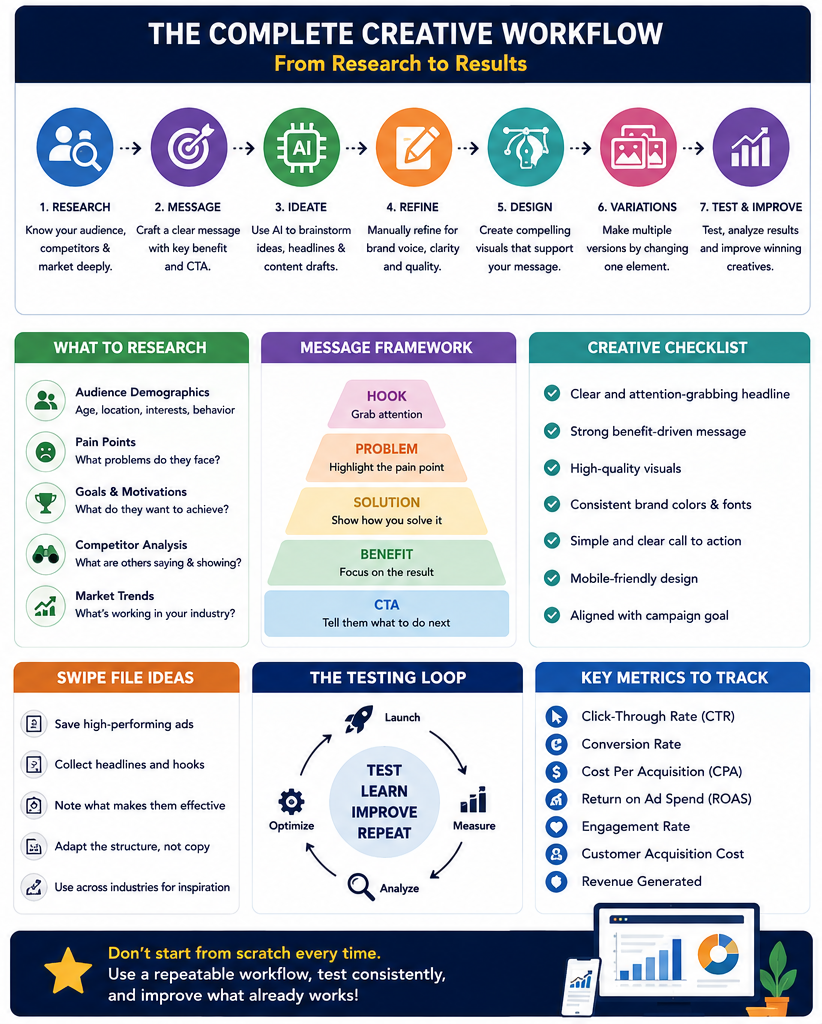
One of the most valuable recommendations is to develop a repeatable workflow.
Rather than creating every campaign differently, businesses should follow the same sequence.
For example:
- Audience research
- Competitor review
- Identify customer pain points
- Define the message
- Write the content
- Review and refine
- Design visuals
- Create variations
- Publish
- Measure performance
- Improve winning creatives
This structured process saves time while improving consistency.
Maintain a Swipe File
A swipe file is a collection of marketing examples that inspire future campaigns.
It may include:
- Advertisements
- Landing pages
- Headlines
- Product pages
- Social media posts
- Email campaigns
- Promotional offers
The discussion recommends using swipe files for inspiration rather than copying content directly.
By studying successful structures, marketers can adapt proven ideas to their own industry while maintaining originality.
For example, a compelling headline formula used in one industry may work equally well when rewritten for another audience.
Testing Is More Important Than Personal Opinion
Perhaps the strongest consensus in the discussion is that testing should guide decisions.
Many marketers rely on personal preference.
For example:
“I like the blue version.”
“This headline sounds better.”
However, customers often respond differently than expected.
Real performance data provides more reliable answers than assumptions.
Testing allows marketers to discover:
- Which headline attracts more attention
- Which image generates more clicks
- Which offer converts better
- Which call to action performs best
Data should drive creative decisions whenever possible.
Improve Winning Creatives
Another valuable recommendation is to improve successful creatives rather than constantly starting over.
If one advertisement performs well, businesses should analyse why.
Possible improvements include:
- Better headline
- Updated image
- Stronger call to action
- Improved product benefit
- Shorter text
- New customer testimonial
Small refinements often produce better long-term results than completely redesigning campaigns.
This approach also preserves the strengths of the original creative.
Track Meaningful Performance Metrics
Creating better marketing requires measuring results.
Useful metrics include:
- Click-through rate
- Conversion rate
- Cost per acquisition
- Engagement rate
- Time on page
- Return on advertising spend
- Lead generation
- Customer acquisition cost
These measurements help identify which creatives deserve further investment.
Without measurement, businesses cannot confidently improve future campaigns.
Avoid Creative Burnout
Following a structured workflow also reduces creative exhaustion.
Instead of constantly searching for new ideas, marketers can focus on improving existing campaigns.
Benefits include:
- Faster production
- Reduced stress
- Better consistency
- Higher confidence
- Easier delegation
- Better collaboration
A documented workflow also makes it easier for teams to work together.
Continue Learning From Every Campaign
Every campaign provides valuable information.
Rather than asking whether a campaign succeeded or failed, marketers should ask:
- What worked well?
- What attracted attention?
- What increased conversions?
- What confused customers?
- What should change next time?
Continuous learning creates stronger campaigns over time.
Building Long-Term Marketing Success
Successful marketing rarely depends on a single advertisement.
Instead, it comes from consistently following effective processes.
Businesses that continually research customers, refine messaging, improve visuals, and measure performance generally outperform those relying only on occasional creative inspiration.
A repeatable workflow creates predictable quality while allowing continuous improvement.
Conclusion
Creating better marketing and content creatives requires more than attractive design. The most effective workflow begins with understanding the audience, researching competitors, identifying customer pain points, and defining a clear message before any visual work begins. Strong messaging provides the foundation for every successful campaign.
Artificial intelligence can accelerate brainstorming and idea generation, but human refinement remains essential to ensure content reflects the brand’s voice, quality standards, and business goals. Consistency, clarity, and authenticity are key elements that cannot be overlooked.
Equally important is developing a repeatable workflow rather than starting from scratch for every campaign. Maintaining a collection of inspiring examples, creating multiple creative variations, and making small improvements to successful content enables businesses to produce marketing more efficiently while maintaining quality.
Finally, testing should guide every major decision. Instead of relying on assumptions or personal preferences, marketers should continuously evaluate performance, learn from results, and refine winning creatives over time. This research-led, message-first, test-driven approach creates a sustainable system for producing high-quality marketing content that resonates with audiences and supports long-term business growth.