Customer support is one of the most important pillars of a successful online business. No matter how excellent the products, competitive the pricing, or attractive the website may be, customers ultimately judge a business by how it responds when questions, concerns, or problems arise. In the early stages of a business, handling customer inquiries is often manageable because order volumes are relatively low. Business owners usually answer emails, messages, and phone calls themselves while also managing inventory, marketing, and daily operations.
However, as sales increase, customer support quickly becomes more demanding. More orders naturally generate more questions about shipping, returns, exchanges, payments, product details, warranties, and account issues. Eventually, responding to every customer personally becomes difficult, and business owners face an important decision: how should customer support scale without sacrificing quality or customer satisfaction?
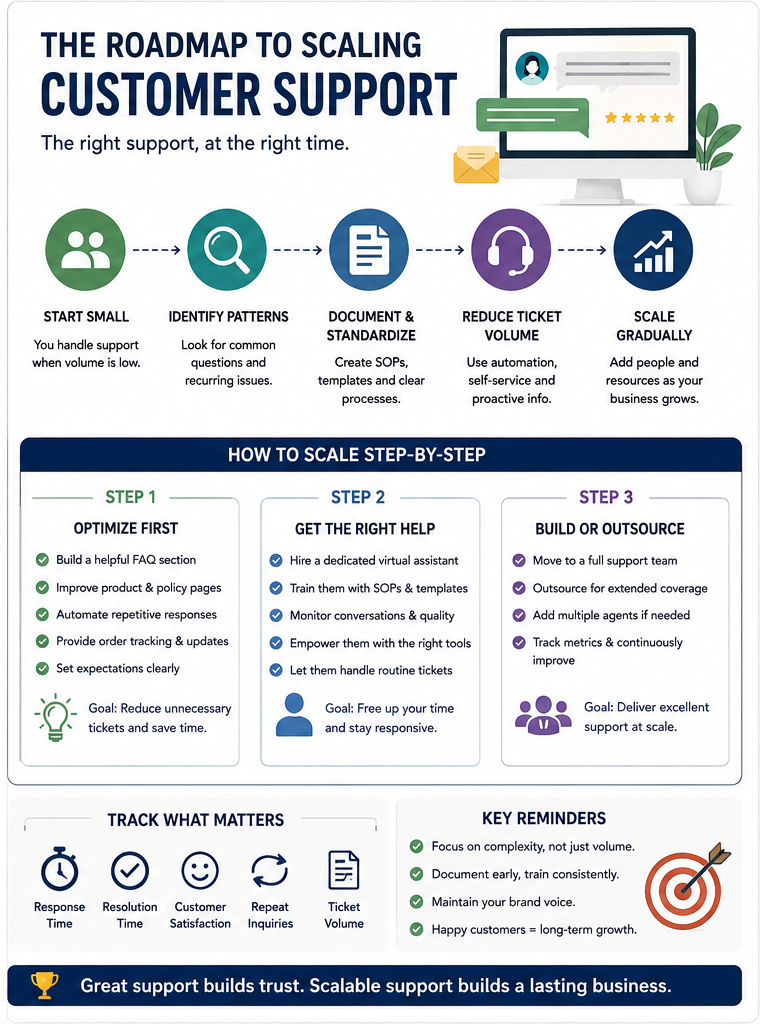
The discussion explores this challenge and emphasizes that there is no universal point at which a business should hire additional support staff. Instead, the decision should depend on the complexity of customer inquiries and the amount of time required to resolve them. Businesses are encouraged to reduce repetitive work through better organization and automation before expanding their support teams. When customer inquiries consistently consume several hours each day, hiring a dedicated assistant becomes a practical next step. Larger support teams or outsourced departments are generally recommended only when ticket volume becomes predictable and requires broader coverage.
Another major recommendation is to document common responses and create standard operating procedures early. Well-documented processes help maintain consistent service quality regardless of who handles customer inquiries.
This article explores how businesses can successfully scale customer support, maintain customer satisfaction during growth, and build efficient support systems that continue delivering excellent service as the business expands.
Why Customer Support Matters
Customer support is much more than answering questions.
Every interaction influences how customers perceive a business.
Excellent customer service can:
- Build trust
- Increase repeat purchases
- Encourage positive reviews
- Improve customer loyalty
- Reduce refund requests
- Strengthen brand reputation
Poor customer service, on the other hand, may lead to negative reviews, lost sales, customer frustration, and damaged credibility.
As businesses grow, maintaining high-quality support becomes increasingly important.
The Early Stages of Customer Support
Most new businesses begin by handling support personally.
Owners typically respond to:
- Product inquiries
- Shipping questions
- Order updates
- Return requests
- Payment concerns
Handling support personally offers several advantages.
Business owners gain direct insight into:
- Customer expectations
- Common problems
- Product feedback
- Purchasing behavior
This early experience often helps improve products, policies, and website information.
Recognizing When Support Becomes Overwhelming
One of the central ideas discussed is recognizing when customer support begins consuming too much time.
Many entrepreneurs delay hiring because they believe they should continue handling everything themselves.
However, excessive time spent answering routine questions can reduce attention available for:
- Business development
- Marketing
- Product sourcing
- Financial planning
- Strategic growth
Support should not prevent business owners from focusing on long-term success.
Ticket Complexity Matters More Than Store Size
An important recommendation from the discussion is that the decision to expand customer support should depend more on inquiry complexity than total sales volume.
For example:
A business receiving hundreds of simple shipping questions may require less specialized support than a business receiving fewer but highly technical product inquiries.
Complexity determines how much expertise and training support representatives require.
Therefore, businesses should evaluate the nature of customer requests rather than focusing only on order numbers.
Identifying Repetitive Questions
Many customer inquiries follow predictable patterns.
Common examples include:
- Where is my order?
- When will my package arrive?
- How do I return an item?
- What are your shipping rates?
- Is this product available?
- Can I change my order?
Identifying these recurring questions helps businesses improve efficiency.
Reducing repetitive inquiries often provides greater benefits than simply hiring more staff.
Improving Self-Service Resources
One effective strategy involves giving customers the information they need before they contact support.
Businesses can improve self-service by providing:
- Frequently asked questions
- Shipping information
- Return policies
- Product guides
- Size charts
- Order tracking instructions
Well-organized information allows customers to solve simple problems independently.
This reduces overall support workload while improving customer satisfaction.
Standardizing Responses
Another important recommendation is documenting common responses.
Standard responses help ensure:
- Consistency
- Accuracy
- Faster replies
- Better training
Rather than rewriting similar messages repeatedly, businesses can prepare clear templates for common situations.
This improves efficiency without reducing service quality.
Creating Standard Operating Procedures
The discussion strongly emphasizes developing standard operating procedures.
These documents explain exactly how customer inquiries should be handled.
They may include:
- Greeting guidelines
- Refund procedures
- Escalation rules
- Return processes
- Shipping policies
- Complaint resolution steps
Clear documentation allows new team members to learn quickly while maintaining consistent customer experiences.
Why Documentation Is Essential
Without documented procedures, customer service quality often depends on individual experience.
Different employees may provide different answers to the same question.
This inconsistency creates confusion.
Documentation ensures every representative follows the same policies and communicates consistent information.
Consistency builds customer confidence.
Reducing Manual Work
Businesses should examine which support activities consume unnecessary time.
Examples include:
- Copying similar responses
- Looking up order information
- Repeating policy explanations
- Updating customers individually
Reducing repetitive manual work allows support teams to focus on situations requiring human judgment and empathy.
Knowing When to Hire
The discussion suggests that when customer support consistently occupies several hours each day, businesses should consider hiring additional help.
Waiting too long may create:
- Slower response times
- Employee burnout
- Customer frustration
- Missed sales opportunities
Hiring should be based on workload rather than emotions.
The goal is maintaining service quality while supporting business growth.
Starting with a Virtual Assistant
For many growing businesses, hiring a dedicated virtual assistant represents a practical first step.
This approach offers several advantages:
- Lower operating costs
- Flexible working hours
- Scalable support
- Administrative assistance
Virtual assistants can often manage routine customer communication while business owners continue focusing on strategic responsibilities.
Training New Team Members
Hiring alone does not solve support challenges.
Proper training remains essential.
Training should cover:
- Company policies
- Product knowledge
- Communication standards
- Problem-solving techniques
- Customer expectations
Well-trained representatives respond more confidently while reducing costly mistakes.
Maintaining Brand Voice
Customers should receive consistent experiences regardless of who answers their questions.
Businesses should define:
- Communication style
- Tone of voice
- Professional language
- Response expectations
A consistent brand voice strengthens customer relationships while reinforcing brand identity.
Escalating Complex Issues
Not every inquiry requires the same level of expertise.
Businesses should establish clear escalation procedures.
Routine questions may be handled by support representatives.
More complex situations involving:
- Technical issues
- Legal concerns
- Large refunds
- Special requests
- Customer disputes
may require management review.
Clear escalation processes improve efficiency while protecting customer relationships.
Monitoring Performance
Growing support teams should regularly evaluate performance.
Useful measurements include:
- Response time
- Resolution time
- Customer satisfaction
- Repeat inquiries
- Complaint frequency
- Resolution accuracy
Monitoring these indicators helps identify opportunities for improvement.
Balancing Speed and Quality
Customers appreciate quick responses.
However, speed should never replace accuracy.
Incorrect information often creates additional work later.
Support teams should aim for:
- Prompt replies
- Correct information
- Professional communication
- Complete solutions
Quality remains the ultimate objective.
Outsourcing Customer Support
As businesses continue growing, outsourcing may become an option.
External support teams can provide:
- Extended operating hours
- Multiple support agents
- Flexible staffing
- Increased capacity
However, outsourcing should only occur after processes are thoroughly documented.
Well-defined procedures help maintain service quality regardless of who provides support.
Building an Internal Support Department
Large businesses sometimes establish dedicated internal support departments.
This approach offers:
- Greater quality control
- Deeper product knowledge
- Stronger collaboration
- Better communication
Internal teams often become appropriate when customer inquiries remain consistently high over extended periods.
The Human Element
Although efficiency is important, customer support remains a human-centered activity.
Customers appreciate:
- Empathy
- Patience
- Respect
- Honest communication
- Personal attention
Even highly organized support systems should preserve genuine human interaction whenever possible.
Strong relationships encourage long-term customer loyalty.
Learning from Customer Feedback
Every support conversation provides valuable information.
Businesses should regularly analyze:
- Frequently asked questions
- Product complaints
- Feature requests
- Website confusion
- Shipping concerns
These insights often reveal opportunities to improve products, processes, or customer education.
Support should contribute to continuous business improvement rather than simply solving immediate problems.
Preventing Future Questions
Excellent customer support involves preventing problems before they occur.
Businesses can reduce future inquiries by:
- Improving product descriptions
- Providing clearer shipping estimates
- Simplifying return policies
- Enhancing order updates
- Improving packaging instructions
Reducing customer confusion decreases overall support volume while improving customer experiences.
Supporting Business Growth
As companies expand, customer support should evolve alongside every other business function.
Support systems must remain flexible enough to handle increasing demand while maintaining consistent service quality.
Scalable customer support allows businesses to grow confidently without sacrificing customer satisfaction.
Conclusion
Scaling customer support is not simply about hiring more people. It involves creating efficient systems, documenting processes, reducing repetitive work, and maintaining consistent service quality as the business grows. Rather than focusing solely on store size or sales volume, businesses should evaluate the complexity of customer inquiries, the amount of time required to manage support, and the overall impact on daily operations.
Developing clear standard operating procedures, preparing consistent responses, improving customer self-service resources, and hiring additional assistance when workloads become substantial all contribute to sustainable customer support growth. Whether support is managed by the business owner, a dedicated assistant, an outsourced team, or a fully developed internal department, the ultimate objective remains the same: providing reliable, professional, and customer-focused service.
Businesses that invest in scalable support systems not only improve operational efficiency but also strengthen customer trust, increase loyalty, encourage repeat business, and build a stronger reputation in increasingly competitive online markets. By treating customer support as a strategic function rather than simply an operational necessity, businesses create a foundation for long-term growth and lasting customer relationships.