Traffic, Conversions, and Growth
After investing time and money into improving an online store, one of the biggest questions a business owner faces is: What should I do next to bring more customers and increase sales?
This question becomes especially important when a store has already gone through improvements such as better collections, search optimization, new applications, improved product pages, or other technical changes.
At that point, simply making more changes to the store may not be enough. The business needs to understand whether the real problem is lack of traffic, poor conversion, weak customer retention, or a combination of these issues.
A discussion about finding a marketing expert for a Shopify store highlights several approaches to solving this problem. Some participants recommend paid advertising, search optimization, email marketing, conversion optimization, and retargeting. Others suggest first diagnosing the store before spending more money. Another perspective is that business owners can learn marketing themselves instead of depending completely on an agency.
The most important lesson from the discussion is that marketing should begin with understanding the actual problem.
More Traffic Does Not Automatically Mean More Sales
One of the most common assumptions in ecommerce is that increasing traffic will automatically increase revenue.
Imagine an online store receives only 1,000 visitors per month and generates 10 orders.
The owner might conclude that the store simply needs more visitors.
But suppose another 1,000 visitors are added and the store still generates only 10 additional orders. The traffic increased, but the underlying conversion problem was not solved.
Now imagine the store converts a much larger percentage of visitors but receives very little traffic. In this case, increasing qualified traffic could have a much greater impact.
This is why a business needs to distinguish between two major problems:
Traffic problem: Not enough relevant people are visiting the store.
Conversion problem: People are visiting, but too few are purchasing.
These problems require different solutions.
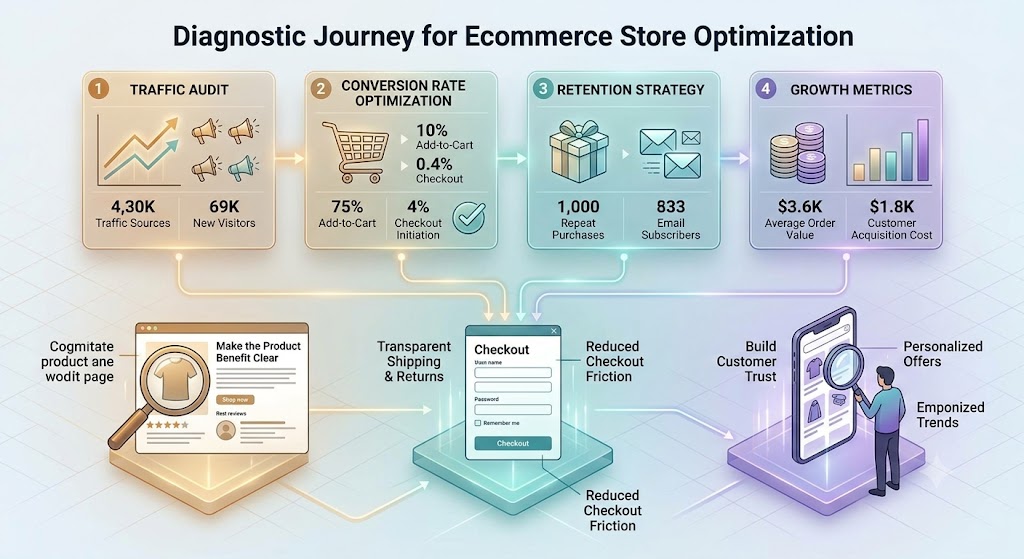
Start With a Store Diagnosis
Before increasing an advertising budget, it can be useful to examine how the store currently performs.
A basic diagnosis should look at:
- Website traffic
- Traffic sources
- Product page visits
- Add-to-cart rate
- Checkout initiation
- Purchase rate
- Average order value
- Customer acquisition cost
- Repeat purchases
- Abandoned carts
- Product-level performance
This information helps reveal where potential customers are leaving the buying journey.
For example, if thousands of people visit a product page but very few add the product to their cart, the issue may be related to the product presentation, price, trust, or offer.
If many people add products to their carts but very few complete checkout, there may be concerns around shipping costs, payment options, delivery expectations, or checkout friction.
If the store has a strong conversion rate but very little traffic, marketing and customer acquisition may deserve more attention.
Without this diagnosis, increasing advertising expenditure can simply increase the number of people reaching a store that is not converting efficiently.
Make the Product Benefit Clear
One of the perspectives in the discussion focuses on the importance of clearly communicating product benefits.
Visitors should quickly understand:
What is this product?
What problem does it solve?
Why should I buy it?
Why should I buy it from this store?
A product page can contain beautiful images and detailed information but still fail to communicate its primary value.
For example, a product description that simply lists technical specifications may not explain how the product improves the customer’s situation.
A stronger product presentation connects features to customer benefits.
Instead of only explaining what a product contains, the store should help customers understand how it can be useful to them.
This becomes particularly important when competing products are easily available elsewhere.
Customer Reviews Build Confidence
Online customers cannot physically inspect most products before purchasing.
Reviews can therefore play an important role in reducing uncertainty.
A customer may have questions such as:
- Is the product actually good?
- Does it look like the pictures?
- Is the quality reliable?
- Did other customers receive it on time?
- Does the product perform as expected?
Reviews provide evidence from previous customers.
They can be especially useful for first-time visitors who have never purchased from the store.
However, reviews should be presented naturally and transparently. The goal is to help customers make an informed decision rather than overwhelm them with promotional claims.
Reviews can appear near product information, purchasing sections, or other points where customers may hesitate.
Shipping and Return Information Should Be Visible
Another important conversion factor is transparency around shipping and returns.
Customers often hesitate when they do not know:
- How much shipping costs
- How long delivery will take
- Where products are shipped from
- Whether returns are accepted
- How long a refund takes
- What conditions apply to returns
If this information is difficult to find, customers may leave the website before purchasing.
Clear shipping and return information reduces uncertainty.
For an ecommerce store, these details should not be treated as minor information hidden at the bottom of a page. They can directly affect a customer’s willingness to complete an order.
Paid Advertising Can Increase Qualified Traffic
If the store has a solid foundation and the primary issue is insufficient traffic, paid advertising can become an important growth channel.
Social advertising can help businesses reach specific audiences based on interests, behaviors, demographics, and previous interactions.
Search advertising can capture people who are actively looking for products or solutions.
However, advertising should focus on qualified traffic, not simply large traffic numbers.
Sending thousands of irrelevant visitors to a store may produce impressive traffic statistics without generating meaningful revenue.
The goal is to attract people who have a genuine possibility of becoming customers.
Start With a Controlled Advertising Budget
One response in the discussion specifically asks about the current monthly advertising budget.
That question is important because advertising strategy cannot be separated from available resources.
A business spending a few hundred dollars per month has different testing possibilities from a business spending several thousand dollars.
The budget determines:
- Number of campaigns that can be tested
- Number of audiences that can be tested
- Amount of creative testing
- Time required to collect data
- Ability to scale successful campaigns
A sensible approach is to start with a controlled testing budget and evaluate performance before making major increases.
The objective is not simply to spend more.
The objective is to determine whether the advertising produces customers at an economically sustainable cost.
Retargeting Helps Reconnect With Interested Visitors
Not every visitor purchases during their first visit.
A customer might browse a product, compare prices, leave the store, and return several days later.
Retargeting allows businesses to communicate again with people who have already interacted with the store.
This audience can include:
- Previous website visitors
- Product viewers
- Cart abandoners
- Previous customers
These people have already demonstrated some level of interest.
However, retargeting should provide a useful reason for the customer to return rather than simply repeating the same advertisement indefinitely.
Different audiences may also require different messages.
Someone who only viewed a product may need additional information.
Someone who added the product to their cart may need reassurance about shipping or returns.
A previous customer may be interested in complementary products.
Email Marketing Supports Customer Retention
Advertising is often focused on acquiring new customers, but ecommerce growth also depends on retaining existing customers.
Email marketing can help businesses communicate with customers after their initial interaction.
Useful communication can include:
- Welcome messages
- Product education
- Order updates
- Abandoned-cart reminders
- Post-purchase information
- Product recommendations
- Customer re-engagement
The purpose is not to send constant promotional messages.
Effective email communication should provide useful information at appropriate stages of the customer journey.
Existing customers may also be more familiar with the brand, making retention an important part of the overall marketing strategy.
Conversion Rate Optimization Is an Ongoing Process
Conversion rate optimization, or CRO, is the process of improving the store so that a larger percentage of relevant visitors take the desired action.
That action could be:
- Adding a product to the cart
- Starting checkout
- Completing a purchase
- Signing up for an email list
- Requesting information
CRO can involve many different elements.
For example:
- Product page layout
- Headlines
- Product images
- Pricing presentation
- Calls to action
- Reviews
- Shipping information
- Return policies
- Checkout experience
- Trust information
Even small changes can sometimes affect customer behavior.
Testing Different Versions Can Reveal What Works
One suggested approach is testing different versions of landing pages.
For example, a store might have two versions of a product page.
Version A emphasizes product features.
Version B emphasizes customer benefits.
If both versions are shown to comparable audiences over an appropriate testing period, the business can compare their results.
The important point is to make decisions based on evidence rather than personal preference.
A design that looks better to the store owner may not necessarily perform better with customers.
Testing can therefore turn assumptions into measurable observations.
Search Optimization Has Long-Term Value
Paid advertising can produce traffic while campaigns are running.
Search optimization can help a store attract visitors through unpaid search results over a longer period.
Improving search visibility may involve:
- Product titles
- Product descriptions
- Category pages
- Search-friendly content
- Internal linking
- Technical site quality
- Useful informational content
Search optimization generally takes time.
It should therefore be viewed as a longer-term marketing activity rather than an immediate replacement for paid acquisition.
A balanced strategy can combine short-term customer acquisition efforts with longer-term efforts to build organic visibility.
Should You Hire an Agency or Learn Marketing Yourself?
The discussion contains different opinions about whether a business should hire an outside marketing expert or learn marketing internally.
There is no universal answer.
Hiring an experienced marketing professional can provide access to specialized knowledge and save the business owner time.
On the other hand, understanding basic marketing principles internally can help the business owner evaluate campaigns, understand performance reports, and make better decisions about where money is being spent.
Even when working with an agency, the business owner benefits from understanding basic concepts such as:
- Conversion rate
- Customer acquisition cost
- Return on advertising spend
- Average order value
- Customer lifetime value
- RTO or return rates where relevant
- Repeat purchase rate
This knowledge makes it easier to evaluate whether marketing activity is producing meaningful business results.
Store Data and Inventory Management Matter Too
Marketing cannot operate independently from the rest of the business.
Imagine an advertising campaign successfully generates demand for a product, but the product is out of stock.
The advertising may have generated interest, but the business cannot convert that interest into sales.
Similarly, inaccurate pricing, incorrect product information, or outdated inventory can create customer frustration.
This is why accurate product and inventory management is an important part of ecommerce marketing.
Marketing brings customers to the store.
The store must then provide accurate information and a reliable purchasing experience.
Avoid Scaling Before Understanding the Numbers
One of the strongest ideas in the discussion is to diagnose the store before aggressively increasing advertising.
Suppose a store spends ₹50,000 on advertising and generates 100 orders.
The owner may decide to spend ₹1,00,000 next month.
But before doing that, it is important to understand:
- How much revenue came from those orders?
- What was the product cost?
- What was the shipping cost?
- What was the actual advertising cost per customer?
- How many customers returned their orders?
- How many customers may purchase again?
- Which products generated the best results?
Without these answers, increasing the budget can increase expenses faster than profits.
A Practical Marketing Process
A structured approach can make marketing decisions easier.
Step 1: Audit the Store
Review product pages, collections, navigation, pricing, shipping information, return policies, and customer trust signals.
Step 2: Identify the Main Problem
Determine whether the biggest issue is traffic, conversion, customer retention, or a combination.
Step 3: Improve the Customer Journey
Make product benefits, reviews, shipping information, returns, and purchasing steps easy to understand.
Step 4: Establish Baseline Metrics
Record traffic, conversion rate, average order value, acquisition cost, and revenue before major changes.
Step 5: Test Traffic Sources
Use controlled advertising and other acquisition methods to determine which sources bring relevant visitors.
Step 6: Improve Conversion
Test product pages, offers, messaging, and other customer-facing elements.
Step 7: Build Retention
Develop appropriate email communication and customer re-engagement strategies.
Step 8: Review the Data
Compare marketing costs with actual sales and profitability rather than focusing only on clicks or traffic.
Step 9: Scale Based on Evidence
Increase investment in activities that demonstrate sustainable business results.
Conclusion
The discussion about finding a marketing expert for a Shopify store highlights an important ecommerce principle: marketing is not simply about getting more visitors.
A successful strategy needs to connect traffic acquisition, conversion, customer trust, retention, and business economics.
Paid advertising can help bring qualified visitors. Search optimization can build longer-term visibility. Email marketing can support customer retention. Retargeting can reconnect with interested visitors. Conversion optimization can help turn more relevant visitors into customers.
But these activities should not be implemented blindly.
Before spending more money, a business should understand whether it actually has a traffic problem or a conversion problem.
Clear product benefits, customer reviews, transparent shipping and return information, accurate inventory, and a smooth purchasing experience can all influence whether visitors become customers.
At the same time, marketing performance should be measured using meaningful business metrics rather than vanity numbers.
The central lesson is that growth should be data-driven and connected to the entire customer journey.
A store does not necessarily need more traffic simply because sales are low. It may need better conversion. Conversely, a well-optimized store may need more qualified visitors.
Understanding that difference allows the business to invest its time and marketing budget more deliberately.
Whether marketing is handled internally, through specialists, or through a combination of both, the fundamental process remains the same: understand the problem, test possible solutions, measure the results, and improve based on evidence.


0 Comments