Supplier fulfillment is one of the most important parts of ecommerce operations, especially for stores that depend on external suppliers to process and ship customer orders. A store may attract customers successfully, receive orders consistently, and maintain a strong product catalog, but delays at the supplier level can quickly damage the customer experience.
A delayed order may lead to customer complaints, refund requests, cancellations, negative reviews, and lost repeat business. The difficult part is that merchants may not always discover supplier problems early enough.
A recent Shopify Community discussion explores an idea designed to solve this problem. A system has been built to monitor store orders and identify potential supplier fulfillment issues. It looks for two major warning signals: orders that remain unfulfilled longer than expected and suppliers whose fulfillment speed becomes slower compared with their own normal performance.
However, the discussion goes beyond the basic idea of detecting slow suppliers. One of the biggest questions raised is whether a store’s data actually contains enough reliable information to identify suppliers accurately.
This is an important issue because Shopify does not have a universal native supplier object that automatically tells a merchant which company is responsible for fulfilling every product. A product’s vendor information may represent the brand or manufacturer rather than the actual fulfillment source.
Therefore, before a system can accurately compare supplier performance, it needs reliable supplier identification.
Why Identifying the Supplier Is So Important
Imagine a store sells 500 different products and works with ten fulfillment partners.
If the system receives an order for a particular product, it needs to know which supplier should receive responsibility for that order.
Without this information, it cannot accurately calculate supplier-specific fulfillment times.
For example, suppose three different suppliers are involved:
- Supplier A normally fulfills orders within one day.
- Supplier B normally takes three days.
- Supplier C normally takes five days.
If an order takes four days to fulfill, that means something very different for each supplier.
For Supplier A, four days could represent a significant slowdown.
For Supplier B, it could be slightly slower than normal.
For Supplier C, four days might actually be faster than its typical performance.
Therefore, supplier identification is the foundation of any supplier-performance monitoring system.
If the supplier data is incorrect, the resulting alerts can also be incorrect.
The Vendor Field Does Not Always Mean Supplier
One of the major concerns raised in the discussion is the difference between a product’s vendor and its actual fulfillment source.
In many ecommerce catalogs, the vendor field represents a brand, manufacturer, wholesaler, or another business associated with the product.
That does not necessarily mean the vendor is the company fulfilling the order.
For example, a store might sell products from Brand A but receive inventory from Warehouse B.
The product’s vendor could be recorded as Brand A even though Warehouse B is responsible for fulfillment.
If a monitoring system assumes that the vendor field always identifies the fulfillment supplier, it could group orders incorrectly.
This can create misleading performance statistics.
The system might conclude that Brand A is becoming slower when the actual issue is with a separate fulfillment partner.
This is why merchants need to understand how supplier information is represented in their own store data.
How Merchants Can Represent Supplier Information
There are several ways a store can maintain supplier information.
A merchant might use:
- Product tags
- Custom product fields
- Order tags
- Inventory locations
- Catalog attributes
- Structured supplier records maintained outside the product catalog
The best approach depends on how the business operates.
A small store working with a few suppliers might maintain supplier information manually.
A larger store with hundreds of products may need a more structured system.
The important point is consistency.
If one group of products identifies the supplier using tags while another group uses a custom field and another group does not identify the supplier at all, automated monitoring becomes difficult.
The data needs to be predictable enough for supplier performance to be measured accurately.
Catalog Cleanup May Be Necessary
The discussion also highlights a less obvious issue: supplier monitoring can expose problems in the store’s underlying product data.
A merchant may think they know which supplier handles each product, but the store catalog may contain outdated or inconsistent information.
For example:
- A product may have an old supplier name.
- Several products may have missing supplier information.
- Two suppliers may be represented by different spellings.
- A product may have changed suppliers without its catalog data being updated.
- One vendor name may represent several different fulfillment sources.
Before implementing automated supplier monitoring, merchants may therefore need to clean up their catalog.
This may seem like additional work, but accurate supplier data is essential for meaningful performance analysis.
Measuring Fulfillment Time
Once supplier identity is reliable, the next question is how to measure fulfillment performance.
A simple approach is to calculate the amount of time between order creation and fulfillment.
For example:
An order is placed on Monday at 10 AM.
The supplier fulfills it on Wednesday at 10 AM.
The fulfillment time is approximately two days.
By collecting this information across many orders, a merchant can calculate typical fulfillment performance for each supplier.
However, using only the average can sometimes be misleading.
A few extremely delayed orders can significantly increase the average.
For this reason, the discussion suggests using more robust measurements such as the median and the 90th percentile.
Why the Median Can Be Useful
The median represents the middle value in a dataset.
Suppose a supplier’s fulfillment times are:
1 day, 1 day, 2 days, 2 days, 2 days, 3 days, 3 days, 4 days, 10 days.
The average can be pushed upward by the 10-day delay.
The median, however, remains closer to the typical experience.
This can make the median useful for understanding a supplier’s normal fulfillment behavior.
If a supplier normally has a median fulfillment time of two days, a sudden increase to four days may deserve attention.
Understanding the 90th Percentile
The 90th percentile provides another useful perspective.
It represents a fulfillment time below which roughly 90% of historical orders fall.
For example, suppose a supplier has:
- Median fulfillment time: 2 days
- 90th percentile: 4 days
This means most orders are fulfilled within a few days, while the slowest portion of orders takes longer.
Now imagine that during the most recent two weeks, many orders are taking six or seven days.
That is different from simply having one unusually late order.
The supplier’s recent performance may have moved outside its normal historical range.
This is the type of change that an alerting system can be designed to detect.
Comparing Recent Performance With Historical Performance
The suggested validation approach is particularly interesting because it does not rely on an arbitrary universal threshold.
Instead, it compares a supplier against its own historical behavior.
One proposed method is:
- Take order data from the last 90 days.
- Identify each supplier.
- Calculate the supplier’s median fulfillment time.
- Calculate the supplier’s 90th-percentile fulfillment time.
- Examine the most recent two weeks.
- Compare recent fulfillment performance with the historical 90th percentile.
- Identify suppliers whose recent performance is consistently outside their normal range.
This creates a supplier-specific benchmark.
A supplier is not considered slow simply because it takes more than a fixed number of days.
It is considered potentially problematic when its current performance is significantly worse than its own historical pattern.
Why 90 Days of Data Can Matter
Historical data is important because a supplier’s normal performance cannot be understood from just a handful of orders.
Suppose a supplier has fulfilled only three orders.
Their fulfillment times are:
1 day, 2 days, and 5 days.
It is difficult to determine what “normal” means from such a small sample.
With 90 days of historical data and a larger number of orders, the merchant can build a more meaningful baseline.
However, even 90 days may not be sufficient for every store.
A supplier with very low order volume may still have too little data.
This creates one of the central unanswered questions in the discussion:
How much historical data is required before an alert becomes reliable?
The Cold-Start Problem
New suppliers create a particular challenge.
Suppose a merchant begins working with a new supplier today.
There is no historical performance data for that supplier.
The monitoring system cannot confidently determine whether the supplier’s current fulfillment time is normal or unusually slow.
This is known as a cold-start problem.
A new supplier may require a minimum number of completed orders before meaningful benchmarks can be established.
For example, a system might monitor the supplier initially without generating strong performance judgments until enough data has accumulated.
This reduces the risk of creating alerts based on very limited evidence.
Business Days Versus Calendar Days
Another useful suggestion from the discussion is to consider measuring fulfillment time in business days.
A supplier may not operate on weekends.
Suppose a customer places an order on Friday and the supplier fulfills it on Monday.
Counting calendar days may make the fulfillment time appear longer than it actually was from the supplier’s operational perspective.
Business-day calculations can provide a more realistic measure when suppliers have standard working schedules.
However, the appropriate method depends on the merchant’s fulfillment promise and the supplier’s operating model.
The important thing is to use a consistent measurement method.
Fulfillment Versus Carrier First Scan
For dropshipping businesses, another important distinction is the difference between fulfillment and actual carrier movement.
A supplier may mark an order as fulfilled after generating shipping information.
But that does not necessarily mean the package has physically entered the delivery network.
This is why the discussion suggests using the carrier’s first scan when possible.
The first carrier scan can provide a stronger indication that the package has actually entered the shipping process.
For example:
Order placed → Supplier processes order → Shipping information created → Carrier receives package → First carrier scan
If the system measures only the “fulfilled” status, it may miss delays occurring between fulfillment marking and actual carrier handoff.
For dropshipping, this distinction can be particularly important.
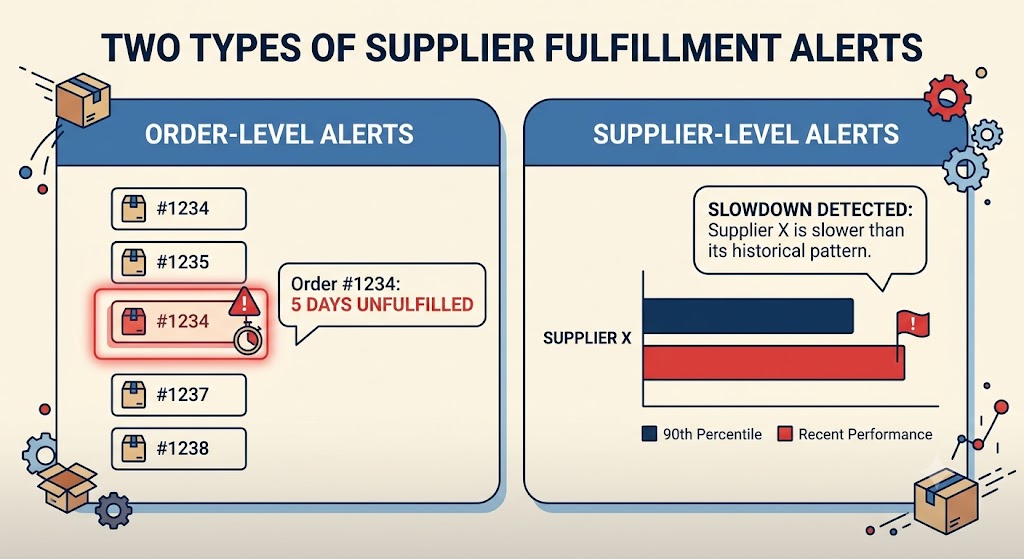
Supplier-Level Alerts Versus Order-Level Alerts
Another unanswered question is what type of alert merchants actually want.
There are two main possibilities.
Order-Level Alerts
These identify specific orders that are taking too long.
For example:
“Order #1234 has remained unfulfilled for five days.”
This type of alert gives the merchant a specific customer issue to investigate.
Supplier-Level Alerts
These identify broader performance changes.
For example:
“Supplier A’s recent fulfillment performance is significantly slower than its historical pattern.”
This type of alert tells the merchant that a larger operational problem may be developing.
Both can be useful, but they serve different purposes.
An order-level alert is focused on an individual customer.
A supplier-level alert is focused on operational management.
The discussion has not yet established which type merchants would prioritize.
Why Both Levels May Be Valuable
From an operational perspective, these two signals can complement each other.
A supplier-level warning can help identify a developing trend.
An order-level warning can help address immediate customer problems.
For example, a supplier may start slowing down.
The supplier-level alert identifies the trend.
At the same time, several individual orders may already be approaching or exceeding their expected fulfillment window.
The merchant can then investigate those orders specifically while also contacting the supplier about the broader slowdown.
This creates a more complete view of the problem.
Validating the Idea With Real Merchant Data
The creator’s decision to ask merchants about supplier counts and unfulfilled orders is important because product validation should be based on real operational conditions.
It is easy for people to say that an idea sounds useful.
A more meaningful validation question is whether merchants actually experience the problem frequently enough to care about solving it.
For example, a merchant with:
- 2 suppliers
- 20 monthly orders
- Very few delays
may not have a strong need for advanced monitoring.
Another merchant with:
- 30 suppliers
- Thousands of monthly orders
- Frequent fulfillment delays
may face a completely different operational challenge.
The second business has more complexity, more data, and potentially more financial impact from supplier problems.
What the Creator Still Needs to Learn
Several questions remain important before the system can be considered broadly useful.
First, do merchants consistently maintain supplier information?
Second, how many orders are required to establish a reliable supplier baseline?
Third, should historical performance be calculated over 30, 60, 90, or another number of days?
Fourth, should the system measure calendar days or business days?
Fifth, should fulfillment be based on the store’s fulfillment timestamp or the carrier’s first physical scan?
Sixth, do merchants care more about supplier-level trends or individual delayed orders?
These questions are not simply technical details. They determine whether alerts will be useful or become another source of noise.
Conclusion
The discussion presents a practical approach to identifying supplier fulfillment problems before they become serious customer-service issues.
The central idea is to monitor order fulfillment and compare supplier performance against historical behavior. However, accurate monitoring depends heavily on accurate supplier identification.
Because the vendor field may represent a brand rather than the actual fulfillment source, merchants may need to maintain supplier information through consistent product data, tags, custom fields, locations, or other catalog structures.
Once supplier identity is reliable, historical fulfillment data can be used to establish meaningful benchmarks. Median fulfillment time can describe typical performance, while the 90th percentile can help identify the upper range of normal fulfillment behavior.
Comparing the most recent two weeks against a supplier’s historical 90-day performance can provide a useful starting point for identifying potential slowdowns.
At the same time, the discussion recognizes several limitations. New suppliers may not have enough historical data, fulfillment timestamps may not perfectly represent physical shipping activity, and calendar days may not accurately reflect supplier working schedules.
The distinction between supplier-level and order-level alerts is also important. One identifies broader performance changes, while the other highlights specific customer orders that require attention.
Ultimately, the concept still needs validation from real merchants. The key question is not simply whether supplier monitoring sounds useful, but whether merchants have reliable supplier data, enough order history, and enough fulfillment problems for automated alerts to provide meaningful value.
For ecommerce businesses that depend on multiple suppliers, this type of monitoring could become a useful way to move from reactive problem-solving toward proactive fulfillment management—provided the underlying data is accurate and the alerts are based on meaningful historical patterns.

0 Comments