Launching a new product is one of the biggest decisions an ecommerce business has to make. One of the first questions a seller faces is simple but difficult:
Should you order a small quantity and test the product first, or should you purchase a large amount from the beginning?
There is no single answer that works for every business. The right decision depends on factors such as product complexity, supplier reliability, production time, available cash, customer demand, expected margins, and how quickly additional inventory can be produced.
The Shopify Community discussion around this topic presents different viewpoints. Some sellers believe a product should only be purchased in large quantities after extensive research and testing. Others strongly prefer small initial orders because they reduce financial risk and provide real-world information before scaling.
A particularly useful approach combines both ideas: test small, but plan the supply chain for growth from the beginning.
Why Large Initial Orders Can Be Attractive
Buying a large quantity often comes with a lower cost per unit.
A supplier may offer better pricing when the order increases from 50 units to 500 units. This can make the product appear more profitable.
Large orders can also provide other advantages:
- Lower manufacturing costs
- Lower shipping cost per unit
- Better production priority
- More consistent inventory availability
- Ability to meet increasing customer demand immediately
- Potentially higher profit margins
For an established product with predictable demand, these benefits can make sense.
The problem is that a new product does not yet have predictable demand.
You may believe customers will purchase it, but the market can respond differently.
The product may sell more slowly than expected. Customers may dislike the design. The selling price may be too high. The supplier’s quality may not be consistent. Shipping may take too long. Advertising may cost more than expected.
A large inventory purchase turns these uncertainties into financial risk.
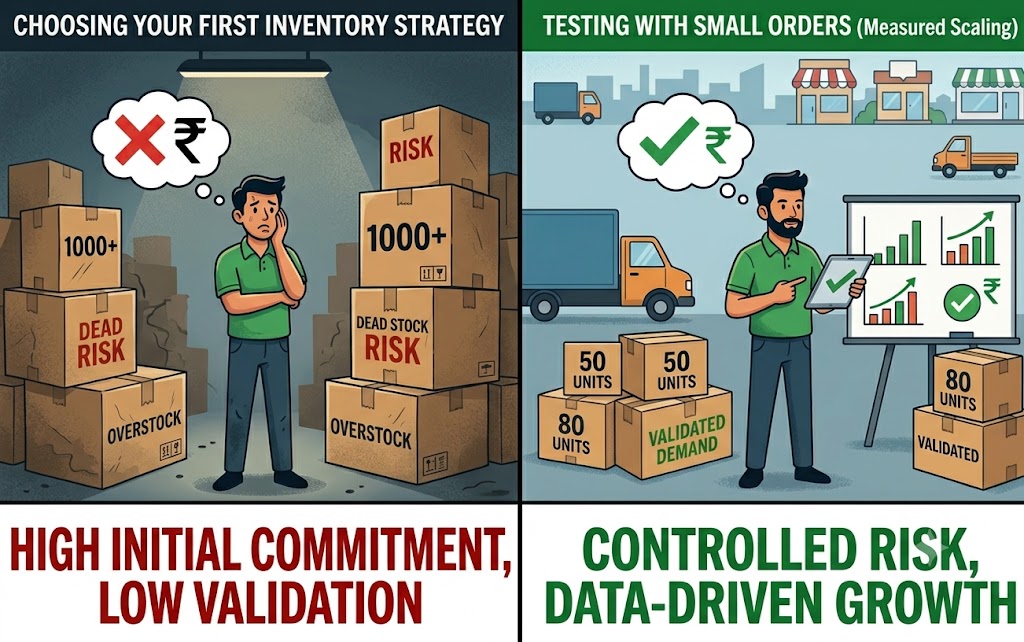
The Problem of Dead Stock
Dead stock is inventory that remains unsold for a long period.
It can become one of the most expensive mistakes for a small ecommerce business.
Suppose a seller invests ₹1,00,000 in a new product and expects to sell everything within two months. Instead, only 20% of the inventory sells.
The remaining stock represents money that is already spent but has not generated revenue.
The seller then has several choices:
- Continue marketing the product
- Reduce the price
- Create bundles
- Offer discounts
- Modify the product
- Sell through another channel
- Hold the stock and wait
- Accept a loss and clear the inventory
None of these outcomes is ideal.
The larger the initial purchase, the larger the potential dead-stock problem.
This is why small initial orders can be valuable for products whose demand is uncertain.
Why Small Test Orders Make Sense
A small test order reduces the amount of money committed before the product is validated.
Instead of purchasing six months of inventory, a seller can purchase enough for an initial testing period.
This allows the seller to learn:
- Whether customers are interested
- How quickly the product sells
- Whether the price is acceptable
- Whether the product quality meets expectations
- Whether customers complain about anything
- Whether packaging works properly
- Whether the supplier delivers consistently
- Whether shipping creates problems
- Whether marketing produces profitable sales
The seller can then make a larger inventory decision based on actual evidence.
The first batch becomes more than inventory.
It becomes a market test.
Small Does Not Mean Unplanned
There is an important distinction between starting small and starting without preparation.
A seller can place a small first order while simultaneously preparing for future growth.
For example, before ordering the first batch, the seller can discuss:
- Future production capacity
- Expected reorder time
- Pricing at different quantities
- Material availability
- Production schedules
- Quality standards
- Packaging requirements
- Shipping expectations
This makes the testing process much stronger.
The seller is not simply asking, “Can I buy 50 units?”
The seller is asking:
“If these 50 units sell successfully, how quickly can I obtain the next 100 or 500?”
That question can be more important than the initial unit price.
Reorder Speed Can Matter More Than Bulk Pricing
One of the strongest ideas from the discussion is that inventory decisions should consider reorder speed, not just supplier discounts.
Imagine two suppliers.
Supplier A offers a very low price but needs 45 days to produce another batch.
Supplier B charges slightly more but can replenish inventory within 7 days.
If demand suddenly increases, Supplier A may leave the seller without stock for more than a month.
Supplier B provides more flexibility.
Therefore, a slightly higher purchase price can sometimes be acceptable if it gives the business faster access to additional inventory.
The real cost of inventory is not simply the purchase price.
It also includes the opportunity cost of:
- Running out of stock
- Losing customers
- Pausing advertising
- Delaying orders
- Missing seasonal demand
- Keeping too much money tied up in inventory
Establish Reorder Timelines in Writing
If a product begins performing well, the seller will need reliable replenishment.
This is why reorder expectations should be discussed with the supplier before scaling.
Important points include:
Production time:
How long does it take to manufacture another batch?
Material availability:
Are the materials normally available, or do they need to be sourced after every order?
Production capacity:
How many units can the supplier realistically produce in a week or month?
Priority:
Will repeat customers receive production priority during busy periods?
Pricing:
Will the agreed pricing remain available when quantities increase?
Quality consistency:
Will future batches maintain the same quality as the test batch?
Having clear expectations reduces unpleasant surprises later.
Test the Supplier Alongside the Product
A product test should not only test customer demand.
It should also test the supplier.
A product may look promising but still become difficult to scale if the supplier cannot maintain consistent quality or production speed.
During the first batch, observe:
- Product quality
- Packaging quality
- Defect rate
- Production time
- Communication
- Shipping preparation
- Quantity accuracy
- Ability to meet agreed timelines
This information becomes extremely valuable when deciding whether to place a larger order.
A successful product with an unreliable supplier can still create serious operational problems.
Product Development and R&D Can Justify Larger Commitments
The discussion also recognizes that there are situations where going bigger can make sense.
For products that require significant research, development, testing, prototyping, or specialized manufacturing, a business may already have strong evidence before commercial production begins.
For example, a company may have:
- Developed several prototypes
- Tested product materials
- Collected customer feedback
- Conducted extensive market research
- Validated the design
- Confirmed manufacturing specifications
- Established expected pricing
- Identified a clear customer segment
In such circumstances, the business may have greater confidence than someone simply launching an untested product.
The important principle is that large orders should be supported by strong evidence.
The more money being committed, the stronger the reason should be.
Define Clear Scaling Criteria
Another useful recommendation is to decide in advance what success looks like.
Without clear criteria, sellers can become emotional about inventory decisions.
A product may generate a few sales and make the seller think it is a huge success. Another seller may become discouraged after a slow first week even though the underlying numbers are healthy.
Instead, establish measurable criteria.
For example:
- Minimum sell-through rate
- Target gross margin
- Acceptable return rate
- Maximum defect rate
- Maximum production time
- Minimum repeat-order potential
- Customer satisfaction level
If the product reaches the agreed thresholds, increase the order.
If it does not, investigate the problem before committing more capital.
This creates a more disciplined scaling process.
Sell-Through Is More Important Than Initial Excitement
A product can generate excitement without generating sustainable sales.
Suppose a seller orders 200 units.
During the first week, 50 units sell.
That sounds excellent.
But then sales slow dramatically and only another 10 units sell over the following month.
The seller should evaluate the complete period rather than focusing on the strong first week.
Sell-through tells you how quickly inventory is actually moving.
A product that consistently sells through inventory is easier to scale than one that produces short bursts of interest.
Margin Matters Too
Sales volume alone is not enough.
A product can sell quickly but still lose money.
Before increasing inventory, calculate whether the selling price leaves enough margin after major costs.
Consider:
- Product cost
- Packaging
- Shipping
- Returns
- Marketing
- Payment-related expenses
- Discounts
- Customer service
- Other operating costs
If the product sells quickly but the remaining contribution is too small, increasing inventory may simply increase the amount of money invested in an unprofitable product.
Therefore, scaling should be based on both sell-through and economics.
Quality Consistency Is Critical
A common problem with scaling is that the first batch may be excellent while later batches are not.
This can happen because suppliers change materials, production methods, workers, or manufacturing conditions.
Customers do not care that the first batch was perfect.
They judge the product they receive.
Therefore, before placing a large order, sellers should establish clear quality expectations.
If possible, compare subsequent batches against the original sample.
Important quality factors may include:
- Materials
- Dimensions
- Appearance
- Functionality
- Packaging
- Finishing
- Defect rates
Consistent quality protects customer satisfaction as the business grows.
What About a Very Small Advertising Budget?
The discussion also raises a separate question: how should sellers test demand when they have very little money for advertising?
There is no universal platform that will work equally well for every product.
The right channel depends on the product, audience, content quality, price, and buying behavior.
A seller with a limited budget should avoid spreading a small amount of money across too many channels at once.
Instead, it can be more useful to test one or two relevant channels and measure the results carefully.
Organic promotion can also help reduce the cost of early validation.
Possible approaches include:
- Product demonstrations
- Short-form content
- Educational posts
- Search-based discovery
- Community participation
- Creator collaborations
- Marketplace listings
- Direct customer feedback
The objective is not simply to generate traffic.
The objective is to determine whether qualified customers are willing to purchase the product.
What If You Do Not Have Inventory Yet?
Some sellers want to test a product before purchasing physical inventory.
This creates another challenge.
You can test customer interest through product concepts, samples, prototypes, or carefully structured product presentations, but you should be careful not to create expectations that you cannot fulfill.
A useful approach is to validate interest first and then obtain a small quantity for actual fulfillment testing.
This allows the seller to separate two questions:
Do people want this product?
and
Can I reliably deliver this product at a profitable cost?
Both questions matter.
A Practical Testing Framework
A balanced approach can be divided into several stages.
Stage 1: Research
Understand the target customer, competing products, expected selling price, production requirements, and potential demand.
Stage 2: Prototype or Sample
Test the physical product and identify quality or design problems.
Stage 3: Small Inventory Purchase
Purchase a manageable quantity that limits financial exposure.
Stage 4: Customer Testing
Begin selling and observe real customer behavior.
Track:
- Sales
- Sell-through
- Returns
- Customer feedback
- Marketing cost
- Profit margin
- Product quality
Stage 5: Supplier Evaluation
Measure whether the supplier can reproduce the same quality and meet expected production timelines.
Stage 6: Reorder
If the product meets the predefined criteria, place a larger order.
Stage 7: Scale Gradually
Increase inventory as demand becomes more predictable.
This process reduces the chance of making a large commitment based only on assumptions.
The Real Balance: Dead Stock vs Stockouts
Ultimately, the decision is about managing two opposite risks.
Buying too much creates dead-stock risk.
Buying too little creates stockout risk.
The right strategy is somewhere between the two.
If inventory is cheap to replenish quickly, starting small is usually easier.
If production takes several months and demand is highly predictable, a larger inventory buffer may be necessary.
If the product is completely new and uncertain, a large commitment is harder to justify.
If extensive R&D has already validated the product, a larger initial order may be more reasonable.
There is no universal inventory number.
The correct quantity depends on the relationship between demand, replenishment speed, cash availability, and supplier reliability.
Final Takeaway
The strongest lesson from the discussion is that sellers do not necessarily have to choose between “always order small” and “always go big.”
A better approach is to start with a manageable order while preparing the supply chain for potential growth.
Use the first batch to validate the product, the supplier, the customer response, the margins, and the fulfillment process.
At the same time, establish realistic expectations for future production, pricing, materials, capacity, quality, and reorder timelines.
Most importantly, define the conditions that will trigger a larger order.
If the product sells consistently, margins are healthy, customers respond positively, and the supplier can maintain quality and replenish stock reliably, scaling becomes easier to justify.
If the product struggles, a small first order limits the amount of capital trapped in inventory.
The goal of the first order is therefore not simply to get the lowest possible unit price.
The goal is to buy enough inventory to learn without taking unnecessary financial risk.
Test carefully, measure real customer behavior, understand your supplier’s capacity, and scale when the evidence supports it.
0 Comments