Choosing the right supplier is one of the most important decisions in ecommerce, wholesale, manufacturing, and dropshipping. A product may look attractive, the quoted price may seem competitive, and the supplier may appear professional, but these factors alone do not tell you whether the supplier will actually be reliable once money has changed hands.
A supplier relationship affects almost every part of a business. Product quality determines customer satisfaction. Shipping performance affects delivery times and reviews. Packaging can influence damage rates. Return policies determine how much a problem costs the business. Even the legal identity of the company receiving payment matters when a buyer is placing a large order.
That is why supplier research should happen before the first significant order rather than after a problem occurs.
A recent discussion among ecommerce sellers focuses on the questions buyers should ask potential suppliers before placing an order. The conversation highlights several areas that deserve attention: product quality, shipping reliability, returns, damage handling, hidden costs, and verification of the supplier’s actual legal business identity.
The goal is not to create unnecessary barriers for suppliers. Instead, the goal is to understand exactly what you are buying, who you are buying from, what happens when something goes wrong, and where your money is going.
Why Supplier Questions Matter
A supplier can have a major influence on the success of an online store.
Imagine a merchant finds a product that sells well during testing. The supplier offers an attractive price, so the merchant places a large order. However, when the shipment arrives, some products have inconsistent quality, several units are damaged, and the supplier takes weeks to respond.
The original product price may have looked profitable, but the real cost becomes much higher.
The merchant may need to replace damaged products, refund customers, pay additional shipping charges, handle complaints, and spend time resolving supplier issues. Negative customer experiences can also affect reviews and repeat purchases.
This is why supplier evaluation should go beyond asking, “How much does this product cost?”
A better approach is to understand the entire supplier relationship before committing significant money.
1. Ask About Product Quality
Product quality should be one of the first subjects discussed with a potential supplier.
A supplier may provide photographs and specifications that make a product look excellent, but photographs do not always reveal how the actual product will perform.
Ask questions about:
- Product materials
- Manufacturing standards
- Available sizes and specifications
- Quality-control procedures
- Acceptable defect rates
- Packaging standards
- Product consistency between batches
- Changes in materials or manufacturing
- Inspection procedures before shipping
If possible, order samples before placing a large order.
A sample gives you an opportunity to inspect the product yourself. Look at its construction, finish, packaging, labeling, dimensions, and overall quality.
However, one sample should not automatically be treated as proof that every future shipment will have identical quality.
For larger orders, ask how the supplier maintains consistency between production batches.
2. Ask About Shipping Times
Shipping reliability can be just as important as product quality.
A supplier may promise that an order will be shipped within a certain number of days, but you need to understand whether that means the order will actually leave the warehouse or simply enter processing.
Ask:
- How long does order processing normally take?
- What is the typical handling time?
- How long does shipping usually take?
- Are there differences during busy seasons?
- What happens when production is delayed?
- How quickly can tracking information be provided?
- What happens if an order is not shipped on time?
It is also useful to ask about normal performance rather than only the best-case scenario.
For example, a supplier might advertise a two-day processing time but regularly need five or seven days during periods of high demand.
Understanding the normal range gives you a more realistic expectation.
3. Understand the Total Cost
The quoted product price is rarely the complete cost of purchasing inventory.
Before placing an order, calculate the total landed cost.
This can include:
- Product cost
- Packaging
- Domestic transportation
- International shipping
- Insurance
- Customs-related charges
- Taxes or duties
- Inspection costs
- Storage
- Return shipping
- Replacement costs
- Special handling charges
This is especially important for bulky, heavy, fragile, or oversized products.
A product with a low unit price may become expensive once shipping and handling are included.
Therefore, suppliers should be asked to clearly explain all charges before the order is confirmed.
A written quotation is useful because it gives both sides a reference point if additional charges appear later.
4. Ask About Returns
Returns are often overlooked during supplier selection.
Many buyers focus heavily on purchasing and shipping but do not ask what happens when a customer wants to return an item.
Before placing an order, ask the supplier:
- Do you accept returns?
- Under what conditions?
- Who pays return shipping?
- Where must the product be returned?
- How long does the return process take?
- Are restocking fees charged?
- What happens to products that are returned damaged?
- Can returned products be replaced instead of refunded?
The answers can significantly affect your business costs.
For low-value products, returning an item may not make financial sense. For expensive products, however, return handling can become a major part of the business model.
Your own customer return policy should therefore be compatible with what your supplier can actually support.
5. Discuss Damage During Shipping
Damage is particularly important for fragile, bulky, or expensive products.
A product can leave the supplier’s facility in perfect condition and arrive at the customer’s location damaged.
The important question is: who is responsible?
Before ordering, clarify:
- How products are packaged
- Whether protective packaging is included
- Whether fragile products receive special handling
- Who is responsible for shipping damage
- What evidence is required for a claim
- How quickly claims must be reported
- Whether damaged products are replaced or refunded
- Who pays for replacement shipping
Do not rely only on verbal promises.
If damage handling is important to your business, ask the supplier to provide the process in writing.
This is particularly important when dealing with products that are expensive to replace.
6. Ask What Happens When Something Goes Wrong
Supplier evaluation should not focus only on normal orders.
The real test of a supplier often comes when something goes wrong.
Ask hypothetical questions such as:
“What happens if ten units arrive damaged?”
“What happens if the shipment is delayed?”
“What happens if the product specification is different from what was ordered?”
“What happens if a customer receives the wrong item?”
“What happens if a batch has a manufacturing defect?”
The supplier’s response can tell you a lot about how they handle problems.
A reliable supplier should be able to explain a reasonable process instead of avoiding the question.
You are not necessarily looking for a supplier that promises to solve every problem at no cost. You are looking for a supplier whose responsibilities and procedures are clear.
7. Verify the Supplier’s Actual Business Identity
One of the most important points raised in the discussion is verifying who you are actually paying.
A supplier may operate under a brand name, website name, marketplace profile, or trading name. However, the legal company behind that business may have a completely different name.
This distinction matters when significant money is involved.
Before paying a deposit, try to understand:
- The supplier’s legal company name
- Its registered business details
- Its business scope
- Its registered address
- Its legal representative
- Whether the company is currently active
- Whether the business activities match what it is selling
For international suppliers, the legal name may also be written in the local language.
This information helps you understand whether the company actually exists as a legitimate business and whether its stated activities are consistent with your transaction.
8. Make Sure the Invoice and Payment Details Make Sense
Another important check is whether the company information is consistent across documents.
For example, you may communicate with a supplier using one business name, receive an invoice under another name, and then be asked to transfer money to an unrelated entity.
That does not automatically mean something fraudulent is happening.
There can be legitimate reasons for differences. A supplier may operate a trading company while manufacturing through another company, or a parent company may handle payments.
The important point is to ask for an explanation before paying.
You should understand why the names differ and what relationship exists between the entities.
If the supplier cannot clearly explain where your money is going, that is a reason to pause the transaction.
9. Ask About Minimum Order Quantities
Minimum order quantity can significantly affect your inventory risk.
Before committing, ask:
- What is the minimum order?
- Can mixed products be included?
- Can different colors or sizes be combined?
- Is the minimum quantity negotiable?
- Does the minimum change for repeat orders?
- Are there different pricing levels for different quantities?
A supplier may offer a lower unit price for a large order, but purchasing too much inventory can create another problem: unsold stock.
A slightly higher unit cost on a smaller initial order may be preferable if it allows you to validate the product before committing more capital.
10. Ask About Reordering
The first order is only one part of the supplier relationship.
If a product performs well, you will need to reorder it.
Ask how quickly the supplier can produce or prepare another batch.
Important questions include:
- What is the normal reorder lead time?
- Can production capacity increase when demand grows?
- Are raw materials consistently available?
- Can prices change between orders?
- Can specifications change between batches?
- Is production affected by seasonal demand?
A supplier that can handle a small test order but cannot support future demand may not be the right long-term partner.
11. Confirm Product Specifications in Writing
Misunderstandings about specifications can create expensive problems.
Before ordering, confirm important details such as:
- Dimensions
- Weight
- Material
- Color
- Model
- Packaging
- Quantity
- Included accessories
- Branding or labeling requirements
- Manufacturing specifications
Written confirmation is much safer than relying on a conversation that may be difficult to reference later.
This is especially important for customized or technical products.
12. Evaluate Communication
Communication quality is an underrated supplier metric.
You should pay attention to how quickly and clearly the supplier responds during the evaluation stage.
If a supplier takes several days to answer simple questions before receiving your money, communication may become even more difficult after payment.
Good communication does not necessarily mean instant replies.
Instead, look for clear answers, accurate information, willingness to explain problems, and consistency between what the supplier says and what they provide.
13. Do Not Treat One Sample as Complete Validation
A successful sample order is a positive sign, but it is not a guarantee.
The sample represents one transaction.
A larger order may involve:
- Different production batches
- Different workers
- Higher production pressure
- Different packaging
- Different shipping conditions
- Different quality levels
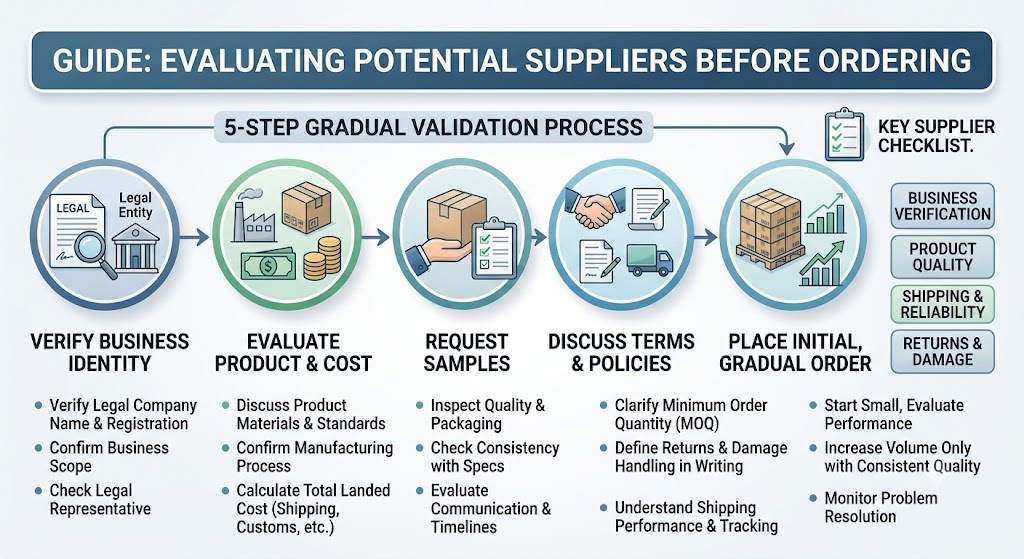
Therefore, supplier validation should happen gradually.
Start with a sample, then consider a manageable initial order. Monitor quality, communication, shipping performance, packaging, and problem resolution before increasing order volume.
14. Create a Supplier Checklist
Instead of asking random questions each time, businesses can create a standard supplier evaluation checklist.
The checklist can include five major categories.
Business Verification
Confirm:
- Legal company name
- Registration details
- Business scope
- Company address
- Legal representative
- Invoice entity
- Payment entity
Product
Confirm:
- Specifications
- Materials
- Quality standards
- Sample quality
- Defect handling
- Packaging
Shipping
Confirm:
- Processing time
- Shipping time
- Tracking
- Packaging
- Damage responsibility
- Delays
Returns
Confirm:
- Return conditions
- Return address
- Return shipping responsibility
- Replacement policy
- Refund process
- Damage claims
Commercial Terms
Confirm:
- Minimum order quantity
- Product price
- Shipping cost
- Payment terms
- Deposit requirements
- Reorder pricing
- Production capacity
Having these questions documented makes supplier comparisons much easier.
15. Look Beyond Price
The cheapest supplier is not always the most profitable supplier.
Suppose Supplier A charges less but has frequent quality problems and delayed shipping.
Supplier B charges slightly more but provides consistent quality, better packaging, predictable delivery, and reliable communication.
Supplier B may actually produce a better business outcome.
The real calculation should consider total cost and operational risk rather than only unit price.
A useful supplier relationship should help you protect customer satisfaction, reduce unexpected expenses, and maintain predictable operations.
16. Start Small and Increase Gradually
For a new supplier, the safest approach is usually to avoid committing too much money immediately.
A practical process can look like this:
Step 1: Verify the business identity.
Step 2: Ask detailed questions about the product.
Step 3: Request pricing and complete cost information.
Step 4: Order samples.
Step 5: Evaluate quality and packaging.
Step 6: Confirm shipping and return policies.
Step 7: Place a manageable initial order.
Step 8: Track the supplier’s performance.
Step 9: Resolve any problems and evaluate the response.
Step 10: Increase order volume only after consistent performance.
This approach reduces the financial risk of choosing the wrong supplier.
Conclusion
Supplier selection is not simply about finding someone who offers the lowest price. It is about finding a business partner that can consistently provide the right product, at the expected quality, within a reasonable timeframe, while handling problems fairly.
Before placing an order, buyers should ask about product quality, shipping, total costs, returns, damage, minimum order quantities, reorder capacity, and communication.
For larger transactions, verifying the supplier’s actual legal company is equally important. The company receiving payment should be understood, and any difference between the supplier’s trading name, invoice entity, and payment entity should be explained before money is transferred.
Most importantly, important terms should be documented rather than left to informal conversations.
A supplier that answers questions clearly, provides consistent information, and is willing to explain how problems are handled gives a buyer much more confidence.
The best supplier relationship is not necessarily the one with the cheapest initial quote. It is the one that provides predictable quality, dependable fulfillment, transparent business information, and a workable process when something goes wrong.
A careful supplier-checking process may take more time before the first order, but it can prevent much larger costs later. For ecommerce businesses that depend on suppliers for customer-facing products, that extra preparation can protect cash flow, reputation, customer trust, and long-term growth.

0 Comments