Introduction
When customers shop online, they cannot physically touch a product, examine its quality, or speak directly with a salesperson. They must make purchasing decisions based on the information and experience presented on the website. This uncertainty can make customers hesitate, especially when they are visiting a store for the first time or considering an unfamiliar brand.
Social proof helps reduce this uncertainty by showing potential buyers that other people have purchased, used, or recommended a product. It can include customer reviews, star ratings, customer photos, testimonials, user-generated content, and mentions in the media. These elements provide evidence that a product or business has earned the confidence of real customers.
However, simply adding reviews to an online store does not guarantee more sales. Their placement, relevance, presentation, and credibility can influence how effectively they support purchasing decisions. A review displayed immediately beneath a product title serves a different purpose from a detailed testimonial placed near the bottom of a product page.
For ecommerce businesses, the goal is not to display social proof everywhere. It is to present the right evidence at the right moment, helping customers answer their questions and feel confident about completing a purchase.
1. Understanding Social Proof in Ecommerce
Social proof is the influence that other people’s experiences and opinions can have on an individual’s decisions. In ecommerce, customers often look for reassurance that a product is worth its price, performs as described, and comes from a trustworthy seller.
For example, a shopper comparing two similar products may notice that one has hundreds of detailed customer reviews while the other has no feedback. The reviews can help the first product appear more established and give the shopper additional information to consider.
Several common types of social proof can be used on product pages.
Customer reviews: Written feedback describing a buyer’s experience, including product quality, usability, durability, and satisfaction.
Star ratings: A quick visual summary of customer feedback. Ratings are particularly useful for shoppers who want to evaluate a product without reading multiple reviews.
User-generated content: Photos, videos, and other content created by customers showing how a product looks or works in real-life situations.
Customer testimonials: Selected statements that describe a positive experience with a product or business.
Press mentions and recognition: Relevant media coverage, awards, or industry recognition that help establish credibility.
Each format communicates trust differently. Star ratings offer a quick overview, written reviews provide context, customer photos demonstrate real-world use, and press mentions may support a brand’s reputation.
The most effective approach depends on the product, the target audience, and the questions customers need answered before buying.
2. Placing Star Ratings Beneath the Product Title
One of the most useful locations for social proof is directly beneath the product title. When customers open a product page, they usually begin by identifying the product, checking its price, and looking for signs that it is worth considering.
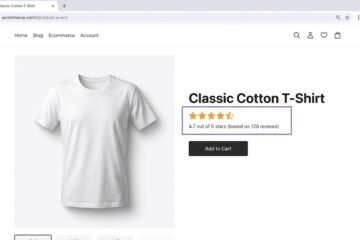
A star rating in this area provides an immediate overview of customer feedback before shoppers need to scroll through the page.
For example, a product page might display a five-star rating alongside the number of customer reviews. This gives visitors a quick indication of how previous buyers evaluated the product.
The placement is particularly useful because it makes feedback visible early in the shopping journey. Customers can notice the rating while reviewing the product’s name and price, rather than having to search for a separate review section.
However, the information should relate to the specific product being viewed. Displaying an overall store rating beneath an individual product title may create confusion if customers assume the rating represents that product’s performance.
Businesses should also make the review count visible when appropriate. A high rating based on a substantial number of genuine reviews can provide different context from the same rating based on only a few reviews.
Star ratings should remain easy to understand and should not overwhelm the product title, price, or purchase button. On mobile devices, where screen space is limited, a compact rating display is often more practical.
3. Displaying Detailed Reviews Beneath the Product Description
Although star ratings provide a quick summary, they cannot explain why customers like or dislike a product. Detailed reviews offer the additional information shoppers may need before making a purchase.
Placing a review section beneath the product description allows customers to learn about the product before reading feedback from other buyers.
This location can work well because visitors have already seen the product’s main features, benefits, price, and specifications. Reviews then help them evaluate whether the product’s advertised qualities match real customer experiences.
For example, a customer considering a backpack may want to know whether it is comfortable, spacious, durable, and suitable for everyday travel. A detailed review can answer these questions more effectively than a star rating alone.
A useful review section should make feedback easy to explore. Customers may benefit from being able to sort reviews, identify verified purchases where applicable, and find comments about specific product characteristics.
Businesses should avoid presenting only vague praise. Specific feedback about sizing, material, assembly, performance, or everyday use is often more informative because it helps shoppers determine whether a product suits their individual needs.
Negative feedback should not automatically be hidden. A balanced collection of genuine reviews can make a business appear more transparent, while constructive criticism can reveal useful information about product limitations.
The main purpose of this section is to support informed decisions, not simply to persuade every visitor that a product is perfect.
4. Using Customer Photos and User-Generated Content
Customer photos and videos can provide a different kind of reassurance from written reviews. They allow shoppers to see products in real-world settings instead of relying exclusively on professional product photography.
For example, a clothing store may display customer photos showing how a garment fits different body types. A home decor store may show a product in an actual living room, while a beauty brand may feature customer demonstrations of how a product is applied.
This type of content can help customers form more realistic expectations about appearance, size, texture, and use.
User-generated content can be displayed within a dedicated gallery, alongside relevant reviews, or near the product description. Its location should depend on how important visual evidence is to the purchase decision.
For visually driven products, such as clothing, furniture, accessories, and decorative items, customer images may be especially helpful. For products that depend more on specifications or technical performance, detailed written feedback may be equally or more valuable.
Businesses should obtain appropriate permission before using customer-created content and should present it accurately. Images should not be edited in ways that misrepresent the product, and customers should not be led to believe that a promotional image is an ordinary customer submission when it is not.
The objective is to show authentic experiences that complement the store’s own product information.
5. Adding Review Sliders to the Homepage
A review slider on the homepage can introduce new visitors to customer experiences before they explore individual products.
This placement is useful when a business wants to communicate its overall reputation, showcase customer satisfaction, or introduce visitors to popular products.
For example, a homepage may feature several customer testimonials describing product quality, delivery experience, or customer service. Visitors can read these statements while learning about the brand.
However, a homepage review slider serves a different purpose from product-specific reviews.
A general testimonial may demonstrate that a store provides reliable service, but it may not answer whether a particular product fits correctly, lasts a long time, or performs as expected. When visitors reach a specific product page, relevant product-level feedback becomes more useful.
Businesses should therefore distinguish between reviews about the store and reviews about individual products.
A homepage slider should also be easy to use. Automatically moving content can disappear before visitors finish reading, particularly on smaller screens. Giving users control over navigation and ensuring the text remains readable can create a better experience.
It is also important to select reviews that offer meaningful information rather than displaying several statements that repeat the same generic praise.
6. Showing Overall Ratings in Announcement Bars and Footers
Some businesses display their overall customer rating in an announcement bar, footer, or another persistent area of the website.
This approach can reinforce general brand credibility, especially when visitors move between different pages. It may help communicate that the business has an established customer base and a record of customer feedback.
However, these locations are not always ideal for detailed social proof.
An announcement bar is usually designed for short, high-priority messages. Adding a long testimonial or several review statistics may compete with important information such as shipping announcements or current offers.
Similarly, the footer is often reached after customers have already explored most of the page. A rating displayed there may be useful for visitors who look for business information, but it is less prominent than feedback shown near the product title.
Businesses should consider what each location is intended to communicate.
A short, accurate store-wide rating may be appropriate in a persistent website area. Detailed reviews, product-specific ratings, and customer photos are generally better placed near the relevant products or within dedicated review sections.
Any rating displayed across the store should clearly represent the correct collection of feedback and should be updated when the underlying information changes.
7. Choosing the Right Placement for Different Customer Needs
There is no single placement that is guaranteed to produce the highest conversion rate for every ecommerce store. The most suitable arrangement depends on the type of product, customer expectations, page design, and the questions shoppers need answered.
The following comparison explains the purpose of common placements.
| Placement | Main purpose | Best use |
| Beneath the product title | Provide immediate reassurance | Quick product evaluation |
| Beneath the product description | Offer detailed customer experiences | Answering product-related questions |
| Customer photo gallery | Show real-world product use | Visually driven purchases |
| Homepage review slider | Establish general brand credibility | Introducing new visitors to the business |
| Announcement bar | Communicate a short trust signal | Brief store-wide reputation information |
| Footer | Provide supporting business credibility | Visitors looking for additional reassurance |
These placements should not be treated as competing choices that require a business to select only one. Different forms of social proof can work together throughout the customer journey.
A store might show a star rating beneath each product title, detailed reviews farther down the product page, and selected customer testimonials on the homepage. This creates several opportunities for customers to find reassurance without forcing every element into the same area.
The key is to ensure that each element has a clear purpose and does not unnecessarily repeat information already available elsewhere.
8. How Social Proof Can Influence Conversion Rates
Social proof may help improve conversions by reducing uncertainty, answering questions, and making product claims more credible. However, its impact depends on how customers interact with the content.
A shopper who is uncertain about product quality may find detailed reviews reassuring. Another shopper may care more about delivery reliability or sizing information. A third may simply want to confirm that other people have purchased the product successfully.
When social proof addresses these concerns, it can make the buying decision easier.
Poorly implemented social proof can have the opposite effect. Too many widgets, large review blocks, distracting animations, or repeated testimonials can clutter the page. If customers struggle to find the price, product details, or purchase button, the additional content may create friction instead of reducing it.
Credibility is equally important. Unsupported claims, suspiciously repetitive reviews, misleading ratings, and customer photos used without permission can undermine trust.
Businesses should also avoid assuming that a placement is effective simply because it looks attractive. A design that works for one store may not work equally well for another because product categories, customer expectations, and traffic sources differ.
The relationship between social proof and conversions should therefore be evaluated using actual store performance rather than assumptions alone.
9. Testing Social Proof Placement Effectively
The original discussion raises an important unanswered question: which placement actually performs better?
Without before-and-after results or controlled comparisons, it is not possible to conclude that placing reviews beneath the product title is always more effective than placing them beneath the description or in a homepage slider.
Businesses can investigate this by running structured tests.
First, identify the specific problem. For example, customers may visit product pages but leave without adding products to their carts. The business should determine whether shoppers have unanswered questions, lack confidence in the product, or encounter other barriers.
Next, select one placement to test. A store might compare a product page with a rating beneath the title against a version where the rating appears farther down the page. Keeping other important elements consistent makes it easier to understand whether the change contributed to a difference.
The business should then choose suitable performance measures, such as:
- Product-page add-to-cart rate.
- Purchase conversion rate.
- Revenue per visitor.
- Engagement with the review section.
- Customer movement from the product page to checkout.
The primary measure should reflect the original business objective. For example, increased interaction with reviews is useful information, but it does not necessarily mean more customers are purchasing.
Testing should also account for differences in traffic, product popularity, device type, and promotional activity. A short test with very few visitors may produce misleading results.
Where possible, businesses should compare similar visitor groups over a suitable period and gather enough data to make a reasonable decision. If the results are inconclusive, the correct conclusion is that more evidence is needed, not that one placement has definitively won.
10. Common Mistakes to Avoid
Several mistakes can reduce the value of social proof on product pages.
Using store-wide ratings as product ratings: Customers need to understand whether feedback refers to the specific item or the business overall.
Showing too much content at once: Excessive review widgets, sliders, badges, and testimonials can distract visitors from essential product information.
Relying only on star ratings: Ratings provide a summary, but detailed comments and customer photos may be needed to answer specific questions.
Hiding all negative feedback: Removing genuine criticism can make reviews seem less trustworthy and prevents customers from understanding potential limitations.
Ignoring mobile visitors: Social proof should remain readable and accessible on small screens without pushing key product information too far down the page.
Using outdated or misleading information: Ratings and review counts should accurately represent the feedback being displayed.
Assuming more social proof always means more sales: Additional content is useful only when it helps customers make decisions without creating unnecessary friction.
Avoiding these mistakes helps businesses build a product page that feels informative, credible, and easy to navigate.
Conclusion
Social proof can play an important role in helping ecommerce customers feel confident about purchasing a product. Star ratings beneath product titles provide quick reassurance, detailed reviews help answer questions, customer photos demonstrate real-world use, and homepage testimonials communicate broader brand credibility.
Overall ratings in announcement bars and footers can support trust, but they should not replace relevant evidence on individual product pages.
The most effective strategy is to match each type of social proof to the information customers need at a particular stage of their shopping journey. Businesses should focus on authenticity, relevance, readability, and a balanced presentation rather than adding as many trust elements as possible.
Most importantly, the best placement cannot be established through opinion alone. The original discussion offers practical suggestions but does not provide measured conversion improvements or comparative results. Ecommerce businesses should treat these suggestions as starting points, test meaningful changes, and evaluate their effects using real customer behavior.
By combining genuine customer feedback with clear product information and thoughtful page design, an online store can create a more trustworthy shopping experience while learning which elements genuinely support better purchasing decisions.


0 Comments