The discussion above raises a question that many software companies eventually face:
Should entry-level plans remain intentionally limited, or should users be allowed to experience more functionality before upgrading?
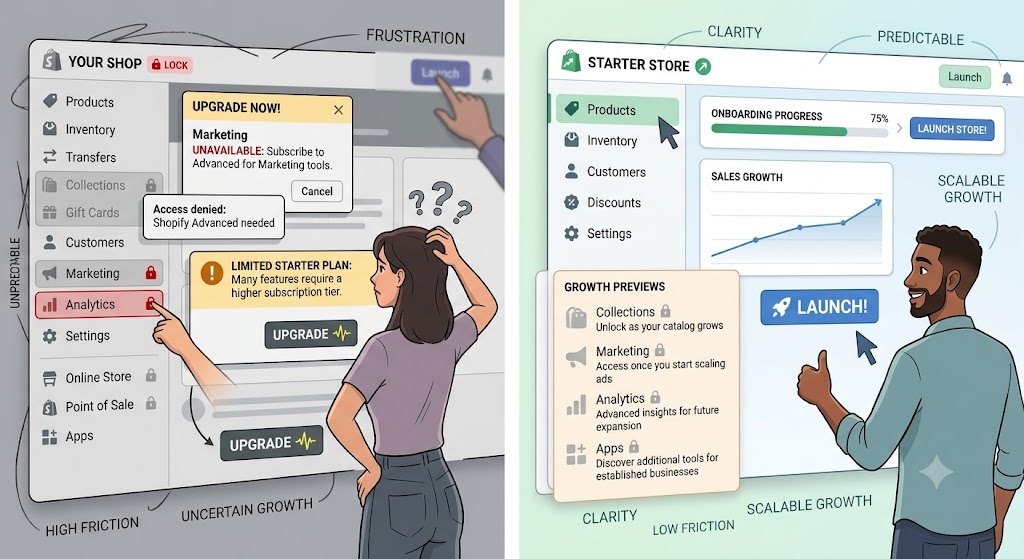
The specific concern centers around Shopify’s Starter plan and how certain administrative areas appear visible inside the dashboard even though users cannot actually access or use them.
Examples mentioned include areas such as Collections and Main Menu appearing available while remaining restricted.
For new merchants, this creates confusion.
From the merchant’s perspective, seeing a menu item suggests the feature exists within their subscription.
But discovering that it cannot actually be used creates friction and interrupts the onboarding experience.
The proposal argues for a different approach:
instead of aggressively limiting access to core storefront capabilities, Starter could function as a complete but smaller storefront plan with restrictions based on product volume or business scale.
The discussion generated mixed opinions.
Some participants focused on user experience and transparency.
Others argued that subscription platforms naturally reserve advanced capabilities for higher pricing tiers.
The broader conversation reveals something much larger than pricing.
It reflects how product design decisions influence customer trust, onboarding success, and long-term platform adoption.
Let’s explore why this topic matters.
Why First Experiences Shape Customer Decisions
Most businesses judge software quickly.
Early experiences strongly influence perception.
During setup, merchants expect:
clarity
predictability
easy exploration
visible next steps
When users encounter unavailable options unexpectedly, confusion increases.
First impressions matter because they shape expectations.
Why Visible but Locked Features Feel Frustrating
There is a difference between:
not seeing a feature
and
seeing a feature but being unable to use it.
When unavailable items remain visible, users often assume:
they configured something incorrectly
they missed a setting
their account has an issue
they misunderstood setup instructions
That uncertainty creates unnecessary friction.
Why Starter Plans Exist in the First Place
Entry-level plans serve an important business purpose.
They lower barriers to entry.
New merchants may want to:
test ideas
validate products
learn ecommerce
launch quickly
Lower-cost plans make experimentation possible.
Why Subscription Platforms Use Feature Gating
One side of the discussion argued that restricted features are normal.
This reflects a common software strategy.
Different plans often segment users by:
usage
complexity
business maturity
operational needs
Feature differentiation supports business sustainability.
Why Feature Restrictions Sometimes Create Confusion
While feature segmentation is normal, implementation matters.
Users typically accept restrictions more easily when limits feel obvious.
Confusion happens when:
menus appear incomplete
upgrade paths feel unclear
capabilities seem inconsistent
Transparency matters.
Why Merchants Expect Growth-Based Pricing
The original suggestion proposed an alternative model.
Instead of restricting important functions immediately, restrictions could scale based on growth.
Examples may include:
product count
traffic volume
order volume
advanced automation
team size
This model aligns payment with business success.
Why Growth-Based Limits Feel More Natural
Many merchants prefer expanding gradually.
They often think:
Let me build first.
Charge me more when growth justifies it.
Growth-based models reduce early resistance.
Why Store Builders Need Different Things Than Established Brands
Not all merchants have identical goals.
Some want:
simple selling
social commerce
small catalogs
Others want:
full storefront customization
complex catalogs
advanced operations
Different segments create competing expectations.
Why Interface Design Influences Product Perception
The discussion repeatedly returns to user experience.
Interface decisions affect emotions.
Visible locked features can feel:
confusing
unfinished
discouraging
A cleaner experience improves confidence.
Why Greyed-Out Features Are Sometimes Better
Several responses suggested alternative approaches.
Examples included:
hidden features
disabled states
tooltips
upgrade previews
These approaches communicate limits more clearly.
Users understand:
what exists
why it is unavailable
how to unlock it
Why Trials Create Better Product Discovery
Another idea suggested temporary access.
Trials reduce uncertainty.
Users can:
explore capabilities
understand value
evaluate workflows
This improves upgrade confidence.
Why Discovery Drives Conversion
People upgrade more comfortably when they understand benefits.
Discoverability helps users connect features with outcomes.
Without context, upgrades feel abstract.
Why Product Education Matters
New merchants often struggle because they do not understand plan differences.
Questions appear frequently:
What can I build?
What changes later?
What am I missing?
Clear communication reduces friction.
Why Hidden Costs Damage Trust
Unexpected limitations can feel expensive emotionally.
Even if pricing is reasonable, unclear expectations reduce satisfaction.
Trust depends on predictability.
Why Software Companies Balance Accessibility and Revenue
Platforms face difficult tradeoffs.
Providing too much may reduce upgrades.
Restricting too aggressively may reduce adoption.
Successful pricing balances:
accessibility
business sustainability
perceived value
Why Merchant Psychology Matters
Users do not evaluate plans mathematically.
They evaluate experiences emotionally.
Questions become:
Can I build what I want?
Will I hit limits immediately?
Will migration become painful?
Confidence matters.
Why Feature Visibility Can Be Strategic
Visible features are not always accidental.
Sometimes platforms intentionally show advanced capabilities.
Reasons may include:
educating users
creating awareness
encouraging upgrades
showing future possibilities
But visibility must remain clear.
Why Onboarding Is More Important Than Many Businesses Realize
The earliest customer interactions often determine retention.
Good onboarding reduces:
confusion
support requests
abandonment
uncertainty
Merchants who understand capabilities stay longer.
Why Simplicity Is Powerful
Starter products usually succeed because they reduce decisions.
Users want to move quickly.
Complexity delays momentum.
Clear experiences improve activation.
Why Feedback Channels Matter
A second concern in the discussion involved feedback submission.
Participants felt it should be easier to communicate improvement ideas.
Good feedback systems help companies:
identify friction
prioritize changes
understand merchant behavior
Feedback supports product evolution.
Why Merchants Want Faster Feedback Loops
Business owners invest time learning platforms.
When they encounter friction, they expect:
easy reporting
clear acknowledgment
visible improvement processes
Accessibility builds engagement.
Why Community Discussions Often Reveal Larger Trends
Feature requests may look isolated.
But repeated requests often indicate broader patterns.
This discussion reveals themes around:
transparency
discoverability
growth alignment
merchant empowerment
Why Pricing Strategy Influences Brand Perception
Pricing communicates positioning.
Low-cost plans suggest accessibility.
Premium tiers suggest capability.
The challenge is maintaining alignment between expectation and reality.
Why Platform Trust Extends Beyond Features
Trust develops through:
clear communication
predictable limitations
easy upgrades
respectful onboarding
Merchants remember experiences more than specifications.
Why Small UX Improvements Create Big Business Impact
This discussion demonstrates how small interface choices influence larger outcomes.
Changing how unavailable features appear may improve:
activation
customer confidence
retention
upgrade conversion
Small details compound.
The Bigger Lesson About Product Design
The conversation is ultimately not about one subscription plan.
It reflects a larger principle:
customers accept limitations more easily than confusion.
People usually understand pricing differences.
What they struggle with is uncertainty.
Good product design makes limits understandable.
Final Thought
The proposal to make more features accessible—or at least more clearly presented—raises an important conversation about onboarding and growth.
Entry-level merchants want enough functionality to experience value without feeling blocked immediately.
At the same time, platforms need sustainable pricing structures.
The opportunity may not always be unlocking everything.
It may simply be communicating capabilities more clearly and creating upgrade experiences that feel natural.
Because great software growth often happens when users upgrade because they want more—
not because they became confused.
Conclusion
The discussion around Starter plan limitations highlights broader questions about usability, transparency, and customer growth.
Merchants want experiences that help them:
understand available capabilities
experiment confidently
upgrade gradually
avoid unnecessary confusion
provide product feedback easily
As digital commerce continues evolving, clear onboarding and thoughtful feature access may become just as important as the features themselves.