Modern eCommerce stores are increasingly focused on reducing friction during the purchasing process. One common strategy is enabling the option that allows customers to continue purchasing products even when inventory reaches zero. This approach is especially popular among businesses that:
- Restock products frequently
- Use pre-orders
- Work with print-on-demand systems
- Manage incoming inventory shipments regularly
- Sell products with flexible fulfillment timelines
Allowing purchases beyond available inventory can help prevent lost sales and improve revenue continuity. Instead of blocking customers completely, stores keep products purchasable while inventory catches up behind the scenes.
However, this operational flexibility creates a new customer communication challenge:
how do you warn customers that inventory is technically unavailable without preventing the purchase itself?
This is exactly the issue discussed in the situation above.
The store owner wanted to keep a stock-status badge visible even while allowing customers to continue buying out-of-stock products. The goal was not to display a traditional “Sold Out” message that blocks purchases, but rather to show a warning indicating:
- Inventory is currently depleted
- Fulfillment may take longer
- Processing delays are possible
At first glance, this may seem like a small theme customization problem. But in reality, it reflects a much larger challenge in eCommerce:
balancing conversion optimization with transparent customer communication.
Let’s explore why this issue matters, why inventory messaging affects customer trust so heavily, and why businesses increasingly need more nuanced stock communication systems instead of simple “in stock” or “sold out” labels.
The Evolution of Inventory Messaging in eCommerce
In traditional retail systems, inventory communication was simple.
Products were either:
- Available
- Unavailable
If stock reached zero, customers could not buy the product.
But modern eCommerce operations are much more flexible.
Businesses now use:
- Backorders
- Pre-orders
- Print-on-demand fulfillment
- Supplier-based inventory
- Delayed shipping models
- Multi-warehouse systems
This means inventory status is no longer binary.
A product may technically be:
- Available for purchase
- But unavailable for immediate shipment
That creates a communication gap between:
- Operational inventory
- Customer expectations
And that gap can create frustration if not handled properly.
Why “Continue Selling When Out of Stock” Exists
The ability to continue selling products after inventory reaches zero exists for several business reasons.
1. Preventing Lost Sales
Customers may still want the product even if fulfillment is delayed.
If the product becomes completely unavailable, businesses risk:
- Lost revenue
- Lost momentum
- Lost advertising efficiency
- Lost customer interest
Allowing purchases keeps sales flowing.
2. Supporting Pre-Order Models
Many brands intentionally sell products before inventory arrives.
This helps:
- Forecast demand
- Generate early revenue
- Reduce inventory risk
- Build launch excitement
In these cases, delayed fulfillment is expected.
3. Supporting Print-on-Demand Businesses
Some businesses manufacture products only after orders are placed.
Inventory technically does not exist in advance.
The system must allow purchases even without available stock quantities.
4. Handling Supplier Restocks
Dropshipping and supplier-based stores often experience temporary stock fluctuations.
Blocking purchases entirely for short inventory gaps may reduce unnecessary lost sales.
The Problem With Shopify’s Standard Availability Logic
The issue discussed here centers around a common limitation in many eCommerce themes:
availability logic usually checks only whether a product is purchasable.
If “continue selling when out of stock” is enabled, the platform still considers the product:
- Available for purchase
- Technically “in stock” from a storefront perspective
As a result:
- Traditional “Sold Out” badges disappear
- Inventory warnings no longer display
- Customers assume immediate availability
This creates misleading expectations.
Operationally:
- Inventory may actually be zero
- Fulfillment may take longer
- Shipping delays may occur
But visually, the storefront appears normal.
Why Customer Expectations Matter More Than Technical Availability
One of the biggest mistakes in eCommerce is assuming technical availability equals customer expectation.
From the business perspective:
“The product is purchasable, so it’s available.”
But customers interpret availability differently.
Most customers assume:
- Available means ready to ship soon
- Inventory exists immediately
- Delivery timelines will be standard
If fulfillment delays happen unexpectedly, frustration increases quickly.
This is why inventory messaging matters so much.
Why Transparency Improves Customer Trust
The store owner’s goal was actually very customer-friendly.
Instead of blocking purchases, they wanted to communicate:
“This item can still be purchased, but fulfillment may take longer because inventory is currently low or unavailable.”
This type of transparency is extremely valuable.
Customers usually tolerate delays better when:
- Expectations are clear upfront
- Communication is honest
- Delivery timelines feel predictable
Unexpected delays create far more frustration than disclosed delays.
The Difference Between “Sold Out” and “Delayed Fulfillment”
This distinction is very important.
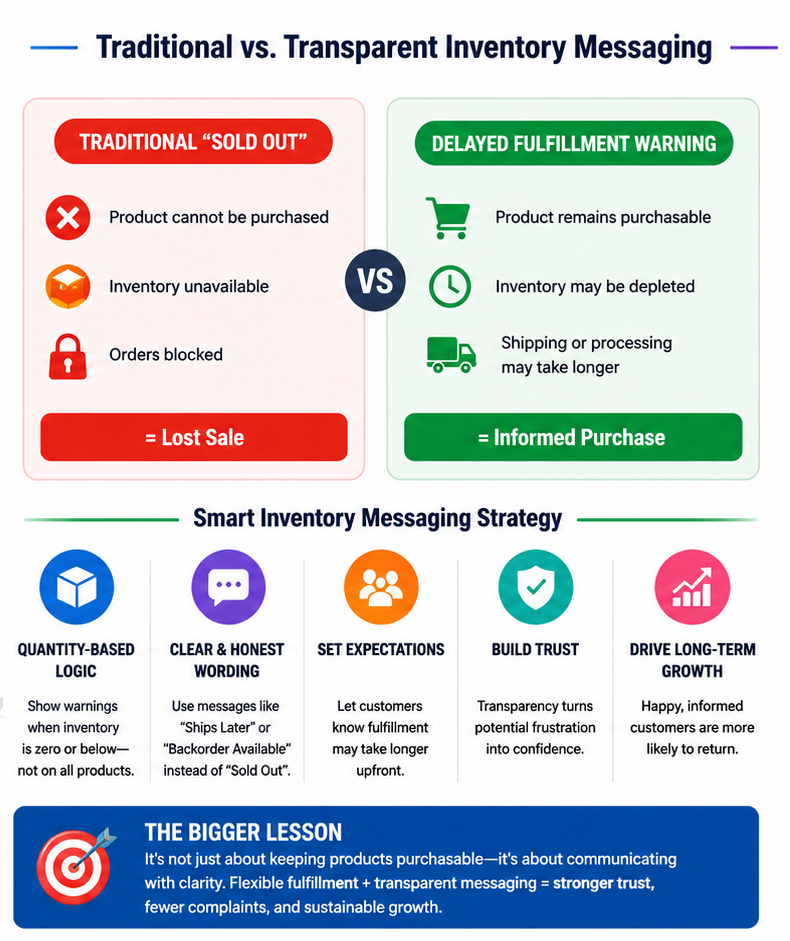
Traditional “Sold Out”
This usually means:
- Product cannot be purchased
- Inventory unavailable
- Orders blocked
Delayed Fulfillment Warning
This means:
- Product remains purchasable
- Inventory may currently be depleted
- Shipping or processing could take longer
These are completely different customer experiences.
The problem is that many storefront systems only support simple binary states:
- Available
- Unavailable
Modern businesses increasingly need more flexible inventory messaging.
Why Inventory Messaging Affects Conversion Rates
Some businesses avoid showing inventory warnings because they fear reduced sales.
But unclear inventory communication can actually damage conversions long-term.
Unexpected delays often lead to:
- Customer complaints
- Refund requests
- Chargebacks
- Negative reviews
- Reduced trust
Transparent communication may slightly reduce impulse purchases, but it usually improves:
- Customer satisfaction
- Long-term trust
- Repeat purchase likelihood
Trust-based conversion is stronger than confusion-based conversion.
The Challenge of Inventory Logic in Themes
The discussion referenced product badge logic connected to:
- Product availability
- Sale pricing conditions
This highlights an important technical limitation in many storefront themes:
they are built around simplified assumptions.
Most themes assume:
- If purchasable = available
- If unavailable = sold out
But modern inventory systems are far more nuanced.
Businesses now need storefront logic that understands:
- Backorders
- Restocking
- Delayed shipping
- Supplier inventory
- Production timelines
This requires more advanced conditional inventory messaging.
Why Quantity-Based Messaging Makes More Sense
One important clarification in the discussion was that the badge should appear specifically when inventory quantity reaches zero or below —
not on all products.
This is a much smarter operational approach.
Instead of relying on:
- Product availability status
the logic should focus on:
- Actual inventory quantity
This allows businesses to:
- Keep checkout active
- Continue accepting orders
- Still communicate inventory reality accurately
It creates a better balance between:
- Sales continuity
- Customer transparency
Why Badge Wording Matters
Another suggestion in the discussion involved changing the badge text itself.
This is extremely important.
Words influence customer perception significantly.
For example:
“Sold Out”
Customers assume:
- Cannot purchase
- Product unavailable entirely
“Ships Later”
Customers assume:
- Purchase still possible
- Delay expected
“Backorder Available”
Customers assume:
- Inventory incoming soon
“Extended Processing Time”
Customers expect:
- Slower fulfillment but active purchasing
The wording should match the actual operational reality.
Customer Psychology Around Inventory
Inventory status strongly affects customer psychology.
Messages about stock influence:
- Urgency
- Trust
- Scarcity perception
- Purchase confidence
Poor inventory communication creates uncertainty.
Customers begin asking:
- Is this store reliable?
- Will I actually receive my order?
- Why was this not mentioned earlier?
Transparent messaging reduces hesitation and builds confidence.
Why Operational Clarity Reduces Support Requests
One hidden benefit of better inventory messaging is reduced customer support workload.
When delays are communicated clearly:
- Customers ask fewer questions
- Refund requests decrease
- Shipping complaints reduce
- Expectations stay aligned
Clear inventory communication acts as preventative customer service.
The Growing Importance of Flexible Inventory Systems
As eCommerce evolves, inventory systems are becoming more dynamic.
Businesses increasingly use:
- Multi-location fulfillment
- Supplier inventory syncing
- Made-to-order production
- International warehousing
- On-demand manufacturing
Simple “in stock” vs “out of stock” systems no longer reflect operational reality accurately.
Stores now need:
- Dynamic messaging
- Flexible badges
- Estimated fulfillment communication
- Restock transparency
Why Trust Is More Valuable Than Short-Term Conversion
Some businesses hide inventory problems because they fear lower sales.
But modern customers value honesty.
If businesses communicate clearly:
- Customers feel respected
- Brand trust increases
- Purchase confidence improves
Long-term customer relationships depend heavily on expectation management.
A delayed shipment with clear warning feels acceptable.
A delayed shipment with no warning feels deceptive.
The Bigger Lesson About eCommerce Communication
This issue is ultimately not just about theme logic or inventory badges.
It is about communication strategy.
Modern eCommerce businesses must balance:
- Operational flexibility
- Revenue continuity
- Customer transparency
The best stores do not simply maximize purchases.
They manage customer expectations intelligently.
Because trust is one of the strongest conversion factors in online commerce.
Final Thought
The discussion around inventory badges highlights an increasingly common challenge in modern eCommerce:
how to maintain sales flexibility without creating misleading customer expectations.
Allowing customers to continue purchasing out-of-stock items can be a powerful business strategy, especially for stores using restocking systems, pre-orders, or print-on-demand fulfillment.
But operational flexibility must be paired with transparent communication.
Customers should understand when:
- Inventory is depleted
- Fulfillment may take longer
- Shipping timelines could be delayed
Because in online business, trust is not built only through successful sales —
it is built through clear expectations.
Conclusion
The issue of showing an out-of-stock badge while still allowing purchases reflects a deeper challenge in modern eCommerce inventory management.
Traditional storefront logic often assumes products are either available or unavailable, but modern fulfillment systems require more flexible communication models.
Businesses increasingly need ways to:
- Continue accepting orders
- Maintain revenue flow
- Support delayed fulfillment models
- Still communicate inventory status honestly
Using quantity-based inventory messaging instead of simple availability logic creates a better balance between conversion optimization and customer trust.
In today’s eCommerce environment, transparent fulfillment communication is no longer optional.
It is a critical part of customer experience, operational clarity, and long-term brand credibility.