In the world of eCommerce, customer trust depends heavily on one thing:
successful delivery.
No matter how strong the marketing is, how attractive the website looks, or how good the product quality may be, the customer experience can collapse completely if an order fails to arrive properly.
A recent reported issue involving a print-on-demand order highlights a serious concern many online sellers rarely think about until something goes wrong:
shipping data integrity.
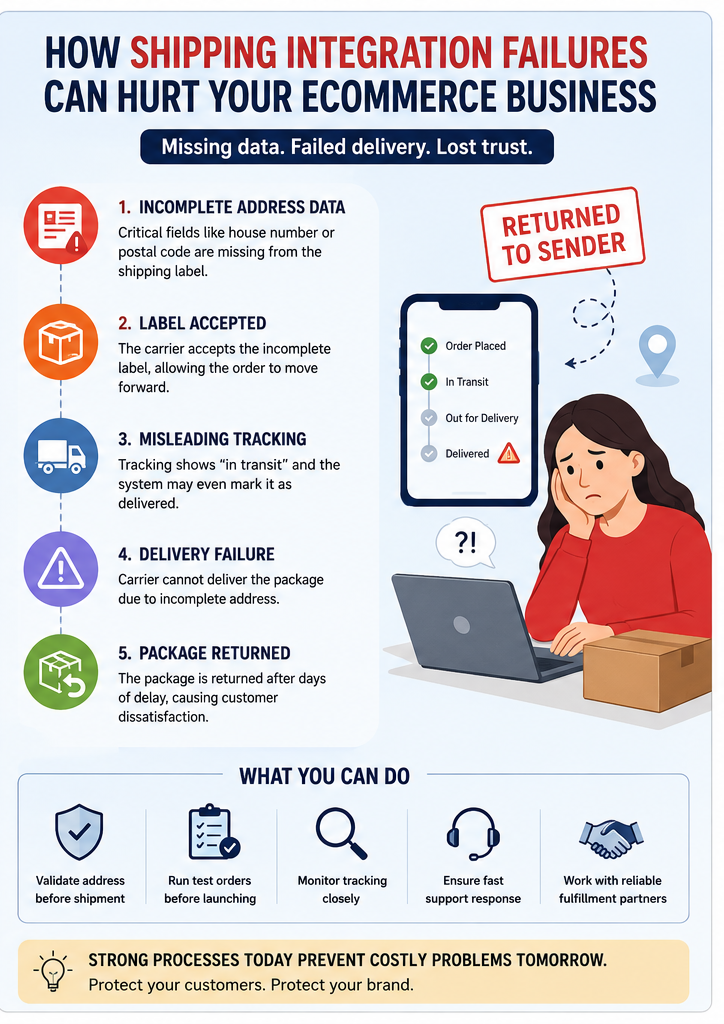
According to the report, a shipping label was generated with critical address information missing — specifically the house number and postal code — despite the store platform displaying the customer’s complete address correctly. The package was eventually returned after the carrier reportedly confirmed the address was too incomplete for delivery.
What made the situation even more alarming for the seller was not only the failed shipment itself, but the chain of operational issues that followed:
- No visible address validation warning
- The shipping label was still accepted
- Tracking appeared misleading
- Delivery status created confusion
- Customer support allegedly failed to respond quickly
- Business operations and marketing campaigns were paused due to fear of additional failures
The discussion reveals a growing reality in modern eCommerce:
automation can improve efficiency, but when automated systems fail silently, the damage can spread across logistics, customer trust, advertising performance, and business reputation.
Let’s explore why this issue matters so much and what online businesses can learn from it.
Shipping Is the Final Trust Test in eCommerce
Most online businesses focus heavily on:
- Product sourcing
- Website design
- Advertising
- Branding
- Customer acquisition
But customers ultimately judge a business based on delivery success.
From the customer’s perspective, the process is simple:
“I placed an order. Did it arrive correctly and on time?”
If the answer is no, everything before that point becomes less important.
A failed delivery creates:
- Frustration
- Refund requests
- Customer distrust
- Negative reviews
- Increased support workload
This is why logistics reliability is one of the most critical parts of online commerce.
The Main Problem: Missing Critical Address Information
The reported issue centers around a shipping label that allegedly excluded:
- House number
- Postal code
These are not small formatting mistakes.
They are essential delivery fields.
Without them, carriers often cannot:
- Verify destination accuracy
- Route packages properly
- Complete final-mile delivery
Even if the street name and city are present, the absence of core identifying information can make delivery impossible.
This becomes especially problematic for:
- International shipments
- Apartment addresses
- Dense urban regions
- Multi-unit buildings
In these cases, even minor address errors can cause delivery failure.
Why Silent Automation Failures Are Dangerous
One of the most concerning parts of the situation is that the order reportedly moved through the system without triggering any obvious warning.
This suggests a silent failure.
Silent failures are dangerous because:
- Sellers may not notice the issue immediately
- Orders continue processing automatically
- Customers assume everything is fine
- Problems appear only after delays occur
Automation is supposed to reduce human error.
But when automated systems process incomplete data without validation, the risk becomes harder to detect.
Businesses trust integrations to:
- Transfer customer data correctly
- Generate accurate labels
- Prevent incomplete shipments
When that trust breaks, operational confidence collapses quickly.
The Importance of Address Validation
One of the biggest concerns raised was the apparent lack of address validation or quality control before shipment.
Address validation is critical because it helps detect:
- Missing postal codes
- Invalid formatting
- Incomplete house numbers
- Incorrect country codes
- Typographical errors
Without validation checks, incomplete addresses may continue directly into shipping systems.
This increases:
- Delivery failure rates
- Return-to-sender cases
- Shipping costs
- Customer complaints
Strong validation systems are especially important in international shipping, where formatting standards vary widely across countries.
Why Carriers Sometimes Still Accept Incomplete Labels
Another issue discussed was that the carrier reportedly accepted the incomplete shipping label.
Many sellers assume:
“If the carrier accepted the label, the address must be valid.”
Unfortunately, that is not always true.
Shipping systems often prioritize:
- Label generation speed
- Processing automation
- Data transmission efficiency
rather than manually reviewing every address.
In some cases, a label may technically generate successfully even when critical delivery information is missing.
This creates false confidence.
The seller believes the shipment is moving correctly —
until the package eventually fails during delivery routing.
The Emotional and Financial Impact on Sellers
Failed shipments are not only operational problems.
They are emotional and financial stress points for businesses.
The seller in this situation reportedly:
- Investigated the issue independently
- Faced delayed delivery outcomes
- Paused international marketing campaigns
- Lost confidence in operational reliability
For small or growing businesses, even a few failed deliveries can create major fear around scaling.
Especially for international commerce.
If sellers cannot trust fulfillment systems, they hesitate to:
- Increase ad spending
- Expand globally
- Launch new campaigns
- Accept higher order volume
This slows business growth significantly.
Why “In Transit” Status Can Be Misleading
Another major frustration mentioned was tracking confusion.
The shipment reportedly continued showing:
- “In transit”
- Delivery-related status updates
despite the package never successfully reaching the customer.
This creates a serious communication problem.
Customers interpret tracking updates as proof the shipment is progressing normally.
But in reality:
- The package may be stuck
- Returned
- Misrouted
- Awaiting correction
This gap between tracking visibility and actual delivery success damages trust quickly.
Why Customer Support Response Matters So Much
One of the strongest frustrations in the report was the alleged lack of response or resolution support.
When operational failures happen, businesses expect:
- Fast communication
- Clear investigation updates
- Accountability
- Corrective action
- Reshipment or compensation discussions
Slow or absent support creates a second layer of frustration.
At that point, the problem is no longer only the shipment.
It becomes a trust issue between the seller and service provider.
The Real Cost of Delivery Failures
Many people underestimate how expensive failed deliveries become.
The damage extends far beyond one returned package.
Possible consequences include:
- Refunds
- Reshipping costs
- Lost customers
- Negative reviews
- Customer acquisition waste
- Advertising inefficiency
- Brand reputation damage
For example:
A business may spend heavily acquiring customers through advertising, only to lose them permanently because of fulfillment problems.
That means the real cost of shipping failure is often much higher than the shipping fee itself.
Why International Orders Increase Complexity
International logistics are already complicated because they involve:
- Customs systems
- Multiple carriers
- Regional formatting standards
- Language differences
- Cross-border tracking systems
Even small address inconsistencies can create large delivery disruptions.
This is why international fulfillment requires stronger:
- Validation systems
- Shipping quality control
- Tracking transparency
- Exception handling processes
Without those protections, scaling internationally becomes risky.
Why Sellers Should Run Test Orders
One practical lesson from the discussion is the recommendation to run test orders before launching large campaigns.
This is extremely important.
Test orders help businesses verify:
- Address formatting accuracy
- Shipping label generation
- Tracking behavior
- Delivery timelines
- Packaging quality
- International routing performance
Many sellers assume systems will work correctly automatically.
But testing often reveals hidden problems before customers experience them.
The Growing Dependence on Automated Ecosystems
Modern eCommerce relies heavily on interconnected systems:
- Storefront platforms
- Payment systems
- Shipping software
- Warehousing
- Fulfillment networks
- Carrier integrations
Businesses increasingly depend on these systems functioning perfectly together.
The challenge is:
when one part fails silently, the seller may not immediately know where the breakdown occurred.
This creates operational vulnerability.
Accountability Confusion in Integrated Systems
One issue hinted at in the discussion was disagreement about responsibility.
When multiple systems interact, sellers often struggle to determine:
- Which platform caused the issue
- Where the data failed
- Who is responsible for resolution
This becomes frustrating because businesses care less about technical blame and more about:
“How quickly can this be fixed?”
Operational accountability becomes blurry in highly integrated ecosystems.
Why Trust Is Everything in eCommerce Fulfillment
At the core of this issue is trust.
Customers trust businesses to:
- Deliver orders accurately
- Communicate clearly
- Resolve issues quickly
Businesses trust fulfillment systems to:
- Handle customer data properly
- Generate accurate labels
- Prevent avoidable delivery failures
When that trust breaks, scaling becomes difficult.
Because online commerce depends heavily on operational reliability.
Operational Stability Is Part of Brand Reputation
Many businesses think branding only involves:
- Logos
- Colors
- Social media
- Advertising
But operational consistency is also branding.
Customers remember:
- Late shipments
- Failed deliveries
- Poor support experiences
just as much as they remember marketing.
Reliable fulfillment creates customer confidence.
Unreliable delivery destroys it quickly.
Final Thought
The reported shipping issue highlights a serious but often overlooked risk in modern eCommerce:
automation without strong validation controls.
While automation increases efficiency, businesses still need:
- Quality assurance
- Shipment verification
- Address validation
- Operational monitoring
because even a small data failure can trigger:
- Customer dissatisfaction
- Revenue loss
- Marketing disruption
- Brand trust damage
The most dangerous failures are often the silent ones —
the issues businesses do not discover until customers are already affected.
Conclusion
The reported delivery issue involving missing address data demonstrates how fragile eCommerce fulfillment systems can become when critical information is not properly validated before shipment.
Even though the store reportedly contained the correct customer address, the shipping label allegedly generated incomplete delivery information, leading to failed delivery attempts, package return, tracking confusion, and business disruption.
The situation emphasizes several important lessons for online sellers:
- Never assume automated systems are error-free
- Validate shipping workflows carefully
- Run test orders before scaling campaigns
- Monitor tracking behavior closely
- Prioritize operational reliability as part of customer trust
In modern eCommerce, successful delivery is not just a logistics function.
It is one of the strongest foundations of brand reputation, customer confidence, and long-term business growth.