The discussion you are referring to is centered around a very practical but often misunderstood problem in modern e-commerce: how a general online store system can work together with a food delivery marketplace, and why this connection is not straightforward.
At the heart of it, the article is trying to answer a simple question: Can a Shopify-based store automatically sync orders, inventory, and product data with a food delivery platform like Uber Eats without custom development? The conclusion from the discussion is essentially: there is no simple, ready-made, fully automatic connection, and businesses usually need to rely on workarounds or custom-built systems.
To understand why this is the case, it helps to break the situation down into several parts: what each system is designed for, where they overlap, where they conflict, and what options businesses realistically have.
1. The Core Problem: Two Very Different Business Systems
On one side, you have a general-purpose online store system. It is designed to help businesses create a digital storefront where they can list products, manage inventory, accept payments, and handle orders. It is flexible and works for many industries—fashion, electronics, beauty products, and even food businesses that want direct ordering from customers.
On the other side, you have a food delivery marketplace. This type of platform is designed specifically for restaurants and food services. It focuses on:
- Real-time menu availability
- Fast order dispatch to delivery partners
- Time-sensitive preparation workflows
- Location-based discovery
- High-frequency order updates
While both systems handle “orders,” they operate very differently. One is built like a general store management system, while the other is built like a real-time logistics and delivery network.
This difference in purpose is the root cause of integration difficulty.
2. Why Direct Synchronization Is Not Naturally Available
A key point from the article is that there is no built-in, seamless connection between these two systems. That is not an accident—it is a structural limitation.
There are several reasons for this:
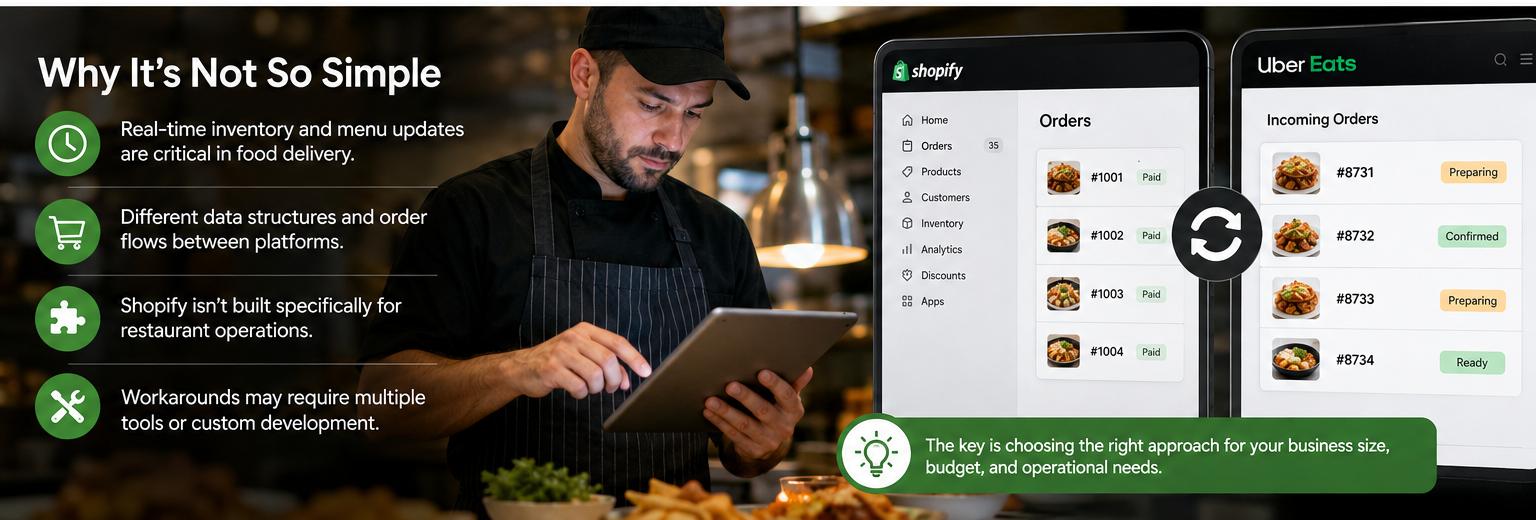
A. Different Data Structures
A typical online store system organizes data in a flexible way: products, variants, collections, inventory counts, and customer orders.
A food delivery marketplace organizes data differently: menus, preparation times, delivery zones, and live availability.
Even though both systems might describe “a burger” or “a sandwich,” the underlying structure is not aligned. One system treats items like catalog products, while the other treats them like time-sensitive menu items tied to kitchen operations.
B. Real-Time Requirements vs. Flexible Updates
Food delivery platforms require near real-time updates. If a dish runs out in the kitchen, it must be removed immediately to avoid customer complaints. If preparation time increases, it must be reflected instantly.
Traditional online store systems are not always designed for this level of real-time responsiveness. They may update inventory in batches or rely on periodic syncing, which can cause delays or mismatches.
C. Order Flow Differences
In a typical online store setup:
- Customer places order
- Order is recorded in the system
- Business fulfills it manually or through a workflow
In a food delivery environment:
- Order is placed
- Order must immediately be sent to the kitchen system
- Delivery partner is assigned quickly
- Status updates must be continuous
These differences in timing and workflow make direct alignment difficult.
3. Why “Simple Plug-and-Play” Solutions Usually Don’t Exist
The discussion emphasizes that there is no straightforward solution that automatically connects everything without effort.
This is mainly because:
- Each restaurant operates differently
- Menus are dynamic and change frequently
- Delivery zones vary by location
- Preparation times are not fixed
- Businesses often already use different systems internally
Because of all this variability, a universal fixed solution would not work reliably for everyone.
Instead, most available options fall into three broad categories:
- Using intermediate services (not deeply customized)
- Building a custom connection system
- Running both systems separately with manual coordination
Each of these has trade-offs.
4. Option One: Using Intermediate Solutions
One approach mentioned in the discussion is using external connectors that sit between the store system and the delivery marketplace.
These act as translators between the two systems. They can:
- Convert product data into menu format
- Sync availability updates
- Forward orders from one system to another
However, these solutions are rarely perfect.
Limitations of this approach:
- They may not support all features equally on both sides
- Sync delays can occur
- Errors in mapping products to menu items can happen
- Setup can still require technical configuration
In short, they reduce complexity but do not eliminate it.
5. Option Two: Custom-Built Connection System
Another approach is building a completely custom bridge between the two systems.
This is the most flexible solution, but also the most complex.
A custom system would typically need to handle:
- Product-to-menu mapping
- Inventory synchronization logic
- Order routing logic
- Error handling and recovery
- Real-time update mechanisms
This approach gives full control but requires significant technical effort and ongoing maintenance.
It is often chosen by larger businesses or those scaling heavily, because they need precision and reliability.
However, for small or medium businesses, this approach is usually too expensive or complex.
6. Option Three: Running Systems Separately
Many businesses end up using a simpler approach: they treat the online store system and the food delivery platform as two separate sales channels.
In this setup:
- The online store handles direct customers
- The delivery marketplace handles external traffic
- Staff manually manage inventory coordination
This reduces technical complexity but introduces operational challenges.
For example:
- A product may sell out on one system but still appear available on the other
- Staff must constantly update both systems
- Human error becomes more likely
Despite these issues, this approach is very common because it avoids technical development costs.
7. The Role of “Delivery-Only Logistics Systems”
The article also briefly references a related concept: logistics-only services that focus on delivery rather than ordering interfaces.
These systems do not replace the food marketplace, but instead handle the movement of goods.
However, they are not a direct solution for syncing online stores with food delivery marketplaces. They operate in a different layer of the process.
Their role is more about transportation than data synchronization.
8. Why Food Businesses Struggle the Most
The core challenge highlighted in the discussion is that food businesses are in a difficult position when trying to use general e-commerce tools.
Unlike physical product businesses, food businesses deal with:
- Perishable inventory
- Rapid order turnover
- Short preparation windows
- High dependency on timing
- Constant menu updates
General online store systems are not originally designed with these constraints in mind.
As a result, businesses often find themselves forcing a mismatch between two systems that were never intended to work closely together.
9. The Real Question Behind the Article
Although the surface question is about synchronization, the deeper question is:
Can one system handle both direct online sales and third-party delivery marketplace operations without friction?
The answer implied by the discussion is: not fully.
At best, businesses can:
- Partially connect systems
- Reduce manual work
- Automate some updates
But complete, flawless synchronization without customization is not realistically available.
10. Practical Reality for Businesses
For a restaurant or food business owner, the practical takeaway is important:
If the goal is to operate across both direct sales and delivery platforms, then:
- Expect some level of manual coordination
- Expect inconsistencies unless carefully managed
- Expect that automation will be partial, not complete
Businesses often improve efficiency not by finding a perfect connection, but by designing internal workflows that reduce the impact of system gaps.
11. Future Possibilities
While the current situation is fragmented, the direction of technology suggests improvement over time.
We can expect:
- Better standardized data formats between platforms
- More automation tools designed specifically for food businesses
- Smarter synchronization systems that reduce manual work
- More unified dashboards for managing multiple channels
However, even with advancements, the fundamental differences between general online stores and food delivery ecosystems will likely remain.
Final Summary
The article ultimately explains a simple but important reality: connecting a general online store system with a food delivery marketplace is not a straightforward plug-and-play process. The two systems are built for different purposes, operate on different data structures, and require different levels of real-time responsiveness.
Because of this, there is no widely available, fully automatic solution that handles everything—inventory, orders, and data synchronization—without some level of customization or operational effort.
Businesses must therefore choose between partial tools, custom-built systems, or manual coordination. Each option has trade-offs, and the “best” choice depends on scale, budget, and operational complexity.
If there is one key takeaway, it is this: the challenge is not just technical integration, but alignment of two fundamentally different business models.