Modern commerce businesses no longer sell products through a single storefront. Today’s merchants operate across multiple channels simultaneously, including direct online stores, wholesale portals, point-of-sale environments, partner marketplaces, business purchasing systems, and specialized distribution networks.
While this multi-channel approach creates more opportunities for growth, it also introduces a new layer of operational complexity—especially when managing products with hundreds of variants.
The discussion highlighted above focuses on a growing challenge faced by merchants with large catalogs: the inability to control product visibility at the variant level across different sales channels.
The request is straightforward.
Merchants want one master product containing all variants while being able to decide exactly which variants appear in each channel independently.
At first glance, this may seem like a technical catalog management request.
In reality, it reflects a much larger operational issue involving inventory accuracy, reporting consistency, fulfillment efficiency, and long-term scalability.
The issue remains unresolved, but it highlights an increasingly important conversation in modern commerce:
how businesses maintain centralized product management while delivering customized experiences across multiple selling environments.
Understanding Product Variants in Modern Commerce
A product variant represents a version of the same product with different attributes.
Common examples include:
- Size
- Color
- Material
- Packaging
- Region
- Customer type
- Configuration
- Quantity
- Industry-specific specifications
For example:
One chair product may include:
- Black
- White
- Blue
- Small
- Medium
- Large
A clothing business may manage:
- 20 colors
- 10 sizes
- multiple fits
That single product can easily create hundreds of variants.
For larger businesses, this number grows dramatically.
Why Multi-Channel Selling Changes Everything
Years ago, businesses often sold through a single storefront.
Today, many businesses simultaneously sell through:
- Consumer storefronts
- Wholesale channels
- Retail locations
- Partner networks
- Internal sales teams
- Distributor environments
Each channel often serves a completely different customer type.
This means businesses rarely want every variant visible everywhere.
For example:
Online customers may need:
- best-selling options only
Wholesale buyers may need:
- complete product selection
Retail stores may need:
- regional inventory only
Partner channels may require:
- curated assortments
This creates demand for selective publishing.
The Core Limitation
The discussion highlighted an important limitation.
Publishing controls operate at the product level instead of the variant level.
That means:
If a product is visible—
all variants become visible.
Merchants cannot selectively determine:
- Which colors appear
- Which sizes appear
- Which configurations appear
- Which channel receives which assortment
For businesses with large catalogs, this becomes difficult to manage.
Why Product Duplication Became the Common Workaround
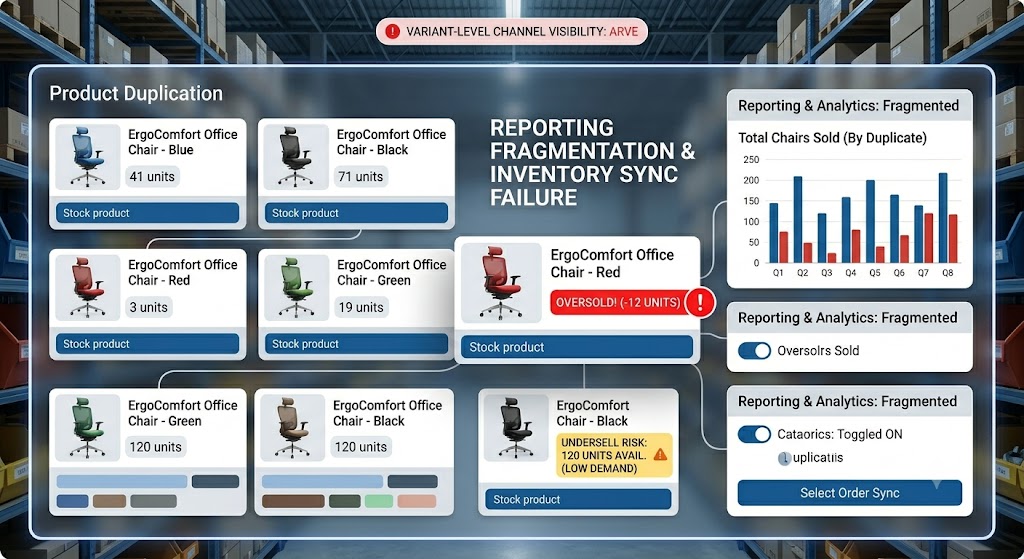
Because selective variant publishing is unavailable, merchants often duplicate products.
Instead of:
One product → multiple channels
They create:
Product A → Online
Product B → Wholesale
Product C → Retail
Product D → Specialized channels
Each duplicate contains different variant combinations.
Initially, this appears manageable.
But as catalogs grow, operational problems begin appearing rapidly.
Why Duplicate Products Create Inventory Problems
Inventory management depends heavily on maintaining a single source of truth.
Duplicate products break that structure.
Imagine:
Product X:
400 total variants
Duplicate 1:
21 variants
Duplicate 2:
4 variants
Duplicate 3:
400 variants
Now inventory must remain synchronized across every copy.
Inventory updates become more difficult because one physical product may exist in multiple catalog records.
This increases risk.
The Problem With Duplicate SKUs
The discussion specifically referenced inventory synchronization problems.
SKU duplication introduces confusion because:
One inventory item may appear:
- multiple times
- under multiple products
- across different channels
As updates occur:
Stock counts may drift.
Businesses begin experiencing:
- overselling
- underselling
- incorrect availability
- fulfillment mistakes
Inventory accuracy becomes harder to maintain.
Why Overselling Is Expensive
Overselling occurs when customers purchase inventory that does not actually exist.
This creates problems such as:
- cancellations
- delayed fulfillment
- customer complaints
- refund requests
- negative reviews
Large catalogs multiply these risks.
When duplicate structures exist, inventory inconsistencies become increasingly difficult to detect.
Why Underselling Is Also Harmful
Underselling receives less attention but can be equally damaging.
When inventory appears unavailable unnecessarily:
Businesses lose:
- revenue
- conversion opportunities
- customer demand
Products sit idle despite actual availability.
Accurate variant publishing directly affects sales performance.
Reporting Fragmentation Creates New Problems
Another issue mentioned was fragmented analytics.
Data becomes difficult to interpret when products are duplicated.
Instead of viewing:
One product’s performance
Businesses see:
Several fragmented records.
Metrics become split across:
- sales reports
- channel reporting
- inventory dashboards
- forecasting systems
Decision-making becomes less reliable.
Why Analytics Accuracy Matters
Modern commerce increasingly depends on data.
Businesses analyze:
- conversion rates
- inventory movement
- customer demand
- margin performance
- variant popularity
When products are duplicated:
Insights become distorted.
Teams may struggle to answer simple questions:
Which variants perform best?
Which channels convert most efficiently?
Where should inventory move next?
Why Catalog Maintenance Becomes Difficult
The discussion also highlighted operational maintenance.
Product duplication creates ongoing manual work.
When updates happen:
Businesses must synchronize:
- pricing
- descriptions
- images
- specifications
- promotions
- metadata
A single product update may require multiple changes.
Operational workload grows rapidly.
Why Human Error Increases
Every manual process increases error potential.
When managing duplicated catalogs:
Businesses may accidentally:
- forget updates
- apply incorrect pricing
- upload wrong images
- create mismatched descriptions
Customers notice these inconsistencies quickly.
The Importance of One Master Product
The requested solution was simple:
Maintain one master product.
This approach creates a centralized catalog.
Benefits include:
- single inventory source
- cleaner reporting
- reduced duplication
- easier updates
- lower operational overhead
Variants remain connected while visibility becomes flexible.
Why Channel-Level Control Matters
Channel-specific variant visibility solves several business needs.
Examples:
Online:
Show popular consumer variants.
Wholesale:
Show complete selection.
Retail:
Show local inventory only.
Partnership programs:
Show approved assortments.
This allows businesses to tailor product experiences.
Why Large Catalog Businesses Feel This More
Small catalogs often manage duplication manually.
Large businesses cannot.
Imagine:
10 products × 20 variants
manageable.
Now imagine:
5,000 products × 400 variants.
Manual duplication becomes unsustainable.
Catalog architecture becomes critical.
Customer Experience Also Improves
Variant-level control improves shopping experience.
Customers avoid:
- irrelevant options
- unavailable configurations
- overwhelming product pages
Businesses can simplify decisions.
Cleaner product experiences often improve:
- conversions
- browsing
- purchasing confidence
Why Wholesale and Consumer Experiences Differ
Business buyers behave differently from consumers.
Consumers prefer:
- simplicity
- fewer choices
- guided purchasing
Wholesale buyers often require:
- full inventory access
- technical configurations
- bulk options
One catalog structure rarely fits both audiences equally.
Why Centralization Supports Growth
Growing businesses increasingly centralize operations.
Centralization improves:
- inventory control
- forecasting
- pricing governance
- fulfillment coordination
Variant-level publishing aligns naturally with centralized commerce operations.
Why Operational Scalability Depends on Flexibility
Commerce platforms increasingly support:
- global markets
- multiple warehouses
- diverse customer groups
Rigid publishing models become harder to scale.
Businesses want:
- one inventory model
- flexible presentation
That separation becomes increasingly valuable.
The Hidden Cost of Workarounds
Workarounds often appear inexpensive initially.
But over time they create:
- maintenance costs
- training complexity
- operational debt
- process inefficiencies
Long-term growth becomes harder.
Why Catalog Management Is Becoming Strategic
Product catalogs are no longer simple databases.
They influence:
- customer experience
- inventory performance
- operational efficiency
- reporting quality
- business scalability
Catalog architecture increasingly becomes a competitive advantage.
Why This Discussion Reflects a Bigger Industry Shift
This request reflects a broader trend.
Businesses increasingly want:
- centralized operations
- flexible presentation
- intelligent inventory systems
- channel-specific experiences
Modern commerce demands both control and simplicity.
The Bigger Lesson About Commerce Operations
The variant publishing discussion ultimately reveals something larger:
Businesses do not want more duplicated systems.
They want:
centralized control with flexible distribution.
The more channels businesses manage, the more important this balance becomes.
Final Thought
The challenge of variant-level publishing highlights how modern commerce has evolved beyond simple storefront management.
Large catalogs require more than product-level visibility.
Merchants increasingly need:
- centralized product structures
- cleaner inventory systems
- accurate reporting
- flexible customer experiences
Duplicating products may work temporarily, but long-term scalability increasingly depends on maintaining one source of truth while controlling how products appear across channels.
Conclusion
The discussion around variant-level sales channel publishing reflects a growing operational need in modern multi-channel commerce.
Businesses managing large catalogs increasingly struggle with product duplication because it creates:
- inventory synchronization issues
- fragmented analytics
- manual maintenance
- pricing inconsistencies
- higher fulfillment risk
The requested model—a single master product with channel-by-channel variant visibility—offers a cleaner and more scalable approach.
As commerce ecosystems become more complex, businesses will continue moving toward centralized catalog management combined with flexible channel experiences.
In modern commerce, operational simplicity and publishing flexibility are becoming equally important for sustainable growth.