Running a small eCommerce brand often means wearing multiple hats at the same time.
One moment you are fulfilling orders.
The next moment you are answering customer emails.
Then you switch into marketing mode, monitor advertising performance, review analytics, update products, and solve customer issues.
For small teams, especially founder-led brands, every operational decision directly affects revenue.
That is why situations like the one described above can feel unusually stressful.
A high-performing advertisement suddenly stops converting.
Sales slow down.
Traffic remains active.
Then after investigating, you discover negative comments underneath the advertisement accusing the business of slow shipping or even calling it a scam.
To make things more confusing, there appears to be no matching customer order.
No email.
No purchase history.
No clear evidence that the commenter is even a real customer.
The immediate question becomes:
Should this be treated as a customer service problem?
A moderation problem?
A marketing problem?
Or something else entirely?
This discussion highlights a challenge that more direct-to-consumer brands are experiencing:
how to manage public negative comments without allowing them to damage customer trust, advertising performance, and internal team focus.
This issue is bigger than deleting comments or responding faster.
It touches reputation management, customer verification, operational processes, social proof, and conversion psychology.
Let’s explore why this happens and how small teams can manage it more effectively.
Why Negative Comments Feel More Powerful Than Positive Ones
Customer behavior online is heavily influenced by visible signals.
Most customers do not evaluate advertisements independently.
Instead, they look for validation.
Questions often happen subconsciously:
Do other people trust this brand?
Has anyone bought this?
Are customers happy?
Can I trust checkout?
Comments become social evidence.
Because of this, a single highly visible negative comment can influence many buying decisions.
Why Social Traffic Behaves Differently
Visitors arriving from social platforms usually move quickly.
They rarely conduct deep research.
They rely on shortcuts.
Examples include:
comments
reviews
likes
community reactions
visible engagement
Negative comments become part of the buying experience.
Why One Comment Can Affect Conversion Rates
A customer may discover your advertisement.
They feel interested.
Then they read:
“This company is a scam.”
Even if unsupported, uncertainty appears.
Customers may hesitate.
Some leave.
Others continue researching.
Momentum disappears.
Conversion drops.
Why Not Every Negative Comment Is Fake
One important operational principle is avoiding assumptions.
Not every unmatched comment means:
bot activity
competitor attacks
fake engagement
Real customers sometimes:
use different usernames
purchase under family accounts
use alternate emails
forget order details
make emotional complaints publicly first
Verification matters.
Why Verification Should Come Before Escalation
A useful operational mindset is:
Treat comments as unresolved cases first.
Not accusations.
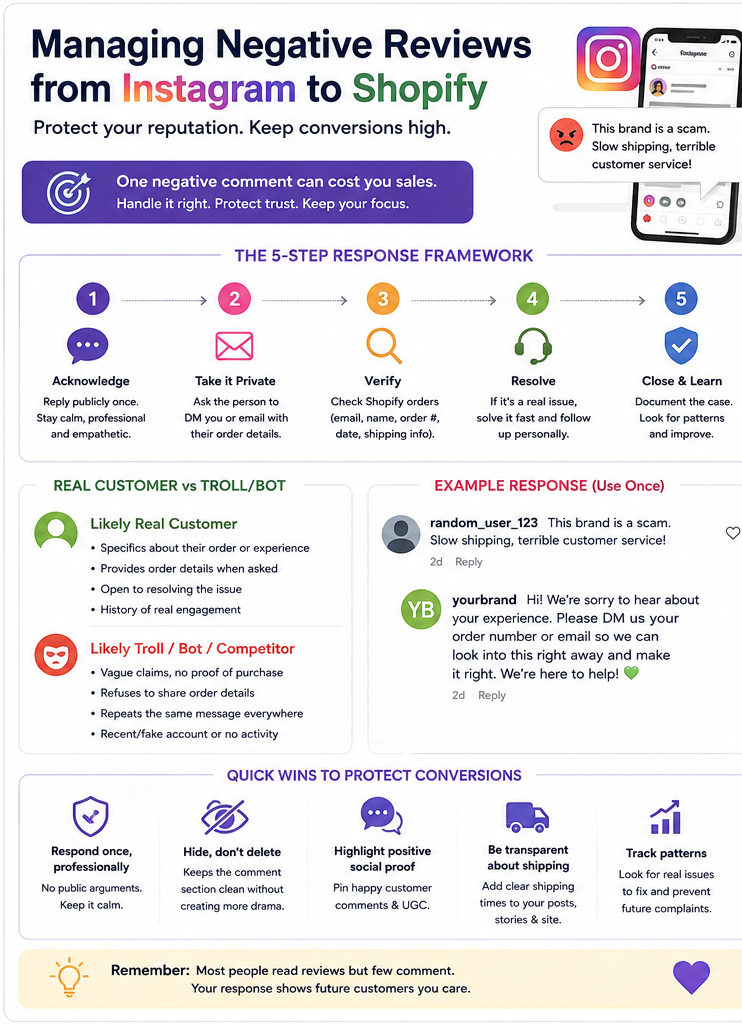
A simple process can help:
Acknowledge publicly.
Request order information privately.
Verify internally.
Resolve if legitimate.
Move on if unsupported.
This creates professionalism.
Why Public Arguments Usually Hurt More Than Help
Small brands often feel pressure to defend themselves.
Long public arguments rarely improve trust.
Observers care less about who wins.
They care about how the business behaves.
Customers notice:
tone
clarity
professionalism
calm responses create confidence.
The Value of Responding Once
A common operational strategy is limiting public engagement.
Example approach:
Thank the commenter.
Ask them to send order information privately.
Confirm willingness to help.
Avoid extended exchanges.
This demonstrates accountability without feeding conflict.
Why Visibility Management Matters
Comment sections become extensions of product pages.
People read comments before purchasing.
This means moderation becomes operational—not cosmetic.
Businesses should manage visibility intentionally.
Why Hiding Often Works Better Than Removing
Removing comments sometimes creates additional conflict.
Visible deletion may escalate complaints.
Limiting public visibility while preserving records often reduces unnecessary escalation.
The goal is not censorship.
The goal is maintaining productive conversations.
Why Teams Need Filtering Systems
Small teams cannot monitor comments constantly.
Operational processes become necessary.
Without systems, founders spend all day reacting.
Filtering helps separate:
real customer concerns
spam
duplicate complaints
irrelevant engagement
priority cases.
Why Customer Verification Standards Matter
A simple framework may include:
Order number
Purchase email
Order date
Shipping information
Verified contact
This allows support effort to stay focused.
Why Shipping Complaints Are Especially Sensitive
Shipping problems create emotional reactions.
Customers often interpret shipping issues as:
poor service
lack of communication
unreliability
Even when fulfillment is functioning correctly, perception matters.
Why Expectations Matter More Than Delivery Speed
Customers tolerate delays more than uncertainty.
Problems appear when expectations are unclear.
Good communication includes:
processing times
shipping windows
delay notices
order updates
Expectation alignment reduces complaints.
Why Reputation Monitoring Should Become Routine
Small brands often react only when problems appear.
A better approach is creating lightweight review habits.
Examples:
daily check-ins
scheduled moderation windows
priority alerts
team ownership
Consistency prevents surprises.
Why Social Proof Must Be Balanced
Negative comments become more influential when positive experiences remain invisible.
Businesses should encourage visible customer experiences.
Examples include:
customer photos
order experiences
review highlights
community stories
Trust becomes more balanced.
Why Customer Testimonials Matter
Positive experiences do more than increase confidence.
They dilute isolated negativity.
Customers think:
Many people appear satisfied.
This complaint may not represent everyone.
Context changes perception.
Why Conversion Drops May Not Have One Cause
Advertising performance changes for many reasons.
Possible variables include:
creative fatigue
audience changes
seasonality
competition
offer strength
comment sentiment
It is easy to overattribute outcomes.
Investigate broadly.
Why Emotional Decision-Making Creates Risk
Founders naturally feel protective.
Negative comments can feel personal.
But operational decisions work better when based on process.
Questions to ask:
Can this customer be verified?
Is the issue recurring?
Is there supporting evidence?
What pattern exists?
Process reduces stress.
Why Documentation Helps Small Teams
Even two-person teams benefit from simple documentation.
Track:
complaint source
resolution status
customer verification
repeated issues
Patterns become easier to spot.
Why Public Trust Is Built Through Consistency
Customers do not expect perfection.
They expect responsiveness.
Brands build trust through:
clear communication
professional responses
visible accountability
consistent support
Why Competitor Anxiety Can Become Distracting
When comments appear suspicious, businesses sometimes become overly defensive.
Assume neither fraud nor legitimacy immediately.
Operate from evidence.
Professional responses work in both situations.
Why Moderation Is Part of Marketing
Advertising performance increasingly depends on post-click experience.
Customers evaluate:
creative
landing page
comments
reviews
trust signals
Comment management influences conversion.
Why Community Perception Shapes Growth
People buy from brands they believe are active and trustworthy.
Visible customer care builds confidence.
Ignoring comments entirely can create uncertainty.
Overreacting can do the same.
Balance matters.
Why Operational Simplicity Wins
Small teams need sustainable systems.
Complex moderation processes rarely survive.
Simple frameworks work better:
Review.
Verify.
Respond.
Resolve.
Move forward.
The Bigger Lesson About Reputation Management
This discussion reflects a broader reality of modern commerce.
Advertising does not end when content goes live.
Customer conversations become part of the storefront.
Brands increasingly succeed by managing:
visibility
expectations
verification
communication
trust
Final Thought
Negative comments underneath social advertisements can feel disproportionately damaging—especially when conversion performance changes suddenly.
But the solution is rarely constant monitoring or public confrontation.
The strongest operational approach combines:
calm responses
customer verification
structured moderation
clear communication
trust-building content
Because in modern commerce, reputation is not built by avoiding criticism—
it is built by handling uncertainty consistently and professionally.
Conclusion
Managing negative reviews across social traffic and online storefront operations requires more than reactive moderation.
Small businesses benefit most when they create repeatable processes that allow them to:
identify legitimate concerns
separate real customers from noise
maintain public trust
reduce operational workload
protect conversion performance
As brands grow, thoughtful reputation management becomes one of the most valuable parts of long-term customer acquisition and retention.