As eCommerce stores become more advanced, merchants increasingly rely on structured product data to manage large catalogs efficiently. Modern online stores no longer operate with only simple product titles, prices, and descriptions. Instead, businesses now manage complex product information systems that include:
- Specifications
- Materials
- Dimensions
- Compatibility details
- Technical attributes
- Care instructions
- Product certifications
- Shipping details
- SEO-related information
- Custom product properties
To handle this growing complexity, many merchants use metafields to organize additional product information beyond the standard product setup.
The discussion above focuses on a surprisingly common frustration:
the inability to manually organize category metafields into a cleaner, more intuitive structure such as alphabetical order.
At first glance, this may sound like a small interface inconvenience. However, for businesses managing large product catalogs, organization problems quickly become operational problems.
The request discussed here is ultimately about:
- usability
- efficiency
- scalability
- workflow clarity
- long-term store management
The current system-controlled ordering structure creates friction for merchants who need better control over how product data is displayed and managed internally.
Although some workarounds exist, such as pinning important metafields to the top, the discussion remains unresolved because merchants want more flexible organization options built directly into the platform itself.
This issue reflects a larger challenge in modern eCommerce:
as stores become more data-driven, backend organization becomes just as important as storefront design.
Let’s explore why metafield organization matters so much, why poor structure creates operational frustration, and why flexible product-data management is becoming increasingly critical for growing online businesses.
The Growing Complexity of Product Data
Years ago, many online stores sold relatively simple products.
A typical product page included:
- Product title
- Basic description
- Price
- A few images
That was enough for many businesses.
Modern eCommerce is very different.
Today’s products often require detailed structured information, especially in industries like:
- electronics
- fashion
- beauty
- automotive
- furniture
- supplements
- industrial products
- B2B catalogs
Customers increasingly expect highly detailed product pages.
Businesses now need systems capable of handling large amounts of product-specific information efficiently.
Why Structured Product Information Matters
Structured data improves both:
- customer experience
and - operational management
Well-organized product information helps customers:
- compare products
- understand specifications
- make purchase decisions faster
- trust the store more
Internally, structured product data helps businesses:
- manage catalogs efficiently
- scale product operations
- reduce data-entry errors
- improve consistency
- simplify updates
As catalogs grow, organization becomes essential.
What Makes Metafields So Important
Metafields allow businesses to store custom product information beyond default product settings.
This flexibility is extremely valuable because every business has different product-data needs.
For example, a coffee store may want:
- roast level
- flavor notes
- bean origin
A furniture store may need:
- material type
- weight limits
- assembly instructions
A beauty brand may require:
- ingredient lists
- skin-type compatibility
- certifications
Metafields allow stores to customize their product structure according to business needs.
Why Organization Becomes Difficult Over Time
The problem discussed here appears when businesses begin using many metafields across large catalogs.
Initially, a few metafields may seem manageable.
But over time, stores accumulate:
- dozens of custom fields
- multiple categories
- overlapping product structures
- varying data formats
Without strong organizational systems, the backend becomes difficult to manage.
This creates confusion during:
- product setup
- catalog expansion
- staff training
- data maintenance
The Core Frustration: Fixed Ordering
The discussion specifically highlights frustration around fixed system-controlled ordering.
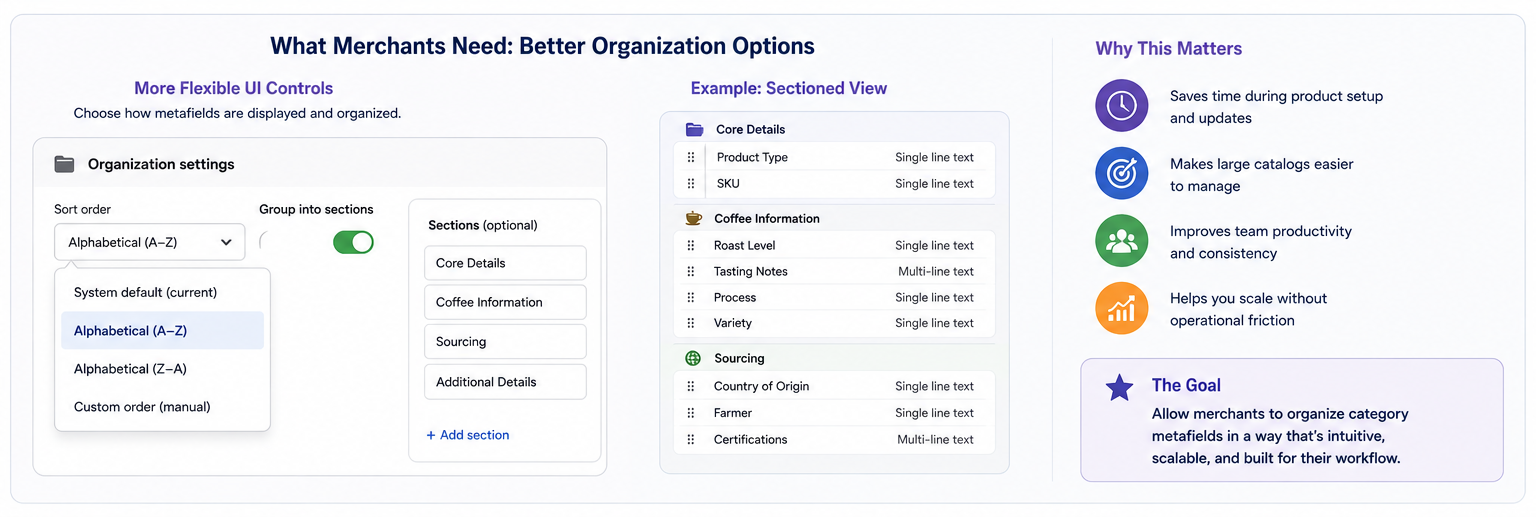
Merchants cannot manually reorganize category metafields into cleaner structures such as:
- alphabetical lists
- grouped sections
- custom sorting arrangements
This becomes frustrating because businesses naturally want organization systems that feel intuitive.
Alphabetical ordering is especially valuable because it:
- improves scanning speed
- reduces searching time
- simplifies navigation
- improves consistency
Without it, finding specific metafields becomes slower and more mentally exhausting.
Why Small Frictions Become Large Operational Problems
At first, scrolling through disorganized metafields may seem like a minor inconvenience.
But small workflow inefficiencies compound significantly over time.
For businesses managing:
- hundreds of products
- multiple team members
- large inventories
- ongoing updates
even small backend inefficiencies create measurable operational costs.
Poor organization increases:
- setup time
- editing errors
- employee confusion
- onboarding difficulty
- maintenance frustration
Why User Experience Matters in Backend Systems
Most discussions about eCommerce focus heavily on customer-facing design.
But backend usability is equally important.
Merchants spend enormous amounts of time inside administrative systems managing:
- products
- pricing
- inventory
- descriptions
- structured data
If backend workflows feel disorganized, operational productivity suffers.
A well-organized admin experience improves:
- speed
- accuracy
- scalability
- employee confidence
Why Pinning Is Only a Partial Solution
The discussion mentioned pinning as a workaround.
Pinning allows important metafields to remain at the top.
This can help temporarily prioritize frequently used fields.
However, pinning does not fully solve the deeper organizational problem.
Pinning still leaves the remaining fields:
- unordered
- harder to scan
- inconsistent
It also forces merchants to manually decide which fields deserve priority placement.
As stores evolve, those priorities may constantly change.
Why Discoverability Matters
Another important issue raised was discoverability.
The merchant explained that better organization options may have influenced earlier setup decisions.
This is extremely important.
Poor organization affects not only daily usage, but also:
- system planning
- architecture decisions
- scalability choices
If merchants cannot clearly understand how metafields will scale operationally, they may choose less efficient setup structures from the beginning.
Why “All Product” Structures Create Complexity
The discussion referenced broader “all product” metafield setups.
This highlights another common challenge:
generic systems often become cluttered quickly.
Businesses sometimes create universal metafields intended for all products because:
- setup feels simpler initially
- flexibility seems useful
- future expansion feels easier
But without strong organization tools, these large shared systems become difficult to navigate over time.
Why Large Catalogs Suffer the Most
Smaller stores with limited products may not feel these problems immediately.
But larger businesses experience them much more intensely.
Especially stores with:
- hundreds of SKUs
- multiple departments
- complex specifications
- multi-category products
As complexity increases, backend organization becomes mission-critical.
Why Flexible Sorting Matters
The request for alphabetical sorting reflects a larger desire:
flexibility.
Different businesses organize information differently.
Some may prefer:
- alphabetical order
Others may prefer:
- workflow priority
- category grouping
- custom sequences
- department-based organization
The issue is not necessarily that one method is universally best.
The issue is lack of choice.
Why Section-Based Organization Could Help
The discussion also suggested organizational sections or windows.
This is a smart idea because grouping related metafields improves usability significantly.
For example:
Product Specifications
- dimensions
- weight
- materials
Shipping Information
- packaging
- delivery timelines
- restrictions
Marketing Information
- SEO details
- promotional tags
- feature highlights
Section-based organization reduces visual clutter and improves navigation efficiency.
Why Scalability Requires Better Data Architecture
As stores grow, structured product data becomes increasingly important for:
- automation
- filtering
- search systems
- analytics
- merchandising
- integrations
Poor organization eventually affects not only usability, but overall operational scalability.
Businesses need systems designed for long-term data management, not only basic setup convenience.
Why Team Collaboration Depends on Clarity
Many growing stores involve multiple employees managing product information.
Without strong organizational systems:
- team members struggle to locate fields
- training becomes harder
- inconsistencies increase
- data-entry mistakes become more common
Clear structure improves collaboration significantly.
Why Mental Load Matters in Admin Systems
Backend organization also affects cognitive load.
When interfaces feel cluttered or unpredictable, users experience:
- slower workflows
- decision fatigue
- frustration
- reduced efficiency
Simple improvements like alphabetical sorting can reduce mental strain dramatically.
This is especially important for merchants managing stores daily.
Why Merchants Want More Customization
Modern eCommerce businesses increasingly expect flexible systems.
Merchants want:
- customizable workflows
- personalized organization
- scalable structures
- operational efficiency
Rigid interface structures increasingly feel outdated as businesses become more operationally sophisticated.
Why Feature Requests Like This Matter
Some feature requests appear minor technically but reveal deeper operational needs.
This request is not only about sorting metafields alphabetically.
It reflects a broader need for:
- organizational flexibility
- backend usability
- scalable catalog management
- operational clarity
As stores grow larger and more complex, these concerns become increasingly important.
Why Better Organization Improves Productivity
Well-organized systems improve productivity in many ways:
- faster editing
- fewer errors
- easier navigation
- reduced training time
- better consistency
Even seemingly small interface improvements can create major operational efficiency gains over time.
Why Product Management Is Becoming More Advanced
Modern product management increasingly resembles structured database management.
Businesses now rely heavily on:
- custom attributes
- dynamic filtering
- structured product relationships
- integrated data systems
As product data becomes more complex, merchants need more advanced administrative organization tools.
Why Simplicity Still Matters
Ironically, as systems become more powerful, simplicity becomes even more valuable.
Merchants want advanced functionality without creating operational chaos.
Good organization helps businesses:
- maintain clarity
- reduce confusion
- scale comfortably
- operate efficiently
Simple usability improvements often create the biggest quality-of-life benefits.
The Bigger Lesson About eCommerce Infrastructure
This discussion reflects a broader evolution in eCommerce operations.
Businesses increasingly need:
- scalable backend systems
- flexible organization controls
- customizable workflows
- efficient data management
Store management is no longer only about storefront appearance.
Operational infrastructure now plays a huge role in long-term business success.
Final Thought
The request for better category metafield organization highlights an increasingly important challenge in modern eCommerce management:
how to keep growing product-data systems organized, intuitive, and scalable.
While fixed ordering structures may work for smaller catalogs, larger businesses increasingly need:
- alphabetical sorting
- custom ordering
- grouped sections
- flexible organization systems
Backend usability directly affects:
- productivity
- operational efficiency
- data consistency
- team collaboration
As eCommerce stores continue becoming more data-driven, merchants increasingly expect organizational systems that adapt to their workflow instead of forcing rigid structures.
Conclusion
The discussion around category metafield organization reveals a deeper operational issue within modern eCommerce product management.
Metafields are essential for handling complex product information, but as stores scale, organization becomes critical.
The inability to manually organize metafields into intuitive structures such as alphabetical order creates:
- workflow inefficiencies
- operational frustration
- reduced scalability
- increased cognitive load
Although workarounds like pinning provide temporary relief, merchants increasingly want more flexible and customizable organizational systems built directly into the platform.
In today’s growing eCommerce environment, backend organization is no longer a minor usability detail.
It is a core part of efficient catalog management, scalable operations, and long-term business productivity.