As eCommerce businesses grow across multiple sales channels, product management becomes significantly more complex. What once worked for a small online store often breaks down when businesses begin selling across:
- Online storefronts
- B2B portals
- Point-of-sale systems
- Wholesale marketplaces
- Collective selling programs
- Retail integrations
- International storefronts
The issue discussed above highlights one of the most frustrating limitations merchants encounter when managing large product catalogs:
the inability to control product visibility at the variant level across different sales channels.
Currently, many eCommerce systems allow publishing control only at the product level. This means merchants can decide whether an entire product appears on a sales channel, but they cannot selectively choose which specific variants should appear in each channel.
For small catalogs, this may not seem like a major issue.
But for businesses managing hundreds of variants under a single product, this limitation creates serious operational problems.
The example provided illustrates the challenge clearly:
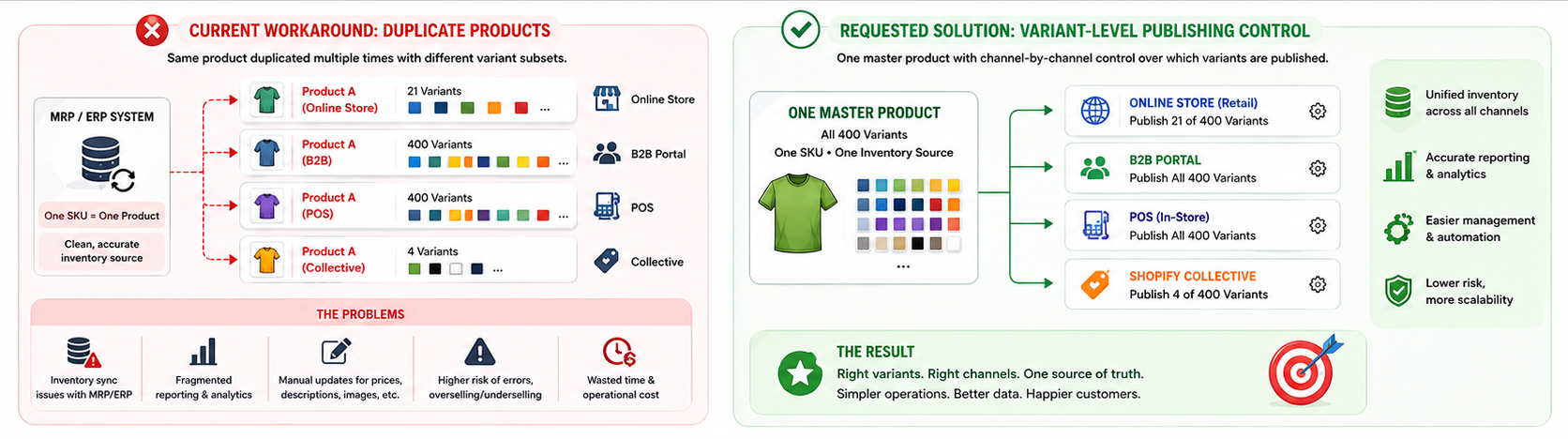
- One product contains 400 variants
- Only 21 should appear in the online store
- Only 4 should appear in a collective marketplace
- All 400 are needed for B2B and POS operations
Without variant-level publishing control, businesses are often forced into inefficient workarounds that create:
- Duplicate products
- Inventory synchronization issues
- Fragmented analytics
- Manual management overhead
- Increased operational risk
This may appear to be a technical catalog-management problem, but in reality it reflects a much larger challenge in modern commerce:
how to manage one unified inventory system across multiple customer experiences.
As multi-channel commerce continues evolving, businesses increasingly need more granular control over how products appear across different environments.
Let’s explore why this issue matters so much, why current workarounds create operational instability, and why variant-level channel publishing is becoming increasingly important for modern eCommerce businesses.
The Evolution of Multi-Channel Commerce
Traditional retail once operated through a single sales environment:
- One store
- One customer type
- One inventory presentation
Modern commerce operates very differently.
Today, a single business may simultaneously sell through:
- Direct-to-consumer online stores
- Wholesale portals
- Physical retail systems
- Marketplace partnerships
- Distributor networks
- International channels
- Membership-based storefronts
Each sales channel serves different customers with different expectations.
For example:
- Retail customers may see only best-selling products
- Wholesale buyers may access the full catalog
- Marketplace partners may require limited assortments
- Physical stores may carry only region-specific variants
This creates a need for selective product visibility.
Why Variant-Level Control Matters
Products today are highly configurable.
A single product may include:
- Sizes
- Colors
- Materials
- Packaging options
- Regional specifications
- Industry-specific versions
- Bulk configurations
These options create large variant structures.
For example:
- 10 colors
- 10 sizes
- 4 packaging formats
can quickly create hundreds of variants under one product.
But not every channel needs every variant.
Retail storefronts may prioritize simplicity.
B2B buyers may require full catalog access.
Marketplace partners may allow only a few approved options.
Without variant-level control, businesses lose flexibility.
The Problem With Product-Level Publishing
Product-level publishing assumes a simple structure:
- Entire product visible
or - Entire product hidden
This approach becomes problematic for large catalogs.
Businesses often need:
- One product structure
- One inventory source
- Different variant visibility by channel
But product-level publishing forces all variants into every enabled channel.
This creates catalog clutter and operational inefficiency.
Why Duplicate Products Become the Default Workaround
Because variant-level publishing is unavailable, many merchants duplicate products.
For example:
- Retail version of the product
- Wholesale version of the product
- Marketplace-specific version
- POS-specific version
Each duplicate contains different subsets of variants.
At first, this may seem manageable.
But duplication creates serious operational problems over time.
Why Duplicate Products Create Inventory Problems
Inventory systems are designed around unique product structures.
When businesses duplicate products:
- The same SKU may exist in multiple products
- Inventory syncing becomes fragmented
- External systems struggle to reconcile stock
This becomes especially problematic when connected to:
- Manufacturing systems
- Warehouse systems
- Resource planning software
- Supplier integrations
The discussion specifically mentioned synchronization problems with an external manufacturing and resource planning system.
This is a very common issue.
External systems expect:
- One SKU
- One inventory source
- One product identity
Duplicate products break this logic.
Why Overselling Risks Increase
Duplicate catalog structures increase inventory risk.
For example:
- One duplicate product updates correctly
- Another duplicate lags behind
- Inventory becomes inconsistent
This can cause:
- Overselling
- Underselling
- Incorrect stock reporting
- Fulfillment confusion
The more duplicate structures exist, the harder inventory accuracy becomes.
The Hidden Cost of Manual Catalog Maintenance
Another major issue mentioned was manual synchronization effort.
When products are duplicated, businesses must repeatedly update:
- Prices
- Images
- Descriptions
- Specifications
- Tags
- Metadata
- Variant information
Every update must be copied across multiple products.
This creates:
- Operational inefficiency
- Human error risk
- Inconsistent storefront experiences
Large catalogs become extremely difficult to manage manually.
Why Reporting and Analytics Become Fragmented
Duplicate products also damage analytics quality.
Instead of one unified product report, businesses see:
- Sales split across duplicate products
- Inconsistent performance tracking
- Fragmented inventory reporting
- Confusing conversion analysis
This makes decision-making harder.
Businesses lose accurate visibility into:
- Best-selling variants
- Customer behavior
- Inventory performance
- Channel profitability
Unified reporting becomes difficult when products are artificially separated.
Why Large Catalog Businesses Suffer Most
Small stores with limited products may tolerate duplication.
But large catalogs experience exponential complexity.
Imagine:
- Hundreds of products
- Hundreds of variants
- Multiple sales channels
- Constant inventory updates
Manual duplication becomes unsustainable.
Businesses managing large catalogs increasingly need centralized control systems.
The Growing Need for Catalog Personalization
Modern commerce increasingly depends on channel-specific experiences.
Different audiences require different assortments.
For example:
Retail Customers
Need:
- Simplicity
- Curated selections
- Easy browsing
Wholesale Buyers
Need:
- Full variant access
- Bulk configurations
- Complete inventory visibility
Marketplace Channels
May require:
- Limited approved assortments
- Simplified offerings
- Marketplace-specific packaging
Variant-level publishing enables these differentiated experiences without duplicating products.
Why One Master Product Structure Is Better
The requested solution in the discussion was simple:
- One master product
- One inventory source
- Channel-specific variant visibility
This approach offers major advantages.
Centralized Inventory
All variants remain connected to one inventory system.
Cleaner Reporting
Analytics stay unified.
Easier Maintenance
Updates happen once.
Lower Error Risk
No duplicate catalog structures.
Better Operational Scalability
Large catalogs remain manageable.
This reflects how modern enterprise systems increasingly operate.
Why eCommerce Platforms Are Struggling to Adapt
Many eCommerce systems were originally built for simpler storefront models.
Historically:
- One store
- One catalog
- One customer type
Modern businesses now require:
- Multi-channel commerce
- Segmented customer experiences
- Dynamic inventory presentation
- Channel-specific merchandising
Legacy catalog systems often struggle to support these newer operational realities.
Why Multi-Channel Commerce Is Becoming More Complex
Commerce channels continue expanding rapidly.
Businesses now sell through:
- Social commerce
- Wholesale portals
- Retail integrations
- Marketplaces
- International stores
- Subscription programs
- Collective selling systems
Each environment may require different catalog rules.
Variant-level visibility becomes increasingly important as channel complexity grows.
Why B2B and Retail Catalogs Differ
One major reason merchants request variant-level publishing is because B2B and retail buyers behave differently.
Retail Shoppers
Usually prefer:
- Simpler catalogs
- Popular variants only
- Faster purchasing decisions
B2B Buyers
Often require:
- Full product access
- Industry-specific configurations
- Bulk purchasing flexibility
Showing all variants publicly may overwhelm retail customers while remaining necessary for wholesale operations.
This creates tension between simplicity and completeness.
Why Catalog Simplicity Improves Conversion
Retail conversion often improves when customers see fewer choices.
Too many variants can create:
- Decision fatigue
- Slower purchasing
- Confusing navigation
- Lower conversion rates
Businesses may intentionally limit visible variants online while preserving full operational inventory internally.
Without variant-level publishing, this becomes difficult.
The Operational Burden of Workarounds
The current workaround discussed —
duplicating products —
essentially forces merchants to simulate missing functionality manually.
This creates:
- Technical debt
- Operational inefficiency
- Increased management costs
- Catalog instability
Businesses spend time maintaining workarounds instead of focusing on growth.
Why Feature Requests Like This Matter
At first glance, this may appear like a niche enterprise request.
But it actually reflects a broader shift in eCommerce:
businesses increasingly need flexible infrastructure capable of supporting complex selling environments.
Modern commerce is no longer:
“One product, one storefront.”
It is:
“One inventory system, many customer experiences.”
Why Inventory Centralization Is Critical
As businesses scale, centralized inventory becomes increasingly important.
Fragmented inventory structures create:
- Forecasting issues
- Purchasing errors
- Warehouse confusion
- Reporting inaccuracies
Centralized product management improves:
- Operational stability
- Inventory accuracy
- Fulfillment reliability
- Data consistency
Variant-level publishing supports this centralization.
Why Channel-Specific Merchandising Is the Future
Modern commerce increasingly depends on tailored merchandising strategies.
Different channels require:
- Different pricing
- Different visibility
- Different assortments
- Different messaging
Variant-level control supports:
- Personalized commerce
- Curated experiences
- Channel optimization
- Inventory flexibility
This is becoming essential rather than optional.
The Bigger Lesson About eCommerce Infrastructure
This discussion highlights a broader truth:
modern eCommerce infrastructure is evolving faster than many platform architectures.
Businesses increasingly expect:
- Unified operations
- Flexible merchandising
- Granular visibility control
- Centralized inventory systems
But many catalog systems still operate using older assumptions built around simpler storefront structures.
As commerce complexity grows, merchants continue pushing for more flexible operational controls.
Final Thought
The inability to publish variants selectively across different sales channels may appear like a catalog-management limitation, but it actually reflects a major operational challenge in modern multi-channel commerce.
Businesses increasingly need:
- One master product structure
- One inventory source
- Flexible channel-specific visibility
Without this flexibility, merchants rely on duplicate products that create:
- Inventory synchronization problems
- Manual maintenance overhead
- Fragmented analytics
- Higher operational risk
The discussion remains unresolved, but it clearly demonstrates how modern eCommerce businesses are outgrowing simplified product-level publishing systems.
Conclusion
Variant-level publishing control is becoming increasingly important as businesses expand across multiple sales channels with different customer needs.
Current product-level publishing systems force many merchants into inefficient duplication workflows that create:
- Inventory management issues
- Reporting fragmentation
- Increased manual effort
- Higher risk of operational errors
A centralized master-product approach with channel-specific variant visibility would provide a far more scalable solution for modern commerce environments.
As multi-channel selling continues evolving, businesses increasingly require flexible catalog systems capable of supporting:
- Unified inventory
- Personalized merchandising
- Channel-specific experiences
- Operational simplicity
The discussion highlights not only a missing feature request, but also a growing shift toward more intelligent and scalable eCommerce infrastructure.